Blog

  • Lactate gels from the Tour de France: what research shows

    Lactate gels from the Tour de France: what research shows

    The peloton of the Tour de France 2026 rides into another mountain stage, and a soigneur from UAE Team Emirates-XRG hands Tadej Pogačar a bottle with something new in it. It doesn’t only contain glucose and fructose. It also contains lactate, a compound athletes were taught for decades to avoid, and which is now being sold as fuel.

    This isn’t a forum rumour. Enervit and its rival From Lab to Field have officially confirmed testing lactate gels and drinks during this year’s Tour. It’s the question every amateur triathlete asks: does this actually make sense for them, or is it another fad that will vanish from the shelves as fast as it appeared?

    What lactate actually is as fuel

    Forget what you were taught in PE class. Lactate, lactic acid in its dissociated form, is not waste that “acidifies” muscles and needs to be “flushed out” with a jog. This is established physiology, confirmed for decades: the lactate shuttle theory, developed by Prof. George A. Brooks of UC Berkeley, shows that muscles, the heart and the brain use lactate as an energy source in real time, during exercise. This isn’t speculation, it’s textbook exercise physiology.

    The novelty isn’t the knowledge about lactate itself. It’s the attempt to deliver it externally, in a form the body can actually use without triggering a stomach disaster. A standard carbohydrate gel has a natural ceiling: glucose enters the bloodstream through a single intestinal transporter, and above 60g/h it stops giving any extra benefit. Adding fructose, which uses a different transporter, raises that ceiling to 90-120g/h, and that’s the basis of today’s carbohydrate gels. Lactate manufacturers claim it enters through a third, independent pathway, so in theory it could push that energy limit even higher. In theory, and that word does all the work here.

    Who’s testing it, and what’s actually in it

    Two specific products are circulating at the Tour, not one.

    ProductManufacturerContents per servingWho’s testing itAvailability
    ExoLactateFrom Lab to Field (FLF)40g carbohydrate (1:1 glucose:fructose) + 5g exogenous lactateUnnamed WorldTour team (under confidentiality)On sale after the Tour de France 2026 ends
    Enervit C2:1PRO Lactate Gel MixEnervit90g carbohydrate (2:1 glucose:fructose) + 10g sodium lactate + vitamin B1UAE Team Emirates-XRG (Tadej Pogačar)On sale after the Vuelta a España 2026 (September)

    ExoLactate is the result of seven years of work by Aitor Viribay, a doctor of exercise physiology and former head physiologist at Ineos Grenadiers, now working in performance at Salomon. Enervit, meanwhile, doesn’t use its product routinely on every stage. UAE Team Emirates-XRG’s nutritionist, Gorka Prieto-Bellver, told Cyclingnews plainly: “we use it when it’s needed, not always… on stages where energy expenditure is high.” That sounds reasonable enough, since the team itself admits it’s still testing rather than running a proven protocol.

    What the research confirms, and what is marketing

    This is where physiology needs to be separated from sales.

    Prof. Brooks, whose years of research Enervit built this product on, called C2:1PRO “a breakthrough that starts a new era in sports nutrition.” That’s a quote repeated in the manufacturer’s promotional material, not a conclusion from an independent clinical trial. Worth keeping those two things apart.

    The actual research says little, and what exists is mixed. A randomised, double-blind crossover study from 2024 (Ewell et al., published in Nutrients) was not conducted on professionals: it involved 15 recreationally active people with an average age of 24, and the authors note that none belonged to the elite. Calcium and magnesium lactate supplementation didn’t change VO2peak, lactate threshold or ventilatory threshold. It recorded a 4 percent increase in average power over a 20-minute time trial, with no change in heart rate or perceived exertion. That’s a signal, but from a small pilot sample of amateurs, not proof for a professional.

    A second 2024 study (Bordoli et al.) went the other way and involved 16 trained cyclists, at a higher dose of about 120mg/kg of body weight, roughly 8g for a 70kg (154lb) rider. Across five repeated blocks with 1km and 4km trials, it showed no time benefit at all, even though it raised blood bicarbonate levels and lowered perceived exertion. A 2025 study from the University of Tokyo (Seike, Takahashi, Hatta) confirmed that the body metabolically uses orally administered lactate, but it also found no breakthrough in performance.

    The shared conclusion from these three studies: exogenous lactate works mostly as a mild acid-base buffer, similar to the already familiar sodium bicarbonate. It reduces perceived exertion and changes blood chemistry, but doesn’t reliably produce a measurable time advantage. Olav Bu, head of performance at Uno-X Mobility, is even more reserved in comments to Cyclist magazine: lactate delivers less energy than glucose for a similar absorption cost, and his team’s own research hasn’t yet found a “hard ceiling” for exogenous carbohydrate oxidation. Until that ceiling is established, lactate remains a less efficient fuel than what’s already known.

    Gut tolerance: promising, but not independently confirmed

    Manufacturers and some riders report that the new formulations, in ExoLactate’s case at a dose of 15-25g of lactate per hour, cause less gastrointestinal irritation than earlier, prototype versions of lactate supplements. That matters, because previous attempts at oral lactate had exactly this problem: it was hard to absorb a meaningful dose without stomach pain during exercise.

    It’s worth being precise here, though: these are reports from the manufacturer and athletes at the race, not the result of a controlled study on gut tolerance under race conditions. No such study exists for this specific formulation. Lactate is, however, a substance the body produces naturally, so these products aren’t on the prohibited substances list. That’s one of the few things here that can be stated without qualification.

    What this means for you as an amateur

    Neither of these products is available for normal purchase yet. ExoLactate will reach the market after the Tour de France 2026 ends, Enervit C2:1PRO after the Vuelta a España, in September. Neither manufacturer has released a retail price yet, so there isn’t one here either. Don’t guess at it based on comparisons to gels like Maurten.

    Before you trade a proven carbohydrate gel for something with lactate, it’s worth remembering: the strategy of 90-120g of carbohydrate per hour in a glucose-fructose mix has decades of research and years of race testing behind it. Lactate has three small, contradictory studies behind it and an enthusiastic quote from a press kit. That doesn’t mean the topic is meaningless, since Aitor Viribay spent seven years on this and UAE Team Emirates-XRG wouldn’t be testing it without reason on cycling’s biggest stage. It means that, for now, this is an elite experiment, not a protocol ready to copy for your next half-distance race.

    If this topic intrigues you, watch what appears after September, and don’t try anything new for the first time on race day. That rule applies to lactate even more than to an ordinary gel, since there’s far less data on its tolerance under race conditions.
  • Zwift 2026: Level Cap Removed, Four Challenge Tiers

    Zwift 2026: Level Cap Removed, Four Challenge Tiers

    For years, level 100 was a ceiling in Zwift. You reached it and kept riding nowhere, at least in points terms. In the spring/summer 2026 update, the platform removed that cap on the bike and raised the running ceiling from 30 to 50. Alongside it comes a feature that suggests your next workout for you, and a challenge linking indoor trainer riding with real roads.

    The end of the level 100 ceiling

    As of 29 April 2026, cycling progression in Zwift has no upper limit. Past level 100 there are no more new kits or unlocks, but every further level still costs 50,000 drops, the in-game currency spent on gear in the virtual shop.

    Zwift also introduced accelerated experience counting for riders who had been stuck at the century mark for a long time despite continuing to ride. The surplus points convert at a rate of 4:1, so the climb catches up faster than new kilometres accumulate. Runners got the same mechanism in a weaker form, 2:1, along with the level cap rising from 30 to 50. For now there are no new kits for the higher running levels, just the number climbing.

    For a triathlete who spends a dozen or so hours a month on Zwift over winter, this is not cosmetic. Once someone hit the top, progression stopped meaning anything. Now the counter keeps turning, so long winter indoor intervals produce a tangible side effect again, beyond the TSS number itself.

    Next Up: Zwift suggests your workout

    The second major change is recommendations inside the Zwift Companion app. The Next Up card suggests what to do in your next session: a specific workout, a Robopacer Ride, or a route, based on your recent ride and run history and your weekly goal, if you set one.

    If you connect a Garmin, Wahoo or Hammerhead account, the recommendations also take in workouts done outside the app, on the road, not just on the trainer. Zwift says this helps the system avoid overtraining and lets it suggest rest. That makes sense for a triathlete: Zwift stops looking only at what happens inside it and tries to judge the load across the whole week.

    The Indoor Outdoor Challenge: four tiers, not one

    The Indoor Outdoor Challenge runs from 1 July to 30 September 2026. Riders mix trainer sessions in Zwift with outdoor activities, and the kilometres add up to a single pool. The condition for outdoor kilometres: a Garmin, Wahoo or Hammerhead account connected through Companion.

    The part that is easy to miss in the announcements is this. There are four reward tiers, not one:

    TierReward
    250 km100,000 drops
    500 kman exclusive cap and 20% off Maurten
    750 km5,000 XP
    1,000 kman in-game kit and an entry into a draw for a trip to L’Étape du Tour de France 2027

    Even if a rider does not reach a thousand kilometres in the quarter, it is still worth doing the maths. The Maurten discount unlocks at 500 km, roughly 40 km a week. The grand prize is a trip to L’Étape 2027, with flight, accommodation and a $100 Maurten voucher, drawn among everyone who reaches 1,000 km.

    No sign-up is needed. Anyone with an active subscription is in the challenge automatically.

    What this actually changes in training

    None of these features replaces a training plan built for a specific race, but for an amateur juggling work, family and training, it helps in two concrete places. First, “stuck at level 100” stops working as a demotivator for winter sessions. Second, linking watch data with the indoor riding app finally gives one coherent picture of the week instead of two separate logs.

    Next Up is brand new, and so far there is mostly beta feedback rather than hard data on how well it works. It is not yet clear how it handles unusual plans, for example full-distance training with long volume blocks instead of the standard 70.3 structure. It is a feature that learns from a rider’s history, so its accuracy should grow with regular use.

  • AI in Triathlon: Do Training Apps Understand Your Data?

    AI in Triathlon: Do Training Apps Understand Your Data?

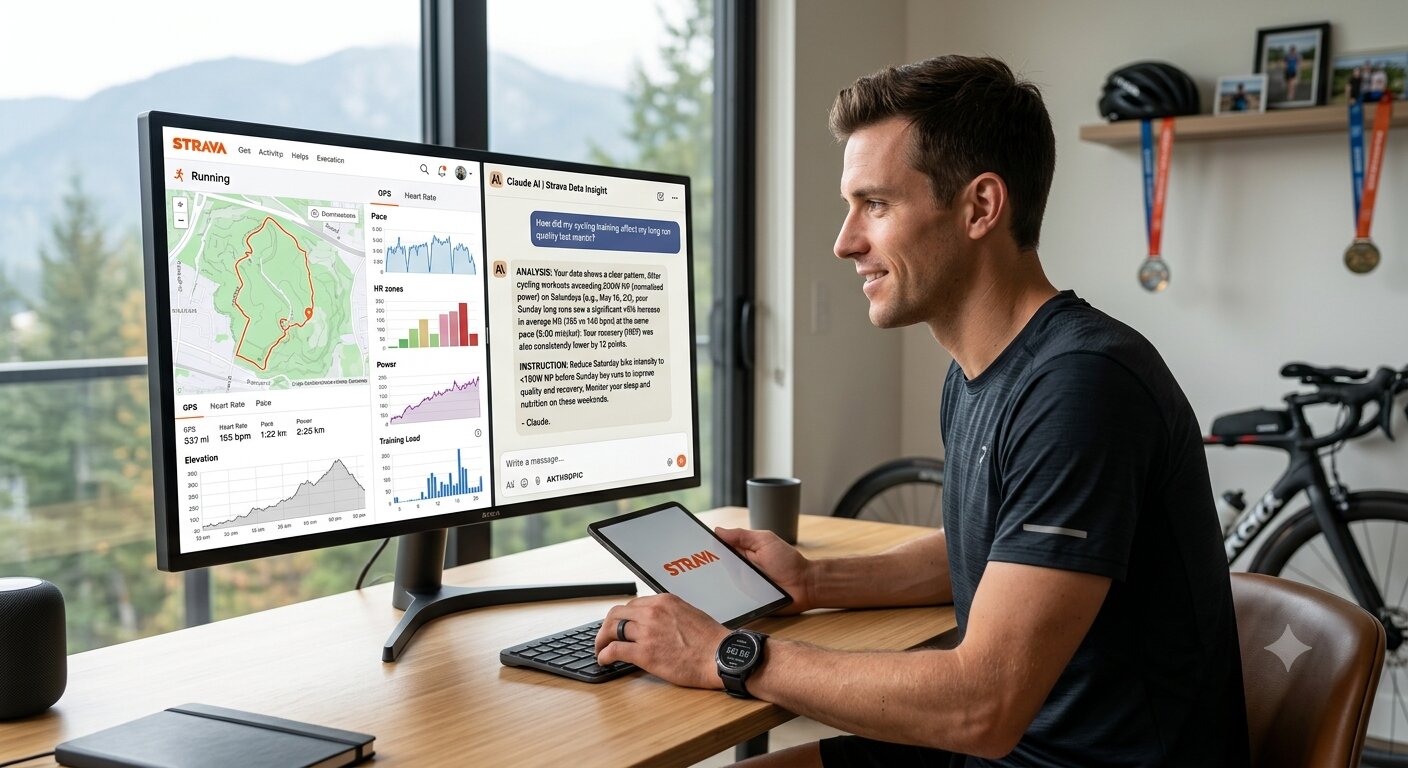
    Not long ago, analysing training meant CSV exports, spreadsheets, manually comparing zones and long evenings spent over charts. Today more and more platforms try to make sense of it with artificial intelligence. The latest example is the Strava MCP Connector, an official link between Strava and Anthropic’s Claude assistant.

    It sounds technical, but the idea is simple: instead of digging through your activity history yourself, you can ask an AI about your own training in plain language. Not generic advice from the internet, but answers drawn from your actual activities.

    Strava MCP Connector: what actually happened

    Strava launched its official MCP Connector on 1 June 2026. The tool is available to Strava subscribers and links a Strava account to Claude. Access is read-only, runs through OAuth authorisation, and can be revoked at any time in settings.

    In practice this means Claude can analyse activity history, fitness trends, training load, GPS data, heart rate, pace and bike power. Strava stresses this is not a static data export but access to a user’s current account data.

    Some example questions that start to make sense:

    • Are my easy sessions actually easy?
    • How has my pace changed on similar routes over the last few months?
    • Does strength training or cycling affect my running?
    • What did my heart rate look like on intervals during my last training block?

    This is not yet an automatic coach that rebuilds an entire plan on its own. It is more of a very fast analyst that can read the data and pull out an answer without anyone copying charts by hand.

    Why this matters for triathletes

    Triathlon is an ideal sport for tools like this, because the data is everywhere. Swim, bike, run, intervals, heart rate, power, pace, sleep, HRV, fatigue, target race, taper. The problem for an amateur is no longer having too little data. It is having too much of it.

    So the biggest shift is not that an athlete gets yet another app. It is that analysis stops being reserved for people who already know how to read load charts, power zones and heart rate drift.

    If a system can answer, in plain language, why a Zone 2 run regularly finishes too hard, or why Sunday’s long run feels weak after Saturday’s ride, an amateur gets something valuable: faster feedback.

    AI in triathlon: a quick platform comparison

    The comparison below is not a ranking, since these tools solve slightly different problems. It is more of a quick map: what to pick if you want to analyse data, and what to pick if you want a plan that reacts to how training actually goes.

    PlatformMain useStrongest pointLimitationsIndicative price
    Strava MCP ConnectorAnalysing training history through ClaudeNatural-language questions about your own data: heart rate, pace, GPS, power, loadRead-only access; at launch, integration is mainly with ClaudePart of a Strava subscription: $11.99 a month or $79.99 a year
    TriathlifyAdaptive triathlon training planPlanning for a race or for weight loss, daily adaptation, Garmin/Strava/Apple Health integrations, Polish-language versionA younger platform than the biggest global players; some integrations are still on the roadmap9.99 USD/month or 99.99 USD/year
    TriDotAdvanced planning and result predictionExtensive training engine, RaceX, plenty of data and race scenariosHigher price; can be too much for beginnersfrom 14.99 USD/month; Essentials 39 USD/month; Complete 99 USD/month
    Athletica.aiAdaptive endurance plansSimple subscription model, dynamic plan adjustment, sports-science methodologyLess triathlon-specific ecosystem than TriDot; more focus on general endurance sport19.90 USD/month or 189 USD/year

    Strava: a conversation with your own training history

    How it works: the Strava MCP Connector lets you talk to Claude about your own training data. It is read-only, so the AI does not edit activities or upload new workouts to the account.

    For now, Strava is launching with Anthropic’s Claude, but says it may support other AI clients in future. That matters, because MCP as a standard could eventually become more than one app’s single integration.

    Who it suits: people with a long history on Strava who want to quickly find trends, dependencies or mistakes in their training, without exporting data by hand.

    Price: the feature is part of a Strava subscription. According to Strava’s current pricing page, an individual subscription costs $11.99 a month or $79.99 a year. Prices can vary by payment channel, promotion and bundle.

    Triathlify: adaptive triathlon training

    How it works: Triathlify is a platform built for triathlon. Its premise is to adapt the plan based on session data, not just display it afterwards. The platform states it syncs with Garmin and Strava, works on a periodised plan from sprint to Ironman distance, and adapts daily based on completed load, calendar and recovery signals.

    On its methodology page, Triathlify describes analysis of sleep, HRV, resting heart rate, wellbeing, adherence to the plan, CTL/ATL/TSB and phases of preparation. That matters, because in triathlon simply knowing “you did the session” is not enough. What counts is whether you did the right stimulus at the right moment.

    Who it suits: athletes who want an adaptive triathlon plan, watch integration and the option to use the platform in Polish.

    Price: according to Triathlify’s current pricing, the Athlete plan costs 9.99 USD a month or 99.99 USD a year. A 7-day trial is also available. So you can test all features for free.

    TriDot: heavyweight and built on a predictive engine

    How it works: TriDot is one of the best-known AI platforms in triathlon. The system is built on analysis of an athlete’s data, training history, race profile and environmental conditions. Among other tools, the platform uses RaceX Performance for forecasts and race optimisation.

    This is a more built-out tool, and a pricier one. For some athletes it will be a great fit, especially if they like a heavily structured process. For others it may feel too heavy, or too rigid against everyday life.

    Who it suits: triathletes who want a very advanced training platform and are willing to pay for the full ecosystem.

    Price: TriDot’s current pricing starts with the Lifestyle plan at 14.99 USD a month. Essentials costs 39 USD a month, Complete 99 USD a month, and the Premium version with a coach starts from 249 USD a month.

    Athletica.ai: microcycle adaptation and simple pricing

    How it works: Athletica.ai focuses on adaptive plans for endurance sports. The platform analyses completed sessions, load and recovery-related signals, then adjusts the next sessions accordingly. Its strong point is a simple model: fewer pricing tiers, more focus on the planning itself.

    Who it suits: athletes who want a dynamic endurance plan without a heavily layered, multi-tier system.

    Price: 19.90 USD a month, 99 USD for 6 months, or 189 USD a year. New users get a 14-day trial.

    What is worth asking the AI after connecting your data

    Tools like this make the most sense once the questions get specific. Instead of asking “how should I train?”, it works better to ask something that can actually be checked against the data.

    • Are my recovery sessions actually recovery?
    • In which weeks did load rise too fast?
    • Does run quality drop the day after a long ride?
    • How has heart rate at the same pace changed over the last 12 weeks?
    • Which sessions correlate best with improved fitness?
    • Was the taper before the last race long enough?

    Where is the catch

    AI in training does not solve everything. A system can read heart rate, pace and power well, but it will not see poor swim technique, a badly fitted saddle, an overuse injury building up, or the fact that an athlete has been sleeping five hours a night for three weeks.

    Data is only powerful when it is complete and well interpreted. The best scenario is not “AI instead of a coach”, but AI as a filter that helps spot a problem faster.

    AI will not replace a coach. It can replace chaos

    The important question is not “will AI replace a coach?”. That is too simple. A good coach still sees more than a chart: life context, stress, motivation, injury history, technique, the athlete’s head before a race.

    But AI can replace something else: chaos. It can catch faster that easy runs are running too hard. It can notice that run quality regularly drops after a hard ride. It can show that a plan looks good on paper while the body has stopped absorbing it.

    For an amateur training between work, family and everyday life, that can make a huge difference. Not because artificial intelligence knows everything, but because it does not get tired of looking at the data.

    What is next

    The Strava MCP Connector points at the direction the whole market is heading. Training data stops being just an archive of activities. It starts becoming material for conversation, analysis and decisions.

    The platforms that win will not be the ones shouting “AI” the loudest, but the ones that turn data into a simple decision: train harder today, ease off today, shift emphasis today, you are ready today.

    Anyone who wants to check how Strava describes its official connection with Claude can look at the documentation: Strava MCP Connector.

    The future of triathlon will not be about getting even more charts. It will be about finally being able to read those charts fast enough to know what to do tomorrow.

  • IRONMAN 70.3 Kraków 2026: Stępniak defends by 20 seconds

    IRONMAN 70.3 Kraków 2026: Stępniak defends by 20 seconds

    The second edition of IRONMAN 70.3 Kraków ended exactly as the crowd would have scripted it. Kacper Stępniak defended the title he won last year, taking a head-to-head fight with a Dane right before the line on Kraków’s Main Square. In the women’s race Nikki Bartlett came out of the water more than a minute down and rode to the win anyway. The race was held on Sunday 2 August 2026, in temperatures reaching 30°C.

    Men: 20 seconds after 113 kilometres

    Germany’s Hannes Butters led out of the water (21:12), just ahead of Marc Dubrick and Cenzino Lebot. Stępniak (21:19) and Daniel Baekkegaard started the bike a few seconds later, in the same group.

    On the 90-kilometre course through Wieliczka and Bochnia, Stępniak took the initiative straight away and cut the lead group to five. When Baekkegaard lifted the pace over the final 30 km of the bike, Johannes Vogel and Butters lost contact. Three men started the run: Stępniak, Baekkegaard and Dubrick.

    Dubrick lost touch in the first kilometres of the half marathon, though not because he cracked. The American put down the fastest run of the day, 1:11:35, and still could not close the gap. Baekkegaard stayed with the Pole stride for stride until the last few metres. Stępniak attacked just before the line and won in 3:36:37, 20 seconds ahead of the Dane (3:36:57). Dubrick completed the podium in 3:38:22.

    A year ago Stępniak won the inaugural edition in 3:39:40. This year’s time is three minutes quicker, against considerably sharper competition.

    Women: Bartlett takes back 1:41 on the bike

    Italy’s Lilli Gelmini led out of the water (24:45). Nikki Bartlett reached T1 in eighth place, 1:41 behind the leader.

    On the bike the Briton started taking that back immediately. She was fourth before the 45-kilometre mark, took the lead a few kilometres later and never gave it up. At T2 she held 1.5 minutes on Brooke Gillies and Megan McDonald, with Francesca Crestani chasing.

    Places behind Bartlett kept changing on the run. The front did not. The Briton won in 4:08:26. Crestani ran through for second (4:09:59), and France’s Aurelia Boulanger took the last podium spot with the third-fastest time (4:10:45).

    The Poles: Stępniak was not alone

    Behind the winner, Jacek Krawczyk took fourth in the PRO classification in 3:41:24, only three minutes down on Dubrick. The fastest Polish woman was Agnieszka Gadomska, seventh in 4:16:51.

    More than 2,000 athletes from several dozen countries started, so on entry numbers Kraków in its second year already sits alongside Poland’s older races over this distance.

    The course: from Zakrzówek to the Main Square

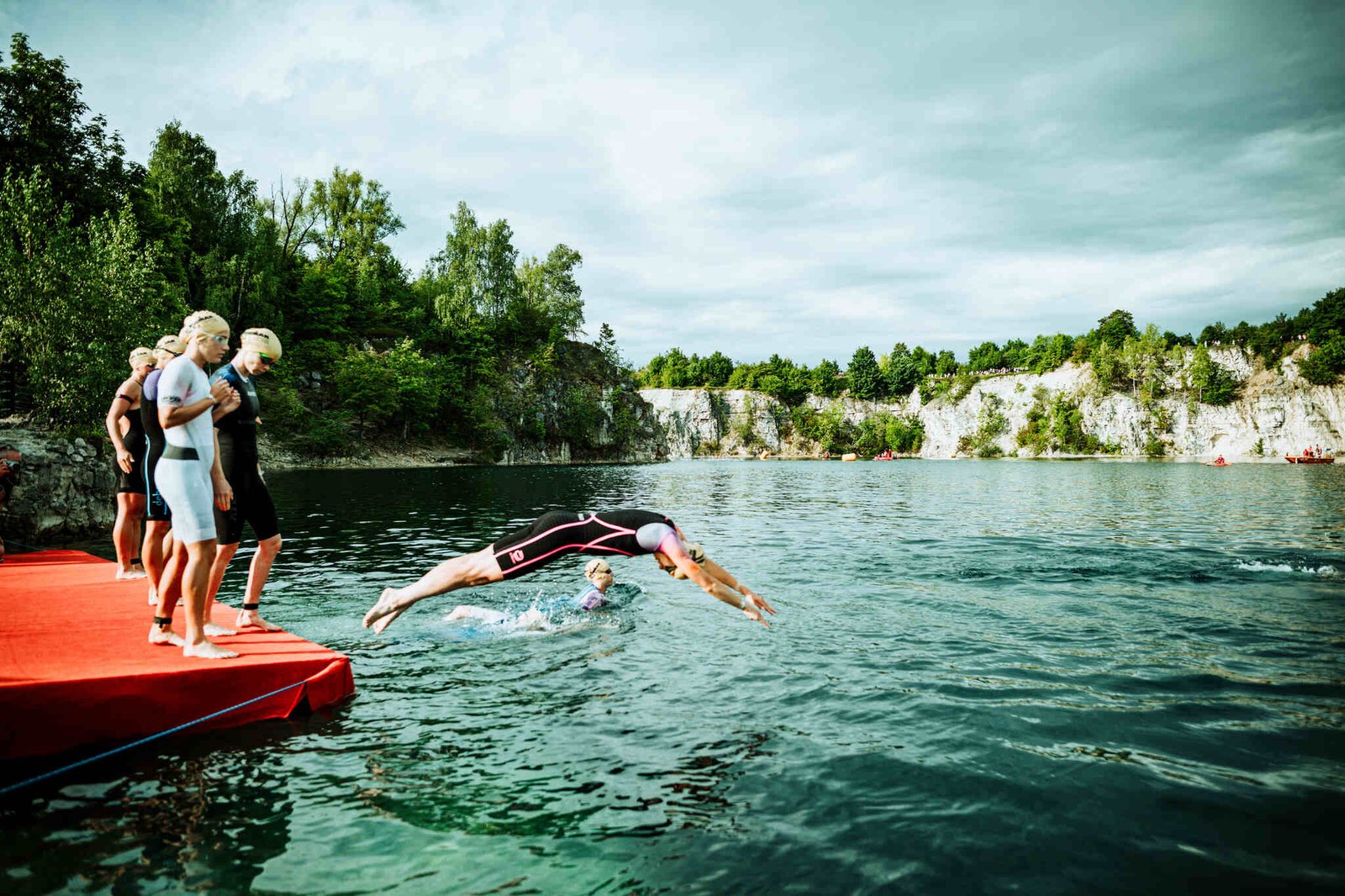
    The swim was held in Lake Zakrzówek, a flooded quarry inside the city limits of Kraków. The bike course ran from there through Wieliczka to Bochnia and back, mostly along the DK94, which makes it a fast leg that rewards strong time triallists. The run finished on the Main Square, still a rare thing for age-groupers racing in Poland. Few events in the country finish in the middle of a major city.

    Thinking about Kraków in 2027?

    Two editions are not enough to draw hard rules, but one thing is already visible: an August date means heat. In 2026 the thermometers showed close to 30°C, and on a half marathon after 90 km on the bike that counts for more than the course profile. If you are planning to race here, train in the heat and rehearse your hydration strategy on brick sessions instead of improvising on the day.

  • Ultra Baltic Swim 2026: Kubkowski swims Sweden to Poland

    Ultra Baltic Swim 2026: Kubkowski swims Sweden to Poland

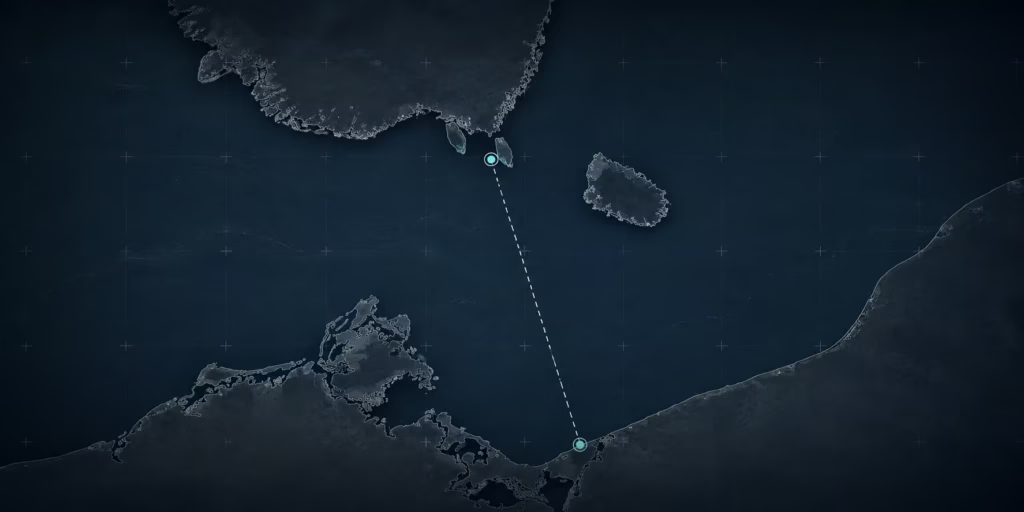
    When Bartłomiej “Foka” Kubkowski walked out onto the beach at Dziwnowo, on Poland’s Baltic coast, under his own power at around 20:30 on Sunday evening, 2 August 2026, everyone on the shore was in tears. After nearly 55 hours of unbroken effort in the black water of the Baltic Sea, he became the first person in history to swim from Sweden to Poland. Roughly 160 kilometres, though some accounts put it closer to 170 km because the currents lengthened the distance actually covered, done at the fifth attempt, announced as “Last Dance”.

    It was not a one-man show. Karolina Szczepaniak started from Sweden in the same weather window, a two-time Olympian (Beijing 2008, London 2012). She spent 58 hours in the water. Extreme exhaustion and heavy chafing led her crew to make the hard call to stop the attempt before she reached the Polish shore, but her swim goes into the history of Polish ultra-swimming regardless. She showed a resilience that carried thousands of people who were following her.

    Baltic Sea crossing, illustration

    Rather than add another round of general congratulations, it is worth breaking the weekend down. Here is what sat behind the project physiologically, in equipment terms and logistically.

    Physiological hell: face, hands and head after two and a half days at sea

    Spending more than two days in high-salinity water at an open-sea temperature of 16-18°C wrecks the human body.

    • Skin maceration: after that long in continuous immersion, skin loses its protective barrier. It soaks up water, goes soft as paper and gives way to the smallest injury. Swimmers’ hands and feet after attempts like this are wrinkled and bleached white, and even the touch of a towel hurts.
    • Damage to the mouth and eyes: constant contact with sea salt swells the face. Eyes sting and fog up behind goggles despite the seal. The worst of it is breathing in salt spray and swallowing water by accident. After many hours the tongue and throat can swell enough to make eating anything a torture.
    • Sleep deprivation and hallucinations: close to three days without sleep, combined with the monotony of black water, throws off the sense of balance. In 2025 Bartek was pulled out of the water 11 km from the Polish shore after more than 50 hours of effort. He had lost his bearings and was close to losing consciousness, so his crew ended the attempt. This year the key was surviving two full nights on open water without losing contact with reality.

    Equipment: what do you swim the Baltic in?

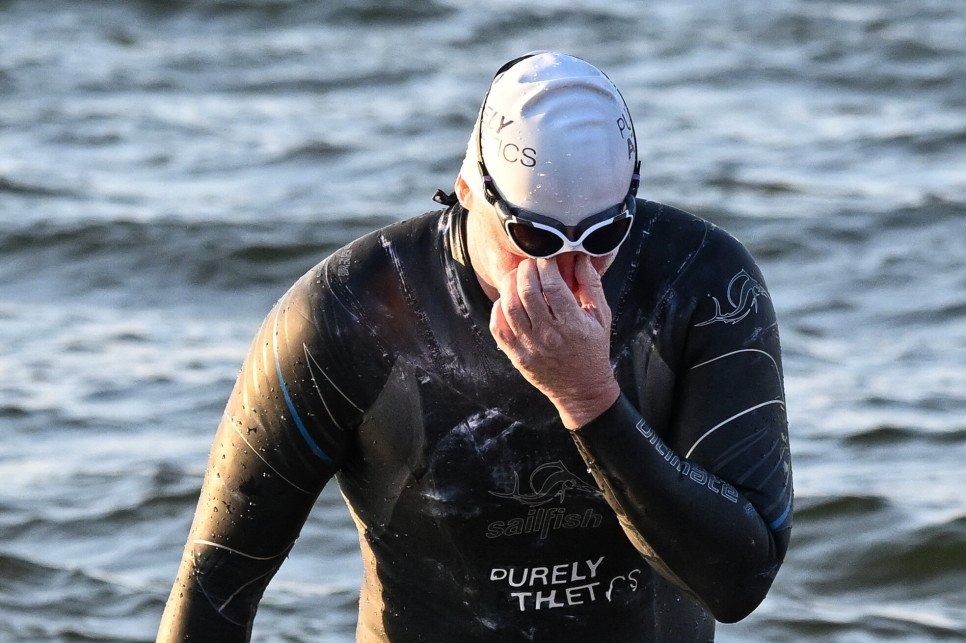
    Under Ultra Baltic Swim rules a neoprene wetsuit is allowed, and it is the basis of survival. What the swimmer may not do, at any point, is touch the support boat. Bartek swam in a sailfish wetsuit, visible in the photographs from the finish at Dziwnowo. The pressure points, neck, armpits and groin, are usually covered in a thick layer of protective grease so the wetsuit seams and salt crystals do not wear the skin down to raw flesh. That is standard practice among long-distance swimmers, not something specific to the Baltic. He used dark-lensed goggles for the crossing, and a lifeboat crew watched over him around the clock.

    Caloric hell: how do you feed a man who cannot stop?

    The constant arm work is only part of the energy cost. Most of it goes on thermoregulation, on fighting hypothermia and generating heat to hold core temperature. According to media reports Kubkowski burned around 55,000 kilocalories during the crossing. Everything was passed to him from the boat without him touching it, as drinks and food handed over on a pole.

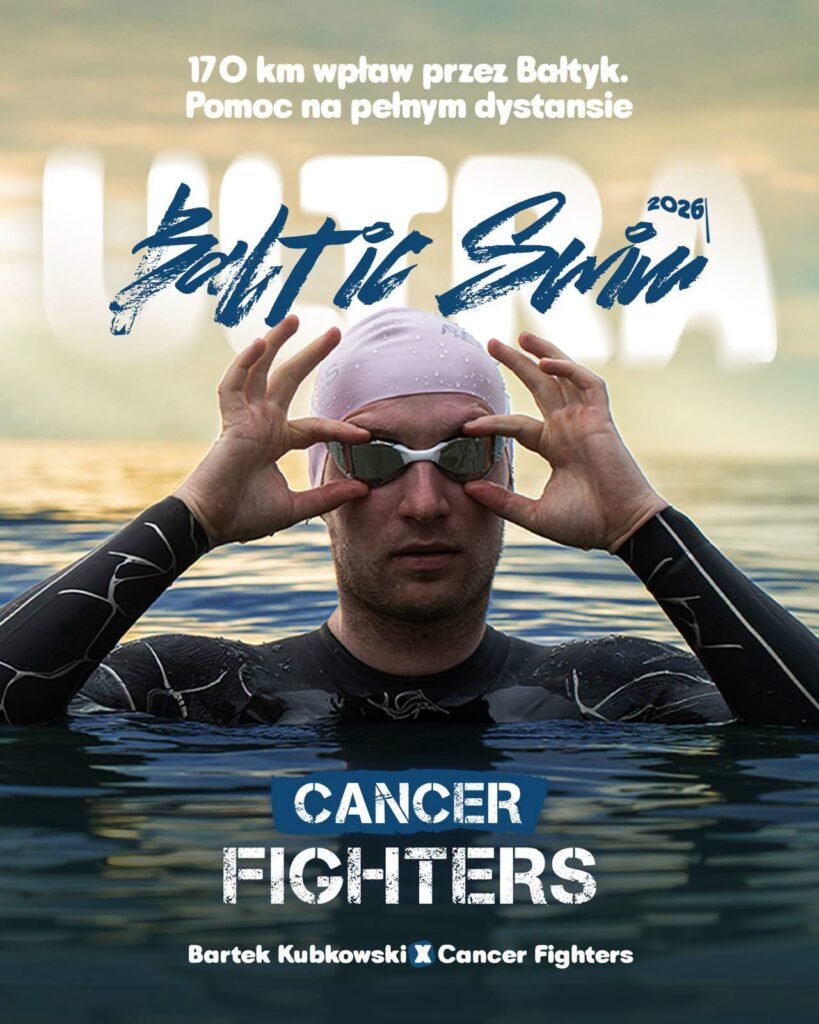
    More than sport: over 800,000 złoty (about €185,000) raised

    The effort had a purpose beyond the swim from the start. Kubkowski swam for the beneficiaries of the Cancer Fighters Foundation, which supports children and adults being treated for cancer. Alongside the sporting record, the one that mattered most fell too: the dedicated fundraiser on the foundation’s site passed 800,000 złoty (about 214,000 USD) and is still climbing (as of 3 August it stood at roughly 780,000 złoty, about 208,000 USD). Conversions use the National Bank of Poland rate of 3.7468 złoty to the dollar, table 149/A/NBP/2026 of 4 August 2026.

    Bartłomiej Kubkowski after the Baltic crossing
  • World Cup Rio: Legg and Michalickova Win It by a Second

    World Cup Rio: Legg and Michalickova Win It by a Second

    Copacabana had not seen elite triathlon since the 2016 Olympics. A decade later, the World Triathlon Cup returned to the beach, and both sprint races, men’s and women’s, were decided by one second. The event took place on Sunday, 2 August 2026.

    Legg wins by a second

    American Braxton Legg won the men’s race in 50:56 over the sprint distance: 750 m swim, 20 km bike, 5 km run. Most of the world’s top-ranked field skipped Rio, opening the door for athletes outside the front line. Legg took the opportunity and held his lead to the finish.

    New Zealand’s Dylan McCullough finished second (50:57), and the Netherlands’ Mitch Kolkman third (51:04). All three finished within eight seconds of each other.

    Michalickova gives Slovakia its first-ever win

    In the women’s race, Slovakia’s Zuzana Michalickova took the win in 58:13, also by a single second. American Kelly Wetteland finished second (58:14), and Italy’s Beatrice Mallozzi third (58:16).

    It is Slovakia’s first-ever World Triathlon Cup win.

    What a race without the stars gives you

    The World Triathlon Cup sits a level below the WTCS. Less show, but a harder fight for ranking points that decide entry into the bigger races. The absence of the top names opened up the field, and both races ended the same way, a sprint over the final metres.

    For anyone who likes spotting athletes before they become well known, the Cup is a better place to look than the WTCS. On Copacabana, two people few had talked about before Sunday won.

  • Flash News: Słupek European gold, WTCS back in London

    Flash News: Słupek European gold, WTCS back in London

    This was a week when triathlon got everything at once: a historic Polish gold, WTCS returning to London, a structural reform of the professional calendar, and Alistair Brownlee starting one of the hardest triathlons in the world. Plus Boise, Toronto, Kórnik, Starachowice, the end of Flora Duffy’s career, and the story of Mohamed Lahna, who crossed America in triathlon format.

    1. Roksana Słupek is European champion. Elbląg went up

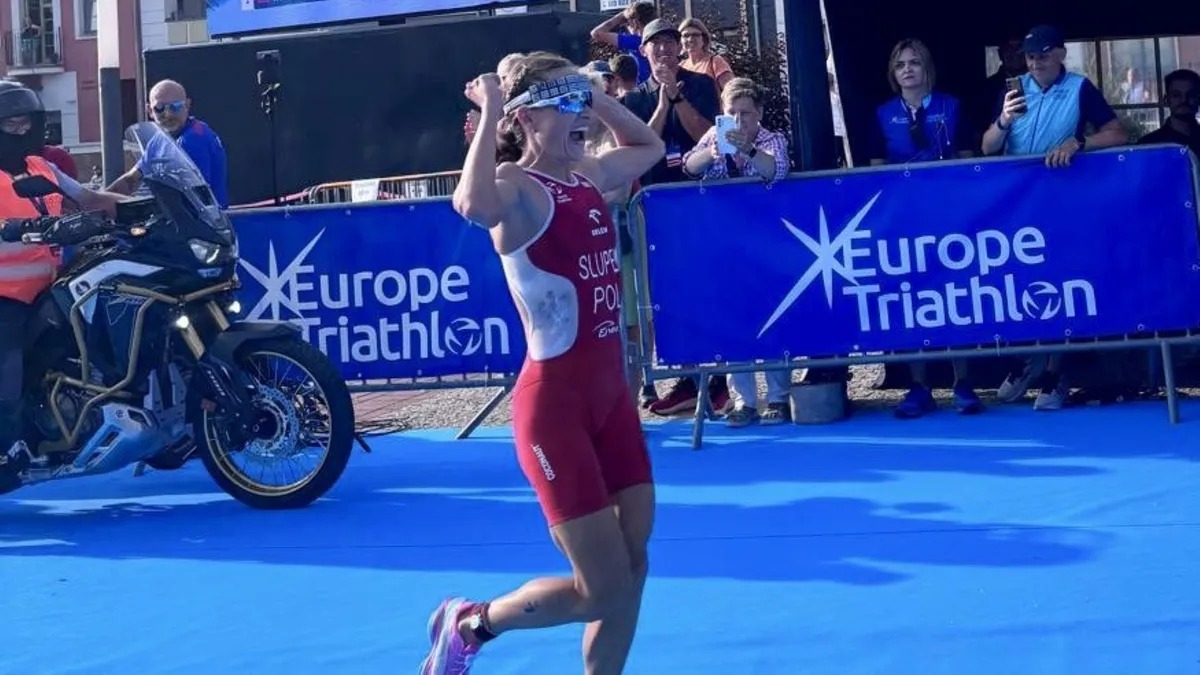
    The biggest Polish story of the week is not in doubt: Roksana Słupek became European champion in sprint-distance triathlon. On Friday 31 July in Elbląg she won the women’s elite race in 1:00:31, 15 seconds ahead of Ambre Grasset and 16 ahead of Léa Houart.

    This was not a case of leading out of the water and riding away with it. After the swim Słupek was 24th and more than 20 seconds down on the front. She came back on the bike, and on the run she did what you expect from someone racing for gold: she left everyone.

    It is Poland’s first ever European Championship medal in this event, and it is gold. A result like that in front of a home crowd needs no extra drama written into it.

    2. Elbląg gave Poland more than one result

    The European Championships in Elbląg did not end with Słupek’s gold. Milan Larivière took the men’s title, and the best of the Poles was Michał Oliwa in eighth. Poland’s mixed relay finished sixth.

    For Polish triathlon it was an important weekend organisationally as well as competitively. Elbląg was given a championship event, the national team put people near the front, and the crowd got something Polish triathlon still wants more of: a big race on home roads.

    3. WTCS returned to London. Hauser and Beaugrand dealt the cards

    After an 11-year gap WTCS came back to London and immediately got a script worth the stage. Matthew Hauser won the men’s race in 50:28, beating Vasco Vilaça by three seconds. Csongor Lehmann completed the podium.

    In the women’s race Cassandre Beaugrand did what she has done best this season: won. It was the Frenchwoman’s third victory in three WTCS starts in 2026, finishing in 56:06. Lisa Tertsch and Tilda Månsson followed her in, and the best of the British, Beth Potter, was fourth.

    The home disappointment was Alex Yee. The Olympic champion raced in front of his own crowd, but after trouble on the bike and a crash he finished 14th. London was a reminder that form guarantees nothing, even for the best.

    4. Triathlon World Tour: the end of the format war?

    London also produced an announcement that could reshape professional triathlon. The PTO and World Triathlon presented the Triathlon World Tour brand, a shared structure meant to bring order to the professional calendar from 2027.

    WTCS is to run as the T50 World Championship Tour, and T100 as the T100 World Championship Tour. A Challenger level is to sit underneath, serving as the qualifying path and feeder for the main series.

    Technical, yes. The point is simple though: less chaos, a clearer hierarchy, and a better chance that athletes, sponsors and spectators end up looking at one coherent system.

    5. T100 puts on smart glasses, IRONMAN bans cameras

    Triathlon currently has two opposing visions of technology on course. IRONMAN’s 2026 rules ban athletes from filming or taking photographs during a race. T100 went in exactly the other direction.

    The PTO announced Meta as the official wearables partner of the T100 series. In practice that means Oakley Meta Vanguard and Oakley Meta HSTN Performance AI glasses used for footage from the perspective of athletes, officials and age-group participants.

    One organisation is talking about safety and concentration. The other is talking about showing people the race from the inside. That argument is more interesting than the hardware, because the same questions will reach age-groupers soon enough.

    6. Sam Long and Kirsten Kasper win IRONMAN 70.3 Boise

    Sam Long was back in Idaho. The American won IRONMAN 70.3 Boise in 3:32:25, building his lead mainly on the bike. Ari Klau was second and Blake Harris third, a few seconds ahead of Vincent Luis.

    The women’s race went to Kirsten Kasper in 4:00:50. It was a strong running comeback: Kasper pulled back time after the bike and took control over the closing kilometres.

    Boise was a reminder of something plain: you can win a 70.3 on the bike, but without a strong run you cannot close it out calmly.

    7. Supertri Toronto: Mislawchuk wins at home

    Toronto gave its crowd a local winner. Tyler Mislawchuk took Supertri Toronto in 51:27, with the fastest run of the day: 13:12 for 5 km.

    Solomon Okrafo-Smart was second and Nathan Grayel third. Among the women Zuzana Michaličková won, the only one to break the hour, in 59:34.

    The race closed qualification for the Supertri Pro Series final in Jersey, where the prize pool is to be 800,000 dollars. Short distance, fast legs, big money. Supertri knows exactly what it wants to be.

    8. Kórnik: full distance for Decewicz and Hanuszewicz

    Kórnik, in western Poland, put in a hard weekend domestically. At the GREATMAN Triathlon Kórnik athletes raced everything from one-eighth distance up to full.

    Over the longest course Przemysław Decewicz won in 9:43:48. The fastest woman was Pamela Hanuszewicz in 11:01:16. Joanna Preiss was third woman overall.

    This is worth saying out loud: Polish triathlon is not only big brands and televised events. It is also races like this one, where full distance still smells of local work, family on the course, and a very long day.

    9. Starachowice: Szymanowski and Madej take the Polish cross titles

    Triathlon does not live on tarmac alone. Starachowice hosted the Polish cross triathlon championships, and the golds went to Przemysław Szymanowski and Zuzanna Madej.

    Szymanowski won in 1:12:55, taking back a national title after 12 years. Madej was the fastest woman in 1:25:29. The course: a swim in the Lubianka reservoir, a technical mountain-bike leg and an off-road run.

    It is a different sport from fast half distances on flat, PB-friendly courses. Less aero, more bike handling. Less sterile, more terrain.

    10. Brownlee at Norseman. No longer “racing”, but second

    Alistair Brownlee said before the start that since retiring from professional racing he no longer competes, he “participates”. Norseman tested how true that was.

    On 1 August the two-time Olympic champion started the Norseman Xtreme Triathlon and finished second. Defending champion Kristian Grue won in 9:53:48, with Brownlee reaching Gaustatoppen in 10:18:21. Hans Christian Tungesvik was third.

    Norseman is a 3.8 km swim in a fjord, 180 km on the bike through the Norwegian mountains, and a marathon with a legendary climb at the end. If that is “participating”, most of us can safely stick to less dramatic hobbies.

    11. Flora Duffy retires

    This one is two weeks old, and still hard to walk past. Flora Duffy announced her retirement on 15 July 2026.

    The Bermudian leaves an exceptional record: Olympic gold from Tokyo, four WTCS world titles, six XTERRA titles, two Commonwealth Games golds and five Olympic appearances. It is one of those careers that needs no footnotes.

    For years Duffy was the definition of a complete triathlete: strong in the water, merciless on the bike, mentally durable on the run. Retirements like hers always leave an empty space in the sport.

    12. Mohamed Lahna crossed America by triathlon

    To finish, a story from the hard-to-believe category. Mohamed Lahna, a Paralympian and Games medallist, completed a 47-day triathlon across the United States.

    In total he covered about 3,300 miles, more than 5,300 km. The project included a swim around Manhattan, roughly 3,000 miles of cycling through 16 states, and 300 miles of running to Venice Beach. It was also raising money for Save the Children and the Challenged Athletes Foundation.

    In a week full of results, tables and seconds, that story sets the proportions well. Triathlon is sometimes a sport about a place on the podium. It is also sometimes a way of telling the world that the limits sit further out than we assume.

    The week in summary

    Roksana Słupek gave Poland a historic gold, London was a reminder of how spectacular a WTCS sprint can be, and the Triathlon World Tour showed that the biggest organisations finally want to tidy the calendar rather than add another layer of chaos.

    Add Brownlee in Norway, Duffy closing a great career, domestic racing in Kórnik and Starachowice, and stories that go well beyond classic results. A good week: plenty of substance, some emotion, and several subjects that will be argued about for a while.

  • Słupek takes European sprint title in Elbląg

    Słupek takes European sprint title in Elbląg

    The European sprint-distance championships came back to Poland, and Roksana Słupek won them in front of a home crowd. The men’s race went the other way: the whole podium fitted inside seven seconds.

    Elbląg, in northern Poland, hosted the event across two days: individual sprints on 31 July, mixed relays on 1 August. Around 300 athletes from more than 30 countries started, in the Elite, U23 and Junior categories. The race zone was the Old Town.

    Słupek: “one of the hardest races of my life”

    The women’s Elite/U23 race started 65 athletes and 62 finished. Słupek settled it on the run and crossed the line in 1:00:31.

    Two French athletes came in behind her. Ambre Grasset, 1:00:46, 15 seconds back, which also took the European U23 title. Léa Houart, 1:00:47, a second behind her team-mate.

    The whole piece could have ended on those times, if not for what Słupek said afterwards.

    “I don’t think it was my day at all. I suffered on the swim, on the bike and on the run. On top of that I had very high expectations of myself. I don’t get many chances to race in front of a Polish crowd, so winning mattered to me.”

    She added that she had told her coach she felt “the way I did before the Olympics”. Her father was waiting at the finish, watching only the second race of his daughter’s career in person.

    Winning on a day she describes as not hers. That usually means the form is higher than the clock suggests.

    Men: the whole podium inside seven seconds

    This one stayed tight to the end. 78 started, 65 finished.

    France’s Milan Larivière won in 54:20. Britain’s Michael Gar lost five seconds (54:25). Hungary’s Zalán Hóbor gave up two more (54:27).

    Seven seconds between gold and bronze after a 750 m swim, 20 km on the bike and a 5 km run. That is what a sprint looks like when nobody rides away and everything comes down to the 5k.

    The best of the Poles was Michał Oliwa, eighth in 54:41, 14 seconds off bronze. Given how compressed the front was, that is genuinely close.

    Behind him:

    • Maciej Bruździak, 21st, 55:18
    • Kamil Kulik, 23rd, 55:20
    • Kuba Gajda, 31st, 55:45

    All four finished within 85 seconds of the winner. Over a sprint that is not a gulf.

    Relays: Hungary confirm their form

    The mixed relays ran on the second day, juniors at 9:00 and Elite/U23 at 12:30. Standard format: four athletes, two women and two men, each over a shortened distance.

    In the Elite/U23 category Hungary won, ahead of Spain and Germany. Three weeks earlier the Hungarians had been second at the mixed relay world championships in Hamburg, so Elbląg simply confirmed where they were.

    Poland’s relay finished sixth.

    The European Championships in Elbląg

    Elbląg handled an event of this level well, and the race zone in the Old Town did its job: spectators stood a few metres from the best of the continent.

  • Vitamin D in Triathletes: Sun Training, Still Deficient

    Vitamin D in Triathletes: Sun Training, Still Deficient

    You would think a triathlete, someone who spends long hours outdoors on a bike or in running shoes, would be the last person to worry about vitamin D.

    The research says otherwise. Deficiency shows up in endurance athletes surprisingly often, including well-tanned ones. The reason is geographic and biological, and it applies directly to anyone training and living in countries with less sun.

    Sun caught during a session is not enough on its own. Here is why, and how the theory translates into watts and faster recovery.

    1. Why sunlight is not always enough for a triathlete

    Skin only produces vitamin D when the sun sits high enough in the sky. From October to March the angle of UVB radiation is too low for any synthesis to happen in the skin, even on a training run in full sun with no shirt on.

    That is not the whole story. Even in summer, when sunlight is theoretically plentiful, triathlon habits themselves get in the way:

    • UV filters (SPF 30/50): sensible sun protection against burns and melanoma during a five-hour ride is the right call. But an SPF 15 sunscreen blocks vitamin D synthesis by more than 95%, and SPF 30 blocks it almost completely.
    • Training hours: to fit sport around work and avoid summer heat, most training happens early morning or late afternoon, when the sun’s angle rules out skin synthesis.
    • Technical clothing: fitted cycling and running kit covers most of the body.

    The result is a season spent covering thousands of kilometres, a cyclist’s tan lined up perfectly with shorts and jersey, and an autumn that starts with an empty vitamin D reserve.

    2. What vitamin D does for muscles and bones

    For an athlete this is not just an “immunity” vitamin. It behaves as a hormone with a strong anabolic and metabolic role.

    Faster type II muscle fibres

    Vitamin D receptors sit directly in muscle tissue. A deficiency leads to fatty degeneration of type II fibres, the fast-twitch fibres responsible for a finishing kick, power on climbs, and sudden force output on the bike.

    Protection against stress fractures

    Without vitamin D, calcium absorption in the gut drops sharply, by as much as 50 to 80%. You can drink litres of isotonic drinks and eat a dairy-rich diet, but with low vitamin D your bones will still lose density. Combined with a high running volume, that is a straight path to stress fractures that can end a season for months.

    Faster recovery and lower inflammation

    An optimal vitamin D level suppresses pro-inflammatory cytokines and speeds up repair of muscle micro-damage after hard sessions. Research also shows a clear correlation between high blood levels of 25(OH)D and a higher VO2max in endurance athletes.

    The enzymes that activate vitamin D in the liver and kidneys need magnesium to work. If you train hard, sweat heavily and run low on magnesium, even high doses of vitamin D may raise your blood level poorly. Keep the two in balance.

    3. Target levels for athletes: Polish 2023 guidelines

    Vitamin D status is measured through the blood metabolite 25(OH)D. Under the latest official guidelines for Central Europe (Płudowski et al., 2023), your supply status breaks down as follows:

    25(OH)D (ng/ml)25(OH)D (nmol/l)StatusWhat it means for a triathlete
    0 to 200 to 50DeficientRed flag. Loss of form, higher injury and infection risk. Needs prompt treatment.
    >20 to 30>50 to 75SuboptimalToo low for an athlete. Needs a supplementation correction.
    >30 to 50>75 to 125Optimal, the targetThe level that delivers full health and performance benefits.
    >50 to 100>125 to 250HighSafe, but with no extra benefit beyond the optimal range.
    >100>250ToxicPoisoning risk. Supplementation should stop immediately.

    While a level of 30 ng/ml is enough for an inactive person, endurance athletes aim to hold a stable level between 40 and 50 ng/ml.

    4. How much to supplement: prevention versus treatment

    Dosing should match your current blood result and the time of year.

    Prevention, for healthy adults

    If between May and September you train in full sun, arms and legs uncovered, no SPF, for at least 30 to 45 minutes between 10:00 and 15:00, you can skip supplementation over summer. Otherwise, and as standard from October to April:

    • At a normal body weight: 1,000 to 2,000 IU a day (cholecalciferol).
    • With overweight or obesity, BMI over 30: double the dose, 2,000 to 4,000 IU a day, year-round.

    Treating a confirmed deficiency, 20 ng/ml or below

    If testing shows a deep deficiency, a preventive 2,000 IU will not be enough. A treatment protocol is then run under a doctor’s or dietitian’s supervision:

    • Therapeutic doses: typically 4,000 to 10,000 IU a day for one to three months, depending on the severity of the deficiency and body weight.
    • Bundled dosing: current guidelines allow safely bundling doses, for example once a week at 20,000 to 30,000 IU instead of small daily amounts, a useful option for anyone who forgets a daily pill.
    • Follow-up: after 8 to 12 weeks of treatment, retest, and once the target level is reached, above 30 to 40 ng/ml, switch to a maintenance dose.

    A note of caution: current guidelines advise against single, high-dose “mega” boosts, for example 100,000 IU at once, in Poland without a clear clinical indication, because of the load on the kidneys. Steady daily or weekly supplementation is considerably safer.

    5. How, when and for how much to test vitamin D

    For a triathlete, the rule is simple: test first, then dose. Vitamin D is fat-soluble and accumulates in the body, so it should not be taken blind in very large amounts.

    • Cost: a private 25(OH)D test at a lab typically runs about $20 to $60 – depending on country. Look for “packages for runners” or “active people”, which often bundle a blood count, iron and ferritin with the vitamin D test at a better combined price.
    • When to test: March or April, at the end of winter, is when levels are at their lowest, a true test of whether winter supplementation worked. October, at the end of the season, shows how well natural summer sun protected you into autumn.
    • Preparation: you do not need to fast, unless other parameters are being tested too. Stop vitamin D supplementation 3 to 5 days before the blood draw, so the result reflects your real stored reserve rather than a recently taken capsule.
    • Take vitamin D with a meal that contains some fat, for example with scrambled eggs, a meal with olive oil, avocado or peanut butter. Taken on an empty stomach it absorbs poorly.

    Vitamin D is one of the cheapest, and most underrated, performance factors in endurance sport. Get tested, plan supplementation around the result, and do not let one small blood parameter cost you power on the day that matters most.

  • COROS Spring 2026: Hill Alerts and Pace Strategy

    COROS Spring 2026: Hill Alerts and Pace Strategy

    COROS has released a spring firmware update that adds 14 new features, including two that triathletes and trail runners have been waiting for. Hill Alerts (COROS’s answer to Garmin’s ClimbPro) and Pace Strategy (its answer to PacePro) arrive free on the current and previous generation of watches. That is the key difference: Garmin usually reserves new features for its newest models. COROS reaches back two generations.

    Hill Alerts: a preview of your climbs

    The feature works during running, trail running and hiking. It requires a route uploaded in advance from the COROS app.

    The watch alerts you at three points: at the start of a segment (length, elevation gain, average gradient), during the climb (remaining distance, remaining gain, current gradient), and at the end (confirmation that you’ve finished it). The Elevation Details view shows the full route profile with each segment’s difficulty colour-coded.

    COROS shows the current gradient in real time, not an average like Garmin. On variable terrain that’s a real advantage. The gradient shading along each segment is clear, comparable to what Hammerhead does on bike computers and, according to reviewers, better than Garmin’s on AMOLED screens.

    Limitations? The feature needs a loaded route: it doesn’t work standalone. You can’t adjust how sensitive climb detection is, which on rolling terrain can clutter the screen with alerts. And there’s no support for cycling. Hill Alerts won’t work on the bike.

    Pace Strategy: a pacing plan for race day

    Pace Strategy generates pacing plans matched to the terrain and your current fitness.

    On the road you pick a distance (5k up to a marathon, or any custom length), and the app generates a target time from your training data. You can set a pacing profile: positive split, negative split, or even. Individual segments can be edited manually, and the target time recalculates automatically.

    On the trail you load the route, and the system spreads pace across the elevation profile and your fitness. If the race is within three days, entering the start date makes the watch overlay a weather forecast onto each segment. You can also mark aid stations with a planned stop time.

    On the watch you see four data fields: target pace, projected finish time, time ahead or behind plan, and, on routes, distance to the next waypoint. After the activity, the watch compares the plan against reality segment by segment.

    The weak point? Route plans split into 1k, 5k or 10k intervals, not individual climbs. On a mountain ultra that’s a problem: a long segment can cover several ascents and descents, and an averaged pace over mixed terrain doesn’t give precise guidance.

    Hybrid Fitness mode: COROS moves into Hyrox

    The new mode tracks all 8 functional stations: SkiErg, Sled Push, Sled Pull, Burpee Broad Jumps, rowing, Farmer’s Carry, Sandbag Lunges and Wall Balls, matching the Hyrox race format exactly.

    There are three modes: Race (all 8 stations with running intervals, in Individual, Doubles or Relay format), Training (any configuration, with Continuous, Fixed or Manual pauses), and Test (a standardised benchmark: 1k run, 50 burpees, 100 lunges, 1k row, 30 push-ups, 100 wall balls).

    On the plus side, COROS pairs with Stryd in Hybrid Fitness mode, giving reliable pace data on the indoor running segments, where GPS struggles.

    On the downside, moving between stations takes 15 presses of the bottom-left button over a full Hyrox race. An accidental press of the crown pauses the activity, and unlike Garmin, there’s no way to undo it.

    Which watches get the update?

    FeaturePACE 4APEX 4NOMADPACE ProPACE 3APEX 2/2 ProVERTIX 2/2S
    Pace Strategy
    Hill Alerts
    Hybrid Fitness
    Nutrition Alerts

    Older models (PACE 2, APEX Pro, VERTIX 1) get only Race Predictor Trend. PIN codes and large-font notifications are, for now, limited to the NOMAD, APEX 4, PACE Pro and PACE 4, with the rest to follow.

    The rest of the update, in brief

    Nutrition Alerts now works in 5-minute increments, across a 5 to 60-minute range. Passcode is a 4-digit PIN that locks the watch once it’s been off your wrist for more than a minute. Sleep Mode syncs to your wake time and cuts screen interruptions. Race Predictor Trend tracks predicted times over time, not just a single reading.

    Verdict

    COROS is steadily closing the feature gap with Garmin, and doing it for free, across a wide range of models. Hill Alerts and Pace Strategy are concrete race-day tools that, a year ago, were exclusive to Garmin. No Hill Alerts support on the bike is a letdown for triathletes, but for running and trail, this is solid work.