Blog

  • Garmin Forerunner 70 and 170: New Running Watches

    Garmin Forerunner 70 and 170: New Running Watches

    On 12 May 2026, Garmin announced two new running watches, the Forerunner 70 and Forerunner 170, on sale from 15 May. Both land in the entry to mid segment with bright AMOLED screens and a feature set that used to be reserved for pricier models. Before getting too excited about the price, there is one catch, and it matters specifically for triathletes.

    What both models offer

    Forerunner 70 and 170 share the same platform: a 1.2-inch AMOLED screen, touch control plus five buttons, the Elevate Gen 4 heart rate sensor (the same one in the FR165), and 50 m (5 ATM) water resistance. Both carry GPS and more than 80 sport apps, including pool swimming and cycling. On the training side: training readiness, training status, wrist-based running power, running dynamics, HRV, sleep tracking, daily suggested workouts and Garmin Coach plans, including new run/walk plans for beginners.

    Smart notifications, LiveTrack and the safety features work once the watch is paired with a smartphone.

    US pricing: the Forerunner 70 is $249.99, the Forerunner 170 is $299.99, and the Forerunner 170 Music, with onboard storage for music, is $349.99.

    What sets the Forerunner 170 apart from the 70

    The Forerunner 170 adds three things the 70 does not have:

    • Barometric altimeter, for floor counting and more accurate elevation on runs and rides
    • Open water swimming mode, tracking distance and pace
    • Garmin Pay, contactless payments from the wrist, with supported banks

    The Forerunner 170 Music adds onboard storage for music and podcasts, so it plays through wireless headphones without a phone nearby. Battery life on the 70 runs to 13 days in smartwatch mode (or 23 hours of GPS); the 170 manages 10 days, since the altimeter draws more power.

    The key gap: no multisport mode

    This is where it matters for triathletes. Neither watch has a multisport or triathlon mode. There is no automatic switch from swim to bike to run, each activity has to be ended manually. That is the real gap against the FR265 (from $449.99) or the Forerunner 570/970, which carry a full triathlon mode with automatic transitions, post-race analysis and dedicated data per segment.

    For someone training running, and maybe cycling, as separate disciplines, the Forerunner 70 is a strong watch for the money. For a triathlete who wants one watch for race day, it is not the right model.

    Who should buy which

    Forerunner 70 suits a runner starting out who wants GPS, AMOLED and solid data without overpaying. It also works as a second, everyday watch for a triathlete, for zone 2 sessions and day-to-day HRV tracking, without wearing out the pricier watch.

    Forerunner 170 and 170 Music suit a runner who wants open water tracking and music without carrying a phone. Locking into a long run with a playlist and no distractions is where the value sits.

    A triathlete looking for one watch to train and race with should look at the FR265, or wait for a price drop on the FR570. The Forerunner 70 and 170 are solid running watches, but they are not built for triathlon.
  • SWOLF and Swimming Economy: Where You Lose Time

    SWOLF and Swimming Economy: Where You Lose Time

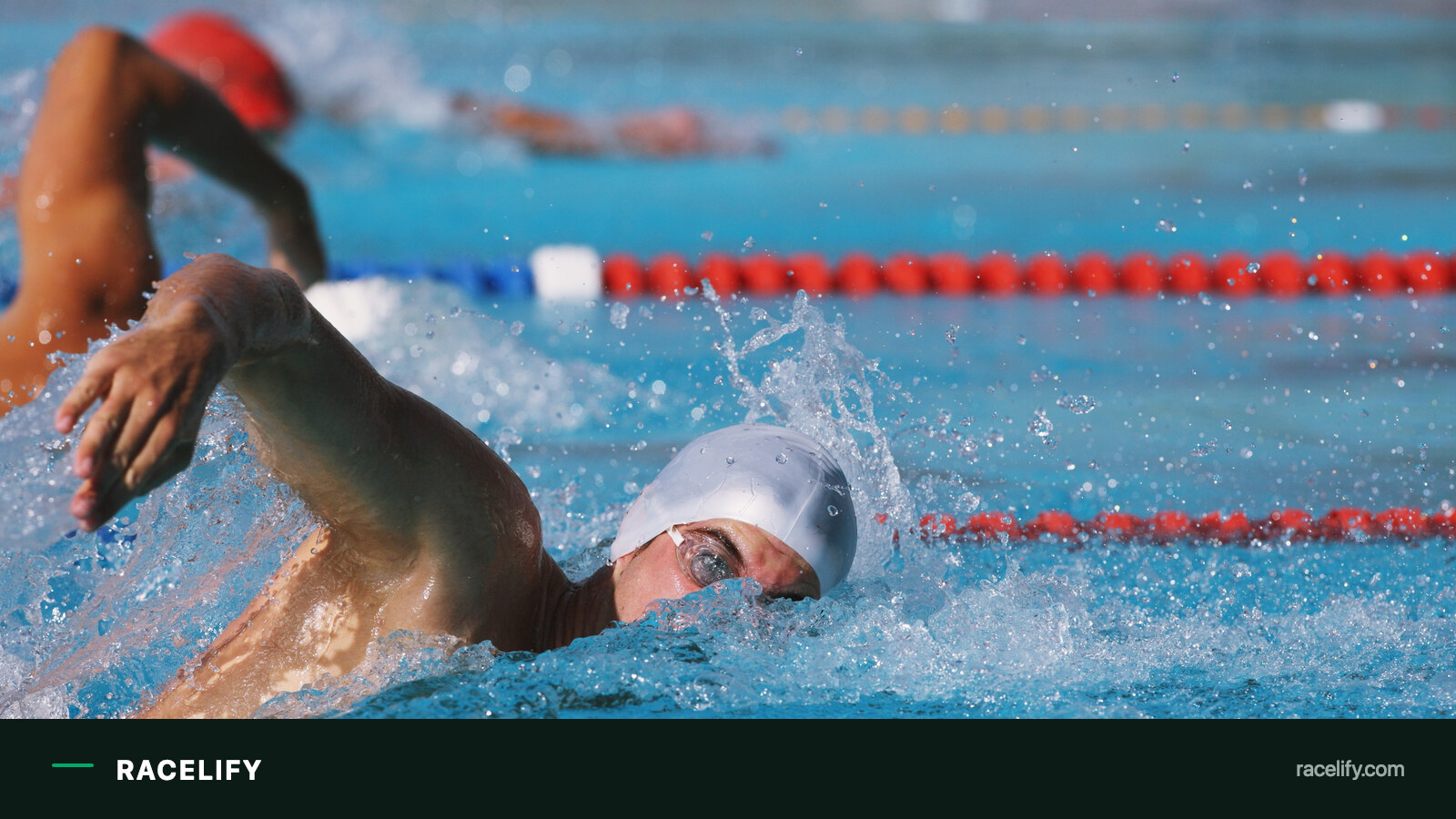
    The watch shows you swam 1500 m in the same time as a year ago, despite training more. The problem is rarely fitness. More often it is how much effort gets wasted every hundred metres. That is why SWOLF is worth knowing.

    What SWOLF is

    SWOLF is short for Swim Golf, and the scoring works exactly like golf: lower is better. Two numbers go into it:

    • time to cover one pool length, in seconds
    • stroke count over the same length

    Add them together. The result is your SWOLF.

    Example: you swim 25 m in 35 seconds with 20 strokes (single-arm cycles). SWOLF is 55. Next time you cover the same 25 m in 33 seconds with 18 strokes: SWOLF is 51. That is a four-point improvement, even if the difference was not obvious to the eye.

    Why it matters for a triathlete

    Runners measure running economy in watts or pace per watt. Cyclists have FTP and TSS. Swimmers mostly measured pace for years, but pace tells you how fast, not how efficient. SWOLF links speed with technique.

    In triathlon, fatigue builds through the swim to the finish. Inefficient technique costs energy that will not come back on the bike. Someone with weaker aerobic fitness but better technique often exits the water almost as fast, and with a noticeably smaller energy deficit.

    How to measure SWOLF

    The simplest way is a sports watch. Garmin, COROS, Suunto and Polar all calculate SWOLF automatically during pool swimming. Start pool swim mode, swim, and the watch counts strokes and time. Once the session ends, there is a SWOLF value per length and an average for the whole workout.

    Without a watch, it can be done by hand: have someone time the swim with a stopwatch and count strokes. One measured session a week is enough to track progress.

    What the numbers mean

    Rough benchmarks for a 25 m pool, freestyle:

    • below 35: elite level, rarely seen among amateurs
    • 35 to 45: very good efficiency, a technically trained amateur
    • 45 to 55: average for regularly training adults
    • above 55: significant technical room, the biggest potential for improvement

    In a 50 m pool the numbers run higher: a result in the 70s over 50 m is very good economy.

    Compare SWOLF against your own numbers, under the same conditions: same pool, similar fatigue. Comparing it against a training partner makes little sense if you have different heights and arm spans.

    The trap: a low SWOLF for the wrong reasons

    SWOLF drops when you swim slower with long strokes, and rises when you thrash through short, fast ones. Neither extreme is ideal. The goal is the right balance of pace and stroke count, not minimising either number at any cost.

    So do not track SWOLF alone. Track it alongside pace. If SWOLF drops by 4 points but pace slows by 5 seconds per 100 m, something has gone wrong.

    How to improve SWOLF: three routes

    1. Increase distance per stroke (DPS)

    DPS, distance per stroke, is how many metres you cover per arm cycle. Longer is better, since it means less work for the same distance. Useful drills: closed-fist drill, single-arm drill, catch-up drill. Each one teaches you to engage the catch before pulling, which produces propulsion for less effort.

    2. Cut frontal drag

    A great pull can still lose energy if the body is not sitting flat in the water. Legs dropping, the hand crossing the midline on entry, lifting the head to breathe: each of these creates drag that raises the number of strokes needed per metre. Footage shot from the side and from underwater often reveals faults that are hard to feel.

    3. Find your optimal stroke rate

    Too slow a stroke rate loses momentum between strokes. Too fast and the strokes get short and inefficient. For triathlon distances of 1.5 km and up, most amateurs settle around 55 to 65 cycles a minute, though it is individual. Rather than copying someone else’s rate, adjust gradually and watch how SWOLF responds at a fixed pace.

    How much you can gain

    Most adult amateur swimmers can improve SWOLF by 5 to 10 points after a few months of consistent technique work. For scale, 10 points in a 25 m pool over an Olympic-distance 1500 m swim means a few hundred fewer strokes, and correspondingly less energy spent, energy that stays available for the bike.

    Start with one measured session a week. Write down the result. Come back in a month and compare.

  • Race Simulation Training: Kill Start-Line Nerves

    Race Simulation Training: Kill Start-Line Nerves

    You’re on the start line. Goggles on for the hundredth time, but the strap never sits the way it does at the pool. The bike: you built it out of the travel box and did a couple of loops round the block, but you’ve never done that in a wet wetsuit, with the PA blaring and a few hundred other athletes around you. A bottle mounted between the aerobars, except how much did you actually drink from that setup in training?

    This is exactly the problem race-simulation training is meant to solve.

    What a Simulation Session Is, and Why It Matters

    A simulation session is a workout where you deliberately recreate the conditions and sequence of race day: the swim exit, T1, the bike, T2, the run. It’s not about covering the full race distance, that’s what your A-race is for. It’s about reprogramming your nervous system so that nothing on race day feels new.

    There are three benefits:

    • You test tactics and pacing before there are real consequences
    • You test gear and nutrition under real conditions, not just in your head
    • You build confidence: you’ve done this before, and you know you can handle it

    When to Schedule a Simulation Session

    The ideal is twice per training block: one session about 8 weeks before the race, a second about 4 weeks before. The first is reconnaissance, you find out what isn’t working and what needs fixing. The second confirms you’re ready.

    What not to do: don’t schedule a simulation the week before the race. You need 5 to 7 days to recover from a session like this, and taper week is not the time for new experiments.

    Structuring a Simulation Session (Olympic Distance)

    Swim: 500 to 750 m

    Instead of just swimming the distance, recreate the effort pattern of the race:

    • 100 m at start pace (the opening metres of a mass start can get chaotic)
    • 200 m at settling pace (moderate effort, finding your rhythm)
    • 100 m hard (simulating a sprint to a buoy or the finish)
    • Short rest, repeat

    One key drill: stripping off your wetsuit. Do it under time pressure, twice, with people watching if you can arrange it.

    Bike: about 30 to 40 km

    A format TrainingPeaks recommends for Olympic distance:

    • 4 x 2 km at race pace-plus (slightly above your target FTP%)
    • 8 km at base pace between intervals
    • No breaks between blocks, ride it continuously, the way you would on race day

    Non-negotiable: eat and drink exactly what you plan to use on race day. Not a simulation of your nutrition, the real thing: the same gel, at the same point on the course, that you’ll use on race day.

    Run: 5 to 10 km

    Run it straight off the bike. That’s the whole point of the exercise.

    • 5 x 1600 m at race pace, with 400 m jog recoveries
    • Run the first 800 m purely by feel, without looking at your watch. Your legs lie about pace after the bike.

    What to watch: how far off your target pace is that first kilometre. If you’re starting too fast, that’s something to fix before race day.

    What to Test During the Simulation

    Some things seem obvious and only fail on race day:

    Goggles. Do new ones slip on a run-in start? If you haven’t been in the water with them 10-plus times, you’re carrying a risk.

    Cleats. Jumping into your shoes with cleats already clipped to the pedals, or putting shoes on standing beside the bike. Do it at least five times before the simulation.

    Race number. How are you fixing it? Pins, elastic, a belt? Does it stay straight through 10 km of running?

    Running cap. Does it stay on during the run.

    The Mental Side: The Invisible Piece

    A simulation session is also a mental exercise. Start the clock, set yourself a race target, and go. Watch what happens in your head once the pace gets hard.

    Feel the pressure? Good, that’s where the learning happens. Every hard 200 metres of a simulation session is a rehearsal for the real race.

    Don’t avoid discomfort in these sessions. You need to learn that you can handle it, and that means being in a hard place at least once before race day.

    Two Sessions per Block

    Eight weeks out: reconnaissance, diagnosing weak points. Four weeks out: confirmation that you’re ready, the sharp point of the season.

    Each session costs 2.5 to 4 hours. In return: a calm start, gear you’ve already tested, and a head that knows it’s done this before.

  • Running in the Heat: How Not to Blow Up on Race Day

    Running in the Heat: How Not to Blow Up on Race Day

    June, 11 a.m., 32°C (90°F), the sun fighting the shaded start of T2. You come off the bike with a plan: hold 5:10 per km. After 800 metres your body says no. By 2 km you’re slowing down. A familiar story.

    The problem isn’t weakness, it’s a bad strategy. Running in the heat follows its own rules, and ignoring them costs minutes, and with bad pacing, costs your health.

    Why Heat Wrecks Your Pace

    Above 28°C (82°F) your body sends more blood to the skin to cool itself. Less blood reaches the muscles. Your heart rate climbs at the same pace you’d hold on a cooler day. This isn’t a motivation problem, it’s physiology.

    Research on heat and endurance performance suggests that every 5°C (9°F) above the optimal starting temperature (roughly 12 to 15°C, 54 to 59°F) can slow an average amateur’s pace by 10 to 20 seconds per kilometre. Over 10 km that’s as much as 1.5 to 3 minutes.

    Strategy: Forget Pace, Run on RPE

    The key mistake on a hot run is fixating on pace from a cool day. In the heat, set a target RPE (rate of perceived exertion) instead of a speed.

    • For an IRONMAN 70.3 in the heat: target RPE 6 to 7/10 for the first 7 km, and let your body pick up the pace only in the final three
    • For a sprint or Olympic-distance race in the heat: RPE 7 to 8/10 for the first 3 km, then see what’s left in your legs

    A Garmin or COROS watch will show your heart rate, which is a better measure of effort on a hot day than pace. A heart rate above lactate threshold in the first two kilometres is close to a guarantee of a blow-up in the closing stages.

    Cooling: Before, During and After

    Before the Run (Pre-Cooling)

    The most effective method: an ice slushie or a cold drink 10 to 15 minutes before T2. Research shows that dropping core temperature by as little as 0.5 to 0.7°C (about 1 to 1.3°F) before the run start translates into noticeably better performance over the opening kilometres.

    Other options: a wet towel on your neck and wrists while you wait for T2, a cold, wet headband.

    During the Run

    At every aid station take water and pour it over your head, neck and wrists, not just drink it. A wet shirt or a cap with a soaked brim noticeably lowers how hot your body feels for a few minutes.

    If organisers hand out sponges, take all of them. Soaked shorts or socks are not a problem, overheating is.

    Hydration and Electrolytes

    General rule: 150 to 250 ml every 15 to 20 minutes in high heat. Water alone isn’t enough, heavy sweating strips sodium and potassium too. Electrolyte tablets or an isotonic drink at aid stations aren’t optional, they’re necessary in races above 25°C (77°F).

    Warning sign: you stop sweating even though your body is hot. That’s a sign of dehydration or heat stroke, get off the course immediately.

    Pacing: The Negative Split in the Heat

    In normal conditions a negative split, the second half faster than the first, is a strategy for advanced athletes. In the heat it should be the default even for amateurs.

    A starting plan for 10 km above 28°C (82°F):

    • km 1 to 3: 15 to 20 seconds per km slower than your target pace
    • km 4 to 7: watch your heart rate, hold RPE steady
    • km 8 to 10: if you have anything left, pick up the pace

    Simple arithmetic: start too fast and you lose 2 to 4 minutes in the second half. Start sensibly and you gain 1 to 2 minutes at the end.

    Heat Adaptation, If You Have Time

    The body adapts to heat training within 10 to 14 days of regular exposure. You don’t need to train through the middle of the day right away, moving a few sessions to the 10 a.m. to 2 p.m. window for two weeks before a hot race is enough. The effect: better thermoregulation, a smaller heart-rate rise in heat, lower perceived effort.

    A 20-minute sauna session after training works too, the same heat-adaptation effect without running in full sun.

  • Mid-Season Volume: How Much Training Do You Really Need?

    Mid-Season Volume: How Much Training Do You Really Need?

    The season is in full swing, and triathlon groups are debating: one athlete trains 15 hours a week and posts it on Strava, another swears four hours is enough. Both are right, and neither is.

    The right training volume depends on your goal, your level and how much recovery you can actually get. But the science points to a few concrete thresholds worth knowing.

    The Minimum That Actually Moves the Needle

    Recommendations from Tri Coaching Finland and TrainingPeaks analysis point to a few tiers:

    4 to 6 hours a week: enough to feel fit and improve your base endurance. A realistic ceiling for someone with a job and a family. Split: one swim, two bike sessions (one longer), two runs. Progress is slow but consistent.

    6 to 9 hours a week: this is where serious sprint and Olympic-distance racing starts. Roughly 75% of volume in zone 2 (aerobic), 25% above threshold. At this level you can compete for decent times at local and regional races.

    10 to 15 hours a week: full-distance ambitions, a half-distance IRONMAN as the season goal. Requires planned recovery and sensible periodisation, or you end up injured in August.

    Zone 2 Is the Foundation, Not the Boring Option

    If you train 8 hours a week and spend 6 of them in zone 3 to 4 (suffering, but not quite hard, not quite easy), you’re doing it wrong. Research consistently confirms that most of your volume should sit in zone 2, conversational pace, where you can talk in full sentences.

    It’s mentally uncomfortable because zone 2 looks too easy. But that’s exactly where mitochondrial density, movement economy and fat-burning capacity get built, and those adaptations move the needle more than another interval session.

    A practical rule: for every hour of intense training, put in at least three hours of aerobic work.

    Why Consistency Beats Intensity

    This is one of the few points where training science agrees across the board: regular, smaller-volume sessions outperform occasional, oversized training blocks.

    Three 45-minute sessions spread evenly through the week beat one 3-hour session once every 10 days, with a much lower risk of injury, illness and burnout. Your muscles, tendons and hormonal system need regular training signals, not sudden overload.

    In practice: if you have less time this week, don’t try to make it up the next. Keep the pattern and shorten the sessions instead.

    When Volume Starts to Hurt

    The trap in the middle of race season is stacking high volume onto a body still tired from racing. After every race you need 1 to 2 days of easy training for every 10 km of running distance covered (a rough rule of thumb). After an IRONMAN 70.3, a minimum of a week of lighter training before you start building volume again.

    Signs you’re training too much: resting heart rate rising more than 5 to 7 beats per minute above normal, HRV clearly below your baseline, worse sleep quality, chronic leg fatigue that persists after three days. A watch with HRV monitoring (Garmin, COROS, Polar) helps you catch these signals earlier.

    What 7 to 8 Hours a Week Looks Like in Practice

    A sample week’s skeleton in the middle of an Olympic-distance season:

    • Monday: rest or 30 minutes of mobility work
    • Tuesday: 45-minute threshold run (1 x 20 minutes in zone 3 to 4)
    • Wednesday: 45 to 60-minute swim (technique plus 2 x 400 m at threshold)
    • Thursday: 60 to 75-minute bike (zone 2, steady rhythm)
    • Friday: rest or a short 30-minute zone 1 run
    • Saturday: long bike, 2 to 2.5 hours, zone 2
    • Sunday: brick session, 45-minute bike plus 20-minute run off the bike

    Total: about 7.5 hours. There’s no room here for heroic sessions, just a plan.

  • Garmin Instinct 3 AMOLED Review: A Triathlon Watch

    Garmin Instinct 3 AMOLED Review: A Triathlon Watch

    The Instinct 3 is for anyone who wants a Garmin with a proper AMOLED screen without paying Fenix 8 money, and without worrying that a crash on the bike will kill the watch. Military-grade durability, automatic T1/T2 transitions and Training Readiness, at $449.99 in the US for the 45mm AMOLED model. The question is what here is genuinely good, and what is a compromise.

    What is new in version 3

    The Instinct 3 gets an AMOLED screen, and it is a change you feel. Previous generations had a matte MIP panel at 176×176 px. The new 45mm version serves up 416×416 px on a 1.2-inch display. Colour, contrast and readability on data screens are not even comparable to the old version.

    It also gains a built-in LED flashlight at the top of the case. It sounds like a gimmick, but it is genuinely useful when carrying gear across a dark transition zone before sunrise.

    New too is Training Readiness, a feature Garmin has finally brought to the Instinct line. It analyses sleep, HRV, training load and recovery to tell you, plainly, each morning whether you can push hard or should back off.

    How it works for triathlon

    Automatic T1/T2 transitions work straight out of the box. Start a triathlon profile and the watch detects the switch from swim to bike to run without you touching anything. It also supports duathlon and multisport.

    Training data on offer at the start line: VO2max, heart rate zones, training effect, training load, race time prediction, interval training with custom sessions, and training plans through Connect IQ. Pool and open-water swimming both get full support.

    What is missing: map navigation. The Instinct has GPS but no tile maps. Anyone riding new routes and needing a map should look at the Fenix or Epix instead.

    A touchscreen? Not on the AMOLED version. That is a deliberate trade-off from Garmin, for battery life and durability, but it is worth knowing before buying.

    Battery: which one to pick

    The Instinct 3 comes in four variants: AMOLED 45mm, AMOLED 50mm, Solar 45mm and Solar 50mm. For a triathlete that is an important decision.

    AMOLED 45mm: up to 18 days in battery-saver watch mode, or around 7 days with always-on display, and about 23 hours of multiband GPS, more than enough for a full IRONMAN.

    Solar 45mm: up to 40 days standby with regular sun exposure, effectively indefinite at around three hours of sunlight a day, but with the MIP screen and its lower resolution.

    For a triathlete racing through a full season and training regularly, the AMOLED makes more sense: the training data is simply easier to read during intervals and on the bike.

    Price and where to buy it

    Garmin lists the Instinct 3 AMOLED 45mm at $449.99 in the US. The 50mm version is $499.99. Both prices are Garmin’s own suggested retail; discounts at other retailers can bring the AMOLED 45mm well below that figure.

    For comparison, the Garmin Forerunner 965 (full maps, AMOLED, triathlon profile) runs $599.99 in the US. The Instinct 3 is therefore a solid option for anyone who wants a Garmin with AMOLED and a triathlon mode without spending a fortune and without needing maps.

    Verdict

    The Instinct 3 AMOLED is an honest triathlon watch for an athlete who:

    • trains regularly and wants Training Readiness plus automatic transitions,
    • prefers a mechanically tough watch (MIL-STD-810 rated for shock and temperature, 10 ATM / 100 m water resistance),
    • does not need maps or a touchscreen,
    • does not want to overpay for a Fenix 8.

    If navigation is the priority, look elsewhere. If training and durability are the priority, the Instinct 3 AMOLED is a solid choice at a reasonable price.

  • What to Eat on Triathlon Race Morning

    What to Eat on Triathlon Race Morning

    Months of training are behind you, the taper is done, the gear is ready. Then at 5:30am you are standing in front of the fridge, unsure whether it is porridge or toast, a banana or nothing, or whether there is even time left to eat. Bad food decisions on race morning have wrecked better preparation than the worst training block ever could. Here is how to avoid that.

    When to get up and when to eat

    The core rule: breakfast 2 to 3 hours before the start. For an early race (6:00 to 7:00am) that means an alarm at 3:30 to 4:00am. Uncomfortable, but necessary. Eating 60 minutes before the gun is asking for stomach trouble in the water.

    If the start is after 9:00am, there is the luxury of a normal morning routine.

    Meal size: 1 to 4 g of carbohydrate per kilogram of body weight, depending on distance. Sprint or Olympic distance sits closer to 1 to 2 g/kg. A 70.3 or full Ironman needs 3 to 4 g/kg, because glycogen stores have to last far longer.

    At a body weight of 70 kg racing Olympic distance, that works out to around 70 to 140 g of carbohydrate. A large bowl of porridge with banana and a spoon of honey lands in that range without any trouble.

    What to actually eat

    Tested options that will not let you down:

    • Porridge with banana and honey. A classic that works. Digestion is predictable, carbohydrate is high, fat is low.
    • White toast with jam or honey. Easy to digest and quick to absorb. Two to three slices is fine.
    • Bagel with jam. Popular among professionals. White flour, minimal fibre, plenty of starch.
    • White rice with banana. Sounds odd, but plenty of Ironman athletes use it, especially those prone to stomach trouble.
    • Gel or an isotonic drink as a top-up. If breakfast was three hours earlier, a gel or a banana 30 minutes before the start works well (one gel is roughly 20 to 25 g of carbohydrate).

    What to avoid, and why

    Fibre: wholegrain cereal, flaxseed, chia seeds, raw vegetables. Everything that is healthy day to day can force an unplanned toilet stop on the course before a race.

    Fat: scrambled eggs with bacon, or avocado on toast, digest too slowly. Fat slows gastric emptying, and it can leave a heavy feeling through the whole bike leg.

    New products: race day is the worst time to experiment. A new brand of energy bar bought at the expo on the way to registration should wait until after the finish.

    High-fat dairy: Greek yoghurt or kefir can bring unpleasant surprises. Anyone who tolerates milk fine can still have it, but sparingly.

    The evening before

    There is room to get this right or to get it wrong here too. The dinner the night before should be carbohydrate-rich, pasta, rice, potatoes, with a moderate amount of protein and without excess fibre. Real carb loading starts 36 to 48 hours before the start, so the pre-race dinner finishes the process rather than starting it.

    Avoid new restaurants and heavily spiced ethnic food. Not because the food is bad, but because the stomach deserves a quiet night.

    30 minutes before the start

    With time in the race zone and 30 minutes to go, an energy gel with 150 to 200 ml of water, or a banana muffin from a nearby café, both work. The goal is a small carbohydrate top-up that will not sit heavy on the stomach.

    Avoid a large dose of caffeine at this point if it is not something the body is used to. But for anyone who drinks coffee regularly and uses caffeine as part of training, around 200 mg roughly 60 minutes before the start can genuinely help. Research backs this up.

    One rule above all the others

    Everything eaten on race day is worth testing beforehand, at least once, during a longer training session. No guide can replace knowing your own stomach. The body has memory and its own preferences. Train nutrition the same way swimming, riding and running get trained.

  • Supertri Jersey Final: Yee Meets Wilde

    Supertri Jersey Final: Yee Meets Wilde

    On Sunday 6 September the island of Jersey hands out the largest single day prize purse in triathlon history, $800,000. And only there, in a season running since January, do Alex Yee and Hayden Wilde finally line up against each other for the first time.

    Where, when, how much

    The race takes place at Elizabeth Marina in St Helier, the capital of Jersey. The women start at 14:10 British time (15:10 CEST), the men an hour and ten minutes later at 15:20 (16:20 CEST). Coverage is free on the Supertri YouTube channel and on TriathlonLive.tv.

    The $800,000 purse splits evenly between women and men, $400,000 per category. The winner takes $100,000, second place $75,000, third $60,000. The money goes all the way down to tenth, which is rare even in World Triathlon or on T100.

    The Enduro format: six transitions in one race

    The Supertri Final is run in the Enduro format, three identical consecutive stages. Each is a 300 m swim, a 4 km bike and a 1.6 km run. In total an athlete covers 900 m in the water, 12 km on the bike and 4.8 km on foot, with six transitions.

    On top of that comes the 90 second rule: anyone losing more than a minute and a half to the leaders is pulled from the race before the next stage. The strongest riders can also earn Short Chutes, a shortened run course on the final stage as a reward for riding well earlier. It is a format where one mistake in transition costs the whole race, not just a few seconds.

    Yee against Wilde, at last

    Alex Yee, the Olympic champion from Paris, and Hayden Wilde have not raced each other in 2026. The New Zealander has been his most consistent rival over recent seasons. Add Matt Hauser, the Australian defending the WTCS world title. Three athletes who in another setup would be fighting for medals on the same finish line meet here for the first time this season, over a distance where every transition counts.

    In the women’s race Cassandre Beaugrand has won all four WTCS races in 2026, the full set. Jersey is a chance to add the richest start of the season to that. Facing her are Georgia Taylor-Brown and the defending Supertri champion Jeanne Lehair of Luxembourg, who knows this format better than anyone else in the field.

    The Enduro format rewards different things than classic Olympic distance racing. Fast exits from the water, aggressive riding from the first metre and a head that holds up through six transitions under the clock. Beaugrand has won in WTCS on the strength of the whole package; here one weak transition from a rival can be the margin.

    Hauser is racing for more than a cheque

    For Hauser, Jersey is not only a payday. The Australian, defending the WTCS world title, deliberately skipped the race in Karlovy Vary to prepare calmly for the season final in Pontevedra. He filled that gap in the calendar with the Supertri start instead. He said himself that he wants to “turn up the speed a bit” in Jersey before the decisive race. Meanwhile his main rival in the WTCS standings, Vasco Vilaça, leads with 3850 points against Hauser’s 3495.76. The Portuguese will race Karlovy Vary without him, so the gap could grow further before Pontevedra. Hauser’s tenth place in Weihai, after a crash on the bike, only raises the stakes here. Jersey is the last form check before the biggest race of the year.

  • Wahoo KICKR Core 2 Review: Wi-Fi and Zwift Cog for $399

    Wahoo KICKR Core 2 Review: Wi-Fi and Zwift Cog for $399

    The Wahoo KICKR Core 2 is the first mid-range trainer where Wahoo seems to have understood that the mid-tier does not have to be a stripped-down version of the flagship. Starting price is $399 / €399 / £399. At that price you get Wi-Fi as standard, a Zwift Cog with Click v2 included, and 10Hz Race Mode: features that a year ago were not even on the $800 KICKR V6.

    This is the biggest overhaul of the Core since the original launched in 2018.

    What changed

    Wi-Fi as standard. Until now, Wi-Fi was reserved for the KICKR V6 and KICKR Move, trainers north of $1,000. Now it comes in the Core for $399. Wi-Fi means more stable pairing with the app, automatic firmware updates and faster syncing with other devices.

    Zwift Cog and Click v2 in the box. The Cog is a cassette-replacement cog compatible with almost any 8 to 12-speed bike, no cassette swap required. Click v2 is a new remote with two double buttons for shifting virtual gears in Zwift. Wahoo gives a choice: the version with Cog and Click, or a classic 11-speed Shimano cassette.

    Race Mode. New for this generation; the original Core did not have it. Race Mode raises the frequency of power-data transmission from 1Hz to 10Hz over Wi-Fi. In practice, the app sees your watts with ten times less lag. In the critical moments of a virtual race, an attack on a climb, a counterattack on a descent, that is the difference between success and getting dropped from the front group. It is the exact same 10Hz Race Mode found on the flagship KICKR V6.

    Other additions: a Sensor Hub (a Bluetooth bridge for connecting sensors to the app), encrypted Bluetooth pairing (compliant with EU standards), redesigned flat legs for better stability and easier setup, and status LEDs showing connection and Wi-Fi status.

    Technical specifications

    SpecWahoo KICKR Core 2
    Maximum power1,800 W
    Maximum simulated incline16%
    Claimed accuracy+/-2%
    Weight13.6 kg
    ConnectivityWi-Fi, ANT+, Bluetooth
    Powermains
    Typedirect drive

    1,800 W of maximum power is a figure the typical age-grouper will never touch. 16% incline covers most simulated climbs on Zwift; Alpe du Zwift tops out at 14%.

    Who it’s for

    A trainer for the age-grouper who:

    • wants to race on Zwift and needs a fast, responsive trainer (Race Mode)
    • does not want to buy a bigger toy every year, but is tired of trainers without Wi-Fi
    • already has a triathlon or road bike and wants to stay with direct drive
    • trains 10 to 15 hours a week, more than an occasional session, less than a professional power database

    Not a trainer for:

    • someone who wants an integrated Zwift Ride plus trainer setup, a separate package that runs roughly $800 to $1,050 more
    • someone who already has a KICKR V6 or Move, where the difference is not worth the upgrade
    • a casual rider who opens Zwift once a month, for whom an older Core still on the secondhand market for about $320 to $400 will do

    The competition: what to pick instead

    Zwift Hub One ($599 in the US, £549 in the UK, with a year of Zwift included) is the closest rival. On the plus side, it also includes a Zwift Cog and identical virtual shifting. On the downside, no Race Mode, no Wi-Fi, and a narrower app ecosystem than Wahoo. The bundled Zwift subscription helps first-timers, but priced against the trainer alone, the Core 2 comes out cheaper.

    Tacx Flux S ($749.99 in the US) has no Wi-Fi, weaker claimed accuracy (+/-3%) and a lower maximum power ceiling. It suits riders who do not need the top-end features.

    Saris H4 ($999.99 in the US) costs more and is very durable, but does not have Wi-Fi as standard. That is exactly where Wahoo sets itself apart.

    Summary

    The Wahoo KICKR Core 2 is the best direct-drive trainer in its price bracket for 2026. Wi-Fi as standard, 10Hz Race Mode and a Zwift Cog in the box are a combination nobody else offers at this price. Wahoo has understood that winning over the age-grouper takes real features, not marketing polish.

    Is it a KICKR V6 killer? Not quite: the V6 runs quieter and has a better road feel. But for 80% of triathletes, the Core 2 is enough. Buying a first serious trainer: buy this one. Upgrading from an older Core: weigh whether Wi-Fi and Race Mode are worth $399. For Zwift racing, yes. For zone 2 aerobic base work, not necessarily.

  • Nice 70.3 Worlds: Col de Vence Decides It

    Nice 70.3 Worlds: Col de Vence Decides It

    Two weeks out, and a course that does not forgive. Nice hosts the IRONMAN 70.3 world championship on 12 and 13 September. The women race on Saturday, the men on Sunday, both fields off at 7:00 local time. The start lists carry 72 men and 78 women, and in the middle of the bike course stands the Col de Vence, which will settle the whole thing.

    Geens has a shot at something nobody has done

    Jelle Geens has started the 70.3 world championship twice and won twice: Taupō in 2024 and Marbella in 2025. A third title from three starts would be something no man has managed, according to Triathlon Magazine.

    His full-distance season, though, was a write-off. A DNF in Texas, then an injury that ruled him out of Lake Placid. So the Belgian returns to the distance nobody has beaten him over, after a year in which very little worked. That is a more interesting setup than a straight title defence.

    Behind him stands Kristian Blummenfelt, who lost by a few strides in Marbella. In Geelong he ran down Geens and Hayden Wilde after both had ridden away from him. The general view is that whoever beats Blummenfelt wins the race. Geens happens to know how that is done.

    Three former champions and one New Zealander

    The full set of previous world champions is on the line: Rico Bogen (2023), Kristian Blummenfelt (2022) and Gustav Iden (2019 and 2021). Add Marten Van Riel, the 2024 T100 world champion, who also won last year’s IRONMAN 70.3 Nice and therefore knows this course from inside a race. And there is Casper Stornes, the reigning IRONMAN world champion.

    The most interesting name is Hayden Wilde. He skipped last year’s 70.3 championship after finishing second in 2024, and since then he has dominated the T100 distance. He comes back to a format he has already stood on the podium in, in very different shape.

    The Americans have waited since 2007

    The only American ever to win the men’s 70.3 world championship is Andy Potts, in Clearwater in 2007. Nothing since.

    This year’s squad is their best chance in a long time. It is led by Sam Long, second behind Iden in 2021, who has not finished outside the top five over this distance since 2023. Alongside him are Trevor Foley, Jason West and Morgan Pearson.

    Three world champions on one women’s start line

    Defending champion Lucy Charles-Barclay has withdrawn to put everything into Kona, so the title is open. Taylor Knibb heads the field instead, three times 70.3 world champion in 2022, 2023 and 2024. Knibb was second last year and won the T100 world title in 2024, but she has never raced the Nice course.

    This is not a one-woman contest. Solveig Løvseth arrives as the reigning IRONMAN world champion, Laura Philipp as the 2024 champion, and Kat Matthews as the defending Pro Series winner. Three athletes with a world title behind them and one who has won the Pro Series. That start list is rare.

    Beyond those four there are two more nobody sensible writes off. Alanis Siffert has won four of six starts this season, among them Challenge Roth ahead of Matthews and Charles-Barclay, plus a third straight win at the Alpe d’Huez triathlon. Paula Findlay won her full-distance debut in Lake Placid last month, and over the last two seasons she has won five of the eight half-distance races she has started.

    There is a local angle too. Marjolaine Pierré lives in Nice, won 70.3 Aix-en-Provence and was second in Jönköping. In Hamburg she set the pace before Løvseth and Philipp came past her, finishing fourth. The shorter distance should suit her better.

    Col de Vence answers every question

    The course is a 1.9 km swim in the Baie des Anges, 90 km on the bike with about 1190 m of climbing, and a flat half marathon. On paper a classic mountain course, but the detail sits in how that climbing is distributed.

    The climb starts at around 26.6 kilometres and runs for 9.7 km at an average of 6.6%, for 633 m of ascent. Individual ramps go past 12%. Before that, at the 10th kilometre, comes the exit out of St-Laurent-du-Var with sections up to 13%.

    The key tactical fact is this: past Coursegoules, at the 44th kilometre, the climbing is over. Less than 90 m of ascent is left across the remaining 46 km. What the course does serve up instead are two technical descents: 2 km with four hairpins from the 47th kilometre, and 11 km back into Nice from the 64th.

    Anyone who overcooks the Col de Vence spends the rest of the bike paying it back. Then comes a flat half marathon with nowhere to hide. That favours athletes with a sensible power-to-weight ratio and a strong run, and works against time-trial specialists.

    Worth knowing as well: at the regular IRONMAN 70.3 Nice, part of the field chooses a road bike with clip-on bars over a time-trial bike. The profile is rolling enough for that to make sense.

    The pick

    In the men’s race, Geens takes a third title, but not by riding away from anyone. The last 5 km of the run decide it, with Blummenfelt a handful of seconds back. In the women’s race the pick is Siffert. The form from Roth and Alpe d’Huez is no accident, and the course profile suits her better than it suits anyone else on the start list. Knibb second.