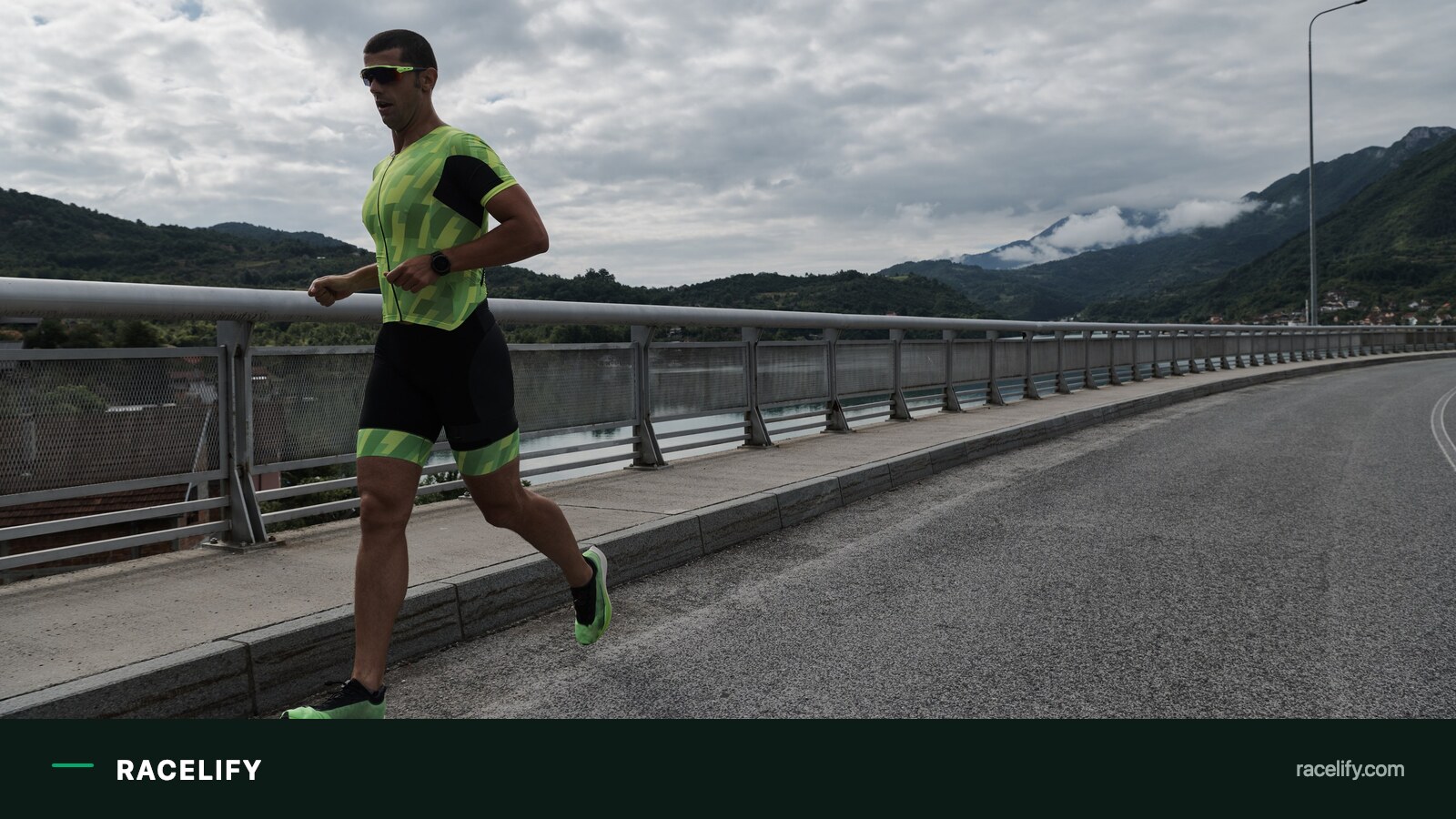
You get off the bike, take the first few steps and it feels as though someone has swapped your legs for two blocks of concrete. It is neither an injury nor a lack of fitness, but the body’s natural reaction to moving from riding to running. Brick training teaches the body to make that shock last seconds instead of kilometres.
Where heavy legs come from
Cycling and running use the same muscles in a different movement pattern. On the bike you work seated, with a limited range at the hip and no flight phase. Running demands full hip extension, shock absorption and push-off, movements you have not performed at all for the past few hours.
Then there is the quadriceps. On the bike it works in a shortened position, and moments later it has to lengthen with every running stride. That is where the stiffness and the lost control over pace come from when you start to run.
The mechanics are not the only thing that changes. Blood flow is different, muscle fibre recruitment is different, and so are the neuromuscular patterns. The body has to switch to a new movement pattern within seconds.
This is not a subjective impression. The review by Millet and Vleck published in the British Journal of Sports Medicine in 2000 sets out exactly what shifts: stride length shortens, stride frequency drops, and the torso leans further forward. The authors also recorded a fall in running economy of around 8% after coming off the bike.
Regular brick sessions accustom the neuromuscular system to that switch. The settling-in period at the start of the run gets shorter, pace becomes steadier, and the risk of the first kilometre wrecking the whole result drops noticeably.
What a brick actually gives you
- Neuromuscular coordination. Regular bricks teach the body to return to normal running mechanics faster, particularly in the first 2 to 10 minutes. That is where most of the time goes.
- A fuelling strategy. A brick is the chance to test what to eat on the bike and when, so the run does not start with an empty glycogen tank.
- Realistic run pace off the bike. Heart rate at the start of the run after a long, hard ride will be higher than in a standalone run. A brick shows what pace you can actually hold instead of leaving it to guesswork on race day.
- Mental resilience. Knowing the concrete-legs feeling from training takes the surprise out of it in a race.
How often to run off the bike
Frequency depends on the target distance and the phase of the season.
- Base, 12 weeks or more out: one easy brick a week. The priority is general endurance, not race simulation.
- Build, 6 to 12 weeks out: one or two bricks a week. One steady, one with race-pace segments.
- Peak, 3 to 6 weeks out: one brick a week, with growing emphasis on race pace.
For an age-grouper training 8 to 15 hours a week, one to two bricks a week is a sensible upper limit. More than that means running on tired legs so often that form falls apart and injury risk climbs.
Sessions by distance
Your first ever brick. Bike: 10 minutes in zone 1 to 2, then 15 minutes in zone 2 to 3 at a cadence above 85 rpm, finishing with 5 minutes in zone 3. Transition under 60 seconds. Run: 10 minutes in zone 2, easy.
Sprint and Olympic distance. The priority here is the speed of the switch, not volume. Ride 45 minutes with three or four 2-minute accelerations at race pace, then straight off the bike into 15 to 20 minutes of running. Run the first 5 minutes faster than target pace to get the legs used to the discomfort, then hold race pace.
70.3. Here it is about holding race pace on tired legs. Bike 3 x 15 minutes at target power or heart rate, with 5 minutes recovery. Then run 3 x 1.6 km (a mile) at race pace, with 3 minutes of jogging between reps.
Full distance. In the build phase, go for longer and steadier transitions: 2 to 3 hours on the bike at long-course pace, then 30 to 60 minutes of easy running. In the peak phase, add race-specific segments, meaning 60 to 90 minutes of running at race pace after riding at 70 to 75% of FTP.
Three tricks for an easier transition
- Change gear before you get off. Over the last 400 to 800 metres drop into an easier gear and lift the cadence. That loosens the muscles instead of leaving them acidic in a big gear.
- Run through transition, do not walk. Even when the legs protest, walking through transition builds the wrong habit.
- Shorten the stride at the start of the run. Run the first 800 m to 1.6 km with a shorter stride and controlled pace until coordination settles. Forcing target pace from the first step usually ends in going out too hard.
The most common mistakes
Too much, too often. A brick every day, or three times a week, does not speed up adaptation. It speeds up injuries. One solid session a week works better than three mediocre ones.
No pause in transition at all. In training you can afford a minute or two to change shoes and drink. This is not a race. Practise the transition itself separately, dry.
Skipping the first minutes of the run. Those first 5 to 10 minutes teach something no other session does: pace control while the legs are screaming to slow down. Do not cut that part short.
When to put bricks in the plan
Coaches usually introduce regular bricks 12 to 16 weeks before the first race of the season. If the bike to run switch is a weak point, short bricks can stay in the plan all year.
Start simple. If you have never done a brick, running 1.6 km (a mile) straight after an ordinary bike session is enough. From there, build the distance and intensity of the run week by week until it approaches the demands of the target race.
Add volume gradually. This is still extra load on the body, and the risk of overreaching climbs faster here than in a single discipline.
The next piece of the same puzzle is Downhill Running: How Eccentric Training Protects Your Legs. When the training is ready for a start line, Racelify lists triathlons worldwide.