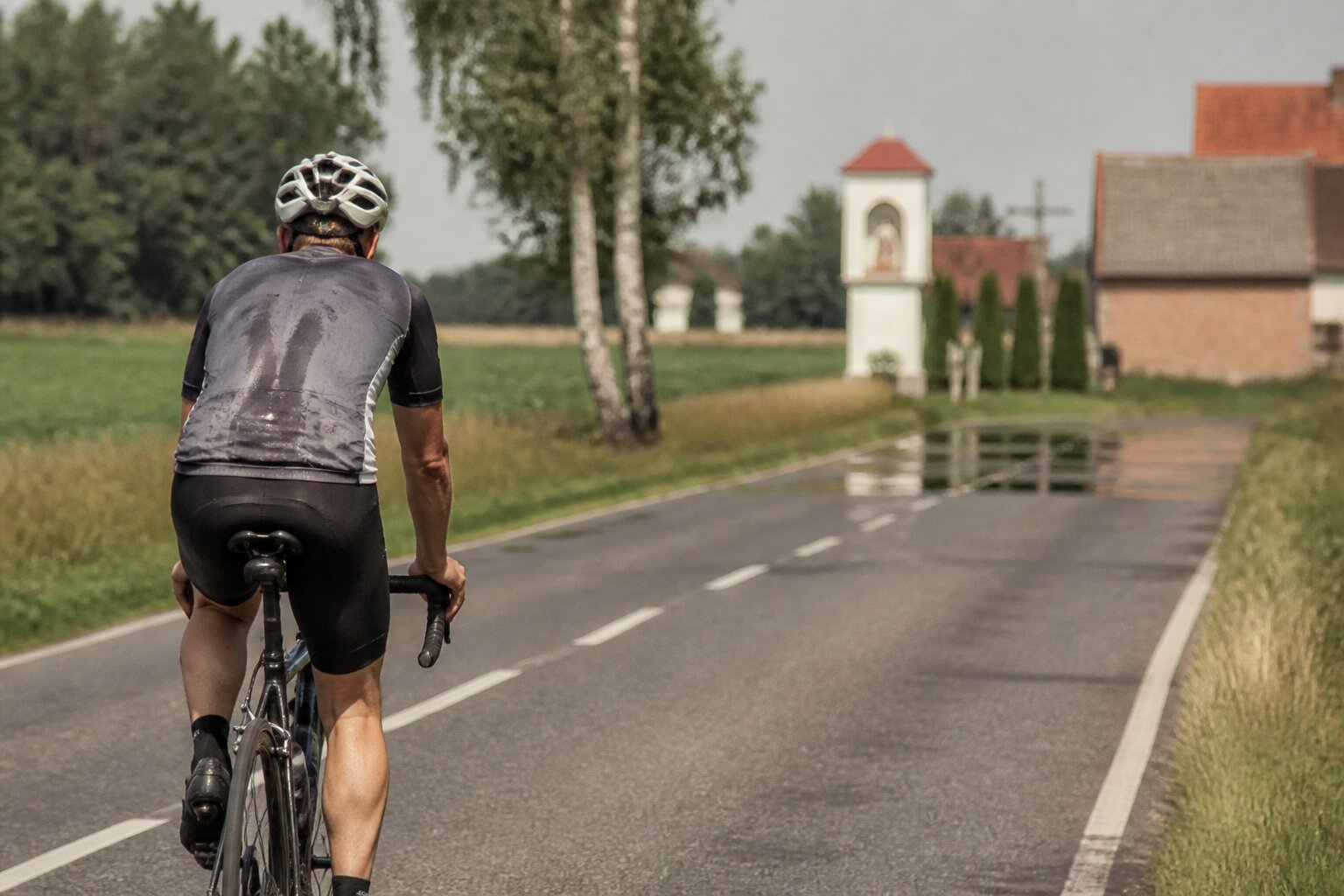
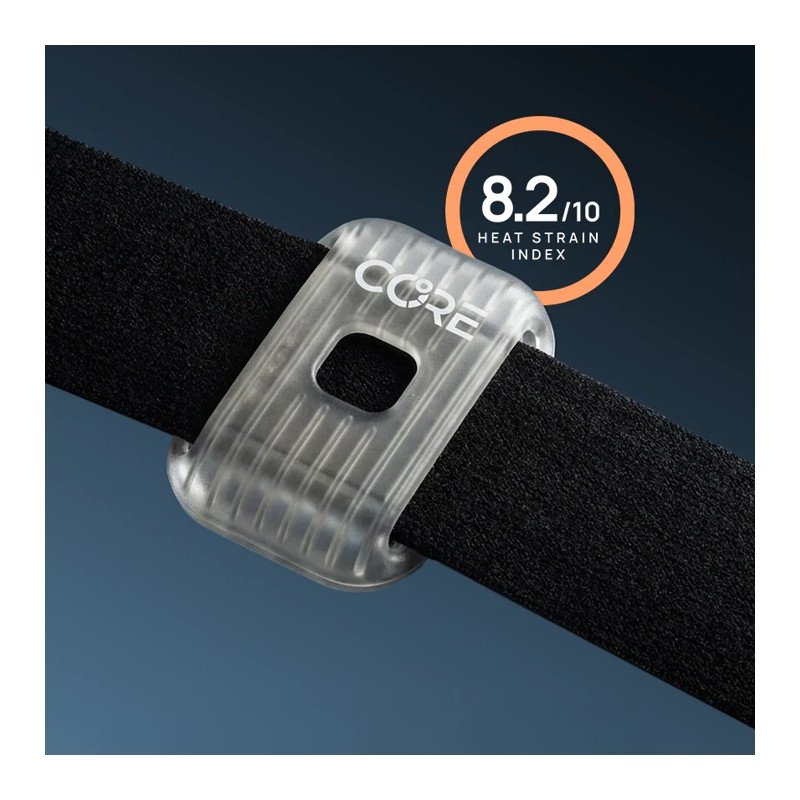
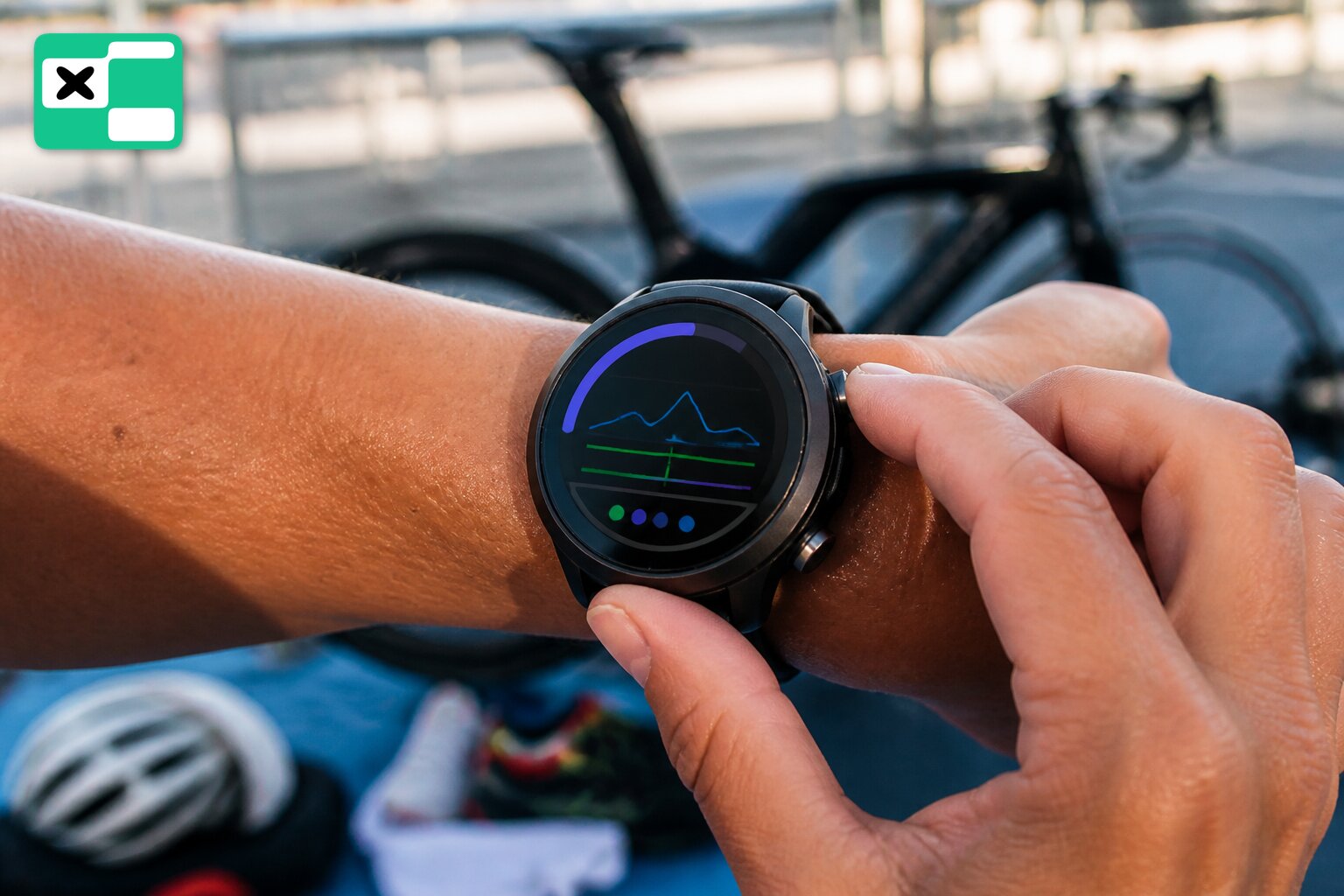
In summer, your power doesn’t drop because “you’re having an off day.” It drops because core body temperature crosses the threshold where the body starts protecting itself. CORE 2 is a sensor that shows that temperature in real time, turning heat acclimation from guesswork into a controlled training input.
What it actually measures, and how
CORE doesn’t insert a thermometer inside you. You wear the sensor on a heart rate strap or stuck to your chest, and it calculates core temperature from heat flow through the skin (thermal energy transfer technology from Swiss company greenTEG) plus an algorithm trained on large measurement datasets. It’s an estimate, not an invasive measurement, but the manufacturer states an accuracy confirmed by studies (average difference in the range of -0.01°C to +0.23°C) and validation for running and cycling.
The second generation is simply more comfortable: 48% smaller and 30% lighter than the original CORE. It moves around less, and you notice it less. Data reaches your watch or bike computer over Bluetooth and ANT+, and the sensor works with Garmin, Wahoo, COROS and Suunto, plus Apple Watch and Wear OS (and, on the computer side, Hammerhead too). In practice, that’s whatever is already on your wrist or handlebars.
What core temperature is for, if you’re a triathlete
Two concrete uses.
First: safe pacing in the heat. As core temperature climbs toward around 39°C (102°F), performance drops sharply and the risk of overheating rises. CORE shows you when to back off before you cook yourself on a 70.3 course at midday in July. That’s the difference between a strong run and a march from aid station to aid station.
Second, and more interesting: heat acclimation as training. Deliberately raising core temperature and holding it in an “acclimation zone” for several days to a couple of weeks produces adaptations similar to altitude training: increased plasma volume and haemoglobin mass. In a classic study by Lorenzo and colleagues (Journal of Applied Physiology, 2010), ten days of heat acclimation improved cyclists’ time trial performance by about 8%, in both heat and cool conditions. CORE turns that protocol into a numbers game: you can see whether you’re actually in the zone, instead of guessing from how much you’re sweating.
Is it worth it, and for whom
To be honest, this isn’t essential kit. If you’re struggling to fit in three sessions a week, don’t buy a temperature sensor, buy consistency instead. CORE 2 makes sense once you’re preparing for a start in a hot climate (Lanzarote, Nice, any IRONMAN in July) or when you treat heat acclimation as a real performance lever rather than a curiosity.
The price cools the enthusiasm: 269.95 CHF (about 285 EUR) from the official store. Authorised resellers list it at much the same price. That’s the cost of a decent watch, for one narrow function.
Verdict: a great tool for a very specific job. If your season centres on hot summer races and you want to approach acclimation deliberately, CORE 2 gives you numbers heart rate alone won’t show you. For most amateurs, though, it’s a “later, once everything else is dialled in” gadget.
A triathlon run does not fail in the legs, it fails in the stomach. Most amateurs who fade in the final kilometres are not undertrained. They are running low on fuel, because they ate too little through the whole bike leg. The bike is the dining table. The only question is how much actually fits in an hour.
The numbers to start from
The longer the race, the more carbohydrate per hour it takes. Short efforts need roughly 30 to 60 g/h. Very long races need more. Specifically for triathlon:
70.3 (half distance): about 60 to 90 g/h
Full IRONMAN: about 90 to 120 g/h
Most of that dose gets taken on the bike. It is the calmest discipline, the one where the stomach tolerates food best. Everything bounces around on the run and absorption drops, so the bike is the moment to fill the tank completely.
Why glucose alone is not enough
This is where the physiology explains the rest. The gut absorbs glucose through a specific transport channel that has a ceiling, around 60 g/h. Anything above that sits in the stomach, ferments, and ends in cramps or a stop in the bushes. That is why 60 g/h was treated as the physical limit for years.
The breakthrough was a second channel: fructose absorbs through a separate route. Combining glucose with fructose bypasses the bottleneck and lets the body oxidise significantly more carbohydrate per hour. A 2:1 ratio of glucose to fructose was the historical standard; newer products lean toward 1:0.8. That is why modern gels and drinks list both sugars on the label. It is not marketing, it is gut throughput.
Individual tolerance: do not copy the pros
Before aiming for 120 g/h because that is what a champion does, remember the gut is not the same from person to person. The differences are large: some athletes do not absorb much more than 55 g/h, others handle 120 g/h or more over many hours of racing.
Which is why dosing should never be guessed on race day. It is set in training, gram by gram. The goal is the highest dose the stomach tolerates without revolt, not the highest number from a table online.
How to train the gut
The good news: gut throughput is a trainable trait, just like FTP. The bad news: it has to be trained deliberately, not left to chance on race day.
The method is simple. Pick long bike rides and treat them as a dress rehearsal for nutrition. Start from a dose already familiar, say 60 g/h, and add 10 to 15 g/h every few weeks. Train on the same gels and drinks planned for race day, since the stomach prefers what it already knows. After every ride, note what and how much was eaten and how the stomach reacted. After a few weeks, there is a proven personal strategy instead of a guess.
More fuel during the ride means less glycogen burned, which means more left for the final run, right when the competition is already slowing down.
The most common amateur mistake
It is not the wrong product or the wrong sugar ratio. It is simply eating too little, too late. The first gel should not wait for hunger or a drop in power, by then it is already too late and the energy deficit is building. Fuel from the first minutes of the bike leg, in a steady, regular rhythm, before the tank runs dry.
The marathon at the end of an IRONMAN does not forgive. You can have a great FTP and swim like a fish, but if your legs do not know a long run, the final 20 kilometres turn into a march. The long run is the foundation of run preparation for the full distance, and most amateurs get it wrong in one of two ways: too rarely, or too long. Both mistakes cost you.
Why run long at all
The long run builds what no shorter session can fake: leg resilience for a marathon after 180 km on the bike. It does more than build fitness: a long run develops the aerobic base, forces mitochondrial development in the muscles, and teaches the body to manage energy over many hours.
There is no shortcut. No series of fast intervals replaces what one solid long session delivers, because the adaptation only comes after many kilometres on tired legs.
What “long” actually means
In concrete terms: in full-distance IRONMAN preparation, long runs usually fall in the 2.5 to 3.5 hour range, and the longest single session is about 3 hours. Many coaches plan two to three runs of 2 hours 15 minutes to 2.5 hours at the peak of the season.
Note the measure: this is about time, not distance. For a slower age-grouper, 3 hours covers different ground than it does for someone near the front of the field, which is exactly why the clock matters and the kilometre marker does not. Your legs do not know how far you ran. They know how long they worked.
Why 3 hours is the ceiling
Here is the most common mistake ambitious amateurs make: if the marathon will take 4 hours, they think they need to run 4 hours in training. You do not. And you should not.
If you are planning to run the marathon in 4 hours or more, a training run beyond 3 hours usually ends in muscle damage that costs more in recovery than it delivers in adaptation. Put plainly: for the following days you are so beaten up that you lose more good sessions than you gained from one mega-run. Some coaching schools go further and cap long runs at 2.5 hours.
The ceiling is not laziness. It comes down to balance: past a certain point, injury risk and recovery cost grow faster than the adaptation.
How often to do it
The long run is not a once-in-a-while session. In the final months before race day, do it on three weeks out of four, with the fourth week lighter, for recovery and supercompensation. That rhythm gives a regular stimulus while still letting the body strengthen instead of just sliding under fatigue.
Do not “jog” for three hours
The single most important fix, if you want long runs to actually work: this is not meant to be mindless shuffling. A long, slow jog on its own has limited value. You gain the most by weaving in stretches at IRONMAN race pace or slightly above, especially in the second half of the run, when the legs are already tired, exactly as they will be on race day.
This trains the body for two things at once: holding target pace and doing it while fatigued. That is precisely the scenario waiting on the run course once you get off the bike. A long run with race-pace segments is the dress rehearsal for that moment.
The verdict: balance, not heroics
The long run is not a contest for who can last longest. It is a tool. Keep sessions around 2.5 to 3 hours, run them on three weeks out of four, weave in race-pace segments, and resist the urge to grind out the full marathon distance in training. The balance sheet here is unforgiving, and patience wins it, not heroics.
IRONMAN introduced a new, results-based qualification system for the Kona world championship, then walked back part of it after less than three months. The reason: after the first races, it turned out that almost all the slots from the performance pool were going to men. If Hawaii is the goal, here is how it works now.
What actually happened
In mid-August 2025, IRONMAN launched the “Kona Standard” system: qualification based on results rather than the number of starters in each age group. The winner of every age-group category got an automatic slot. The remaining places were split by a shared performance pool, where men and women competed against each other on a converted, age-graded scale.
It sounded fair. In practice, it did not work. It quickly became clear that nearly all the pool slots were going to men. At IRONMAN California, beyond the automatic podium slots, only one woman qualified, against 32 men. The petition “Stand Up for Ironwomen” gathered more than 5,000 signatures.
The numbers that forced the change
The data IRONMAN revealed through CEO Scott DeRue is unforgiving. When a slot dropped from the podium into the shared performance pool, it went to a man in 96% of cases. Up to that point in the season, women had been offered 24% of all slots and accepted 20.3%. Modelling of the system against previous seasons had projected 30 to 35%.
DeRue pointed to two causes. First, women decline slots more often: about 15% of podium finishers decline, against 3% of men, and with an on-the-spot roll-down decision, many need more time to work out family logistics. Second, in this part of the season most of the fastest women (around 60% by IRONMAN’s own rankings) were preparing for Kona, racing there, or recovering, which drained the pool of the strongest female contenders.
What exactly changed
IRONMAN backed away from two elements of the new system.
First, roll-down slots now stay within gender. If a woman declines a slot, it goes to the next woman, not to the fastest athlete in a mixed pool.
Second, separate performance pools now exist for women and men, with the slot count in each depending on the gender split of entries for that specific race. The women’s “Kona Standard” is now calculated against the women’s 30 to 34 age group, not the men’s, as it was under the shared pool.
There is a catch. This is a partial return to the old mechanism: since more men enter, they get more slots. With an 85 to 15 entry split, only about one in six performance-pool slots will go to a woman.
What it means for you as an age-grouper
The changes apply retroactively. Slots that previously fell into the shared pool will be reallocated: 24 women’s slots and 8 men’s slots go back to the athletes who would have earned them, and the pool split adds another 44 slots for women, without taking any from men. Combined, the Kona 2026 start field grows by 76 spots, and IRONMAN has said it will not cut pools already announced for upcoming races.
Practical takeaway: if you are chasing qualification, check how many slots for your gender a given race offers, since that now depends on the entry structure. Timing matters too: a roll-down requires an on-the-spot declaration. Arrive with a travel plan ready.
And the pro race continues
This is the age-group system. Professionals have a separate pool. For 2026 that is 56 men’s slots and 55 women’s. Come spring, plenty of spots remained open, and the key opportunities fall now: IRONMAN Frankfurt on 28 June offers six men’s slots. The qualifying window closes in mid-August, so names like Patrick Lange or Magnus Ditlev, both hit by health setbacks (Ditlev with shingles, among others), still have time, but less of it.
Suunto has spent years chasing Garmin on multisport features. A software update from January 2026 (version 2.50.26) closes a good chunk of that gap: the Race 2 now gets automatic transitions in triathlon mode, heart rate broadcast to a bike computer, and swim drills. The catch is that the auto-transitions have a bug that corrupts your data at the finish.
What the update adds
The Race 2 software update, a staged rollout from 7 January 2026, adds a package of features triathletes have been waiting for since launch:
Automatic transitions in the preset Triathlon and Swimrun modes: the watch detects the change of discipline on its own, no need to tap anything in the transition zone.
Default modes for duathlon, aquathlon and swimrun: ready made profiles that were missing before.
Heart rate broadcast: the Race 2 sends wrist heart rate to a bike computer or trainer.
Swim drills: support for technique sets in the pool.
Looped multisport: you can cycle back through the same set of disciplines without ending the session, useful for swim-bike-swim sessions.
The features are catching up, not a revolution. Garmin and COROS have had auto-transitions and heart rate broadcast for a while. For a Race 2 owner it is still a real step up, and one less reason to look enviously at the Forerunner.
The catch: auto-transitions corrupt the data file
That is where the problem starts. According to tests by the5krunner, in the current software version an automatic transition saves the whole activity as one continuous file, with no split into swim, T1, bike, T2 and run segments.
In other words, the watch totals your overall time but does not break it down by discipline or transition zone. For anyone who wants to work out after a race how much time they actually lost in T1, or what their run split looked like, that is useless.
The fix for now is simple: manual transitions save every segment correctly. Until Suunto fixes the recording, tap the button in the transition zone yourself. It costs one second and gets you clean data per discipline.
Who this is worth it for
If you already own a Race 2, update and use it. Heart rate broadcast and swim drills work without issue, and the default duathlon and aquathlon modes genuinely make life easier.
If you are choosing a triathlon watch from scratch, the Race 2 with this update is back in the running as a sensible alternative to the Garmin Forerunner 970, especially on price: the Race 2 starts at $499 in the US, while the Forerunner 970 launched at $749.99. Treat auto-transitions as a feature still in progress, not a reason to buy. Until race day, rely on the manual button.
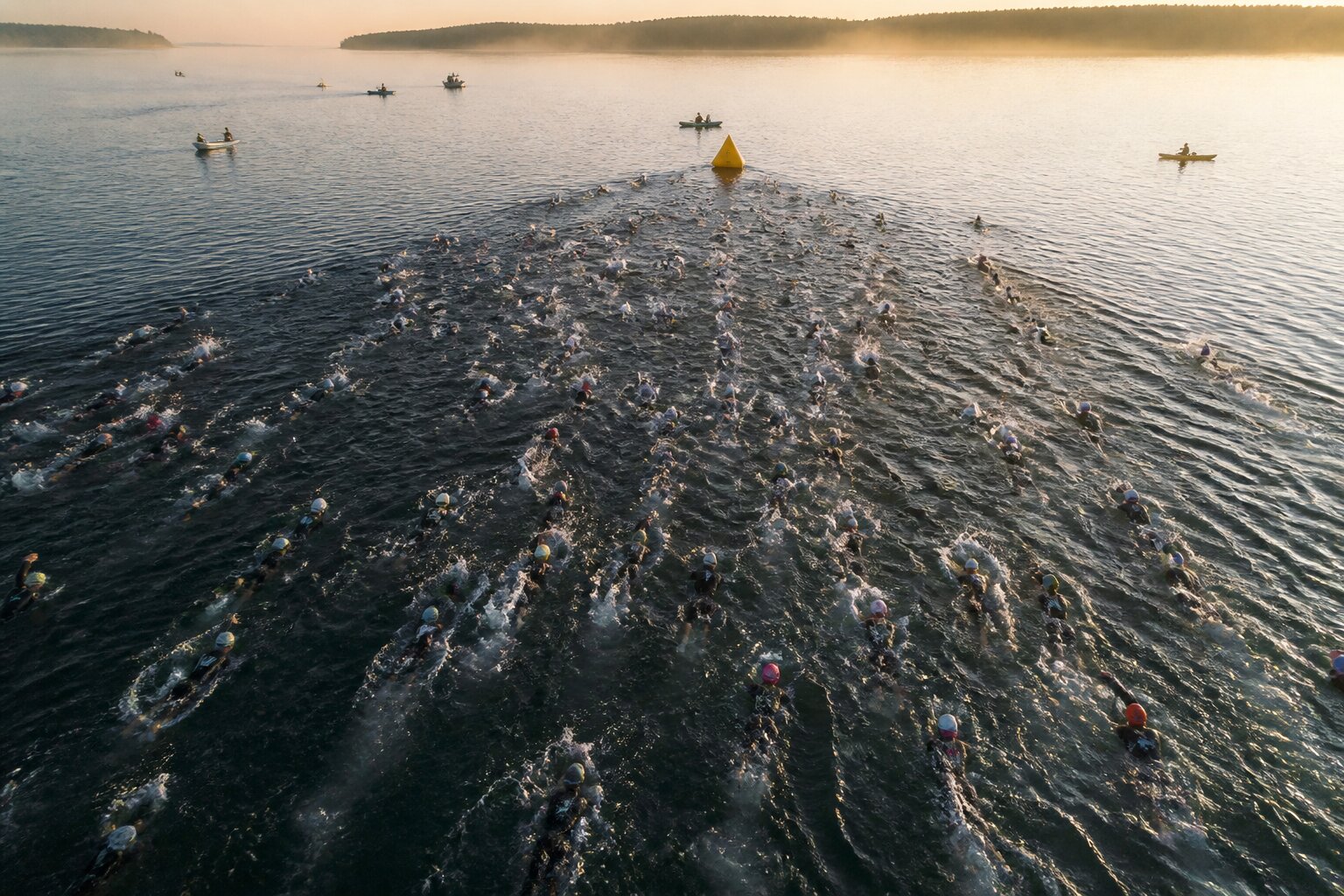
Europe’s strongest full-distance race has its date: 28 June. IRONMAN Frankfurt is not an ordinary race, it is the European Championship, with the largest pool of Kona qualifying spots on the continent. This year 71 professionals will jump into the Langener Waldsee, with six professional slots to the world championship on the line.
The Norwegians split up
The most interesting storyline is the Norwegian tactical split. Casper Stornes, the reigning IRONMAN world champion, and his friend and countryman Gustav Iden both chose Frankfurt over Challenge Roth. The third of the trio, Kristian Blummenfelt, races Roth on 5 July, where he will face Sam Laidlow and Patrick Lange. All three have been sharpening their form at a training camp in St. Moritz.
Stornes and Iden had a difficult start to the season, both dealing with injuries and racing less often than Blummenfelt, who has already won a full IRONMAN in Texas plus two 70.3 races, in Oceanside and Geelong. Even so, both know Frankfurt well. Stornes stood on the podium here last year, third, and has two third-place finishes this season, at 70.3 Oceanside and IRONMAN Texas. Iden finished fourth at last year’s European Championship in Frankfurt, and was second at the world championship in Nice. As a former IRONMAN and 70.3 world champion, he is aiming for the podium.
Ditlev returns after illness
The big unknown in the field is Magnus Ditlev of Denmark. The three-time Challenge Roth winner is only just opening his season, an infection picked up before IRONMAN Texas took longer to shake than he expected. “I still haven’t started the season because of the infection from before Texas, but I hope to be back on the start line soon,” he wrote on Instagram from an altitude camp in Sierra Nevada.
Ditlev is a two-time IRONMAN world championship medallist (2023, 2024) and winner of the 2025 African Championship. On any start line he is a genuine threat, the only question is how much the illness has taken out of him. At Frankfurt he also needs a Kona slot, so his motivation is doubled.
Who else is chasing a slot
The list of contenders for the six tickets to Kona is long. Gregory Barnaby of Italy, winner of the 2024 IRONMAN Pro Series, has already tasted success at Frankfurt, third here two years ago. Vincent Luis of France, after a standout full-distance debut in Texas, fourth in a strong field, jumps onto the list of favourites. Kieran Lindars of Great Britain already has a Kona slot locked in with eighth place in Texas, and was second at Frankfurt in 2024.
The home team will make its presence felt: the German squad includes Jonas Hoffmann, fifth last year, Finn Große-Freese, Wilhelm Hirsch, Jan Stratmann, Florian Angert and Paul Schuster. Also back after an unlucky season is Jamie Riddle of South Africa, who should set a fast pace from the swim and bike.
A shadow over the organisers
The women’s European Championship was held in early June in Hamburg and was won by Norway’s Solveig Løvseth. It will also be remembered for another reason: metal and glass were scattered on the bike course as a protest against the road closures. More than 100 age-group athletes had to withdraw with punctured tyres. IRONMAN announced it would work with police on measures to stop a repeat. The Frankfurt organisers will certainly be taking note.
What to watch for
Frankfurt is a classic where legs alone do not decide the race, the head matters too. The long, flat bike course punishes anyone who starts too fast, and the finish on the medieval Römerberg square can send the crowd into a frenzy. If Ditlev returns to his old form, expect a duel with the Norwegian pair for the European crown. If he does not, the door opens for Barnaby, Luis and the German contingent.
Hydration in triathlon is still a guessing game. Most of us have no idea exactly how much fluid and sodium we lose through sweat, so we go on generic advice and then fade in the heat, cramp, and lose watts in the final kilometres of the bike leg. FLOWBIO promises to turn that guesswork into data. It is a sensor that analyses your sweat during training and tells you what you are actually losing.
What it actually measures
FLOWBIO measures two things: fluid loss rate and sodium loss. The sensor captures sweat through a tiny channel, using the pressure your own sweat glands generate, and there is no needle involved. That is the key difference from the now-discontinued Supersapiens, which pierced the skin. The light module (about 10g) clips onto a chest strap, and the reading updates every few seconds.
The data lands in the FLOWBIO app, where the in-house AHi engine (Advanced Hydration Intelligence) combines it with intensity and ambient temperature and outputs a specific plan: how much to drink, when, and why. You go from “I hope I took in enough electrolytes” to knowing how much sodium you will lose over a 70.3 at 30°C (86°F).
Does it work: the hard numbers
The manufacturer has not hidden behind marketing and published an independent, peer-reviewed validation in the journal Frontiers in Physiology (2025). The study compared the sensor against lab reference methods: body weighing for fluid loss, and flame photometry plus an L’Aqua Twin analyser for sodium. The team was led by David Bandiera, with Yannis Pitsiladis among the co-authors, and the work was carried out at the University of Rome Foro Italico and at CREPS Montpellier.
On accuracy: in lab conditions FLOWBIO claims 90% accuracy. In the field, it drops to up to 83% for sodium (a difference of up to 180mg, about six times less than a pinch of salt) and 73% for fluids (a difference of up to 250ml). That is not laboratory perfection, but for an amateur planning a drinking strategy for a long race, it is a step up from generic tables.
Device compatibility and battery
This is the freshest news. A live data feed to Wahoo head units launches in late June 2026, putting sweat loss straight on your bike computer screen mid-ride. A live view on Garmin watches and head units is in internal testing and is due to reach beta later in the summer. Long term, FLOWBIO is built to work with Garmin, Wahoo, COROS and Zwift.
Battery life is a strong point: over 100 hours of use, charged over USB-C. The sensor is reusable, with no disposable inserts and no extra subscription; you pay once.
Spec
FLOWBIO
Measures
Fluid and sodium loss from sweat
Mount
Chest strap, about 10g
Needle
None, sweat collected through a channel
Battery
100+ hours, USB-C
Connectivity
Garmin, Wahoo, COROS, Zwift
Live data (Wahoo)
Late June 2026
Live data (Garmin)
Beta later in summer 2026
Price, and who it is for
International pricing runs about £295 to £379, or $399. That puts it firmly in “serious gadget” territory, not an impulse buy. But if you race 70.3 and full IRONMAN distance, fight the heat, or cramp regularly, a personalised sodium strategy can be worth more than another pair of aero socks.
It is not for someone running 40-minute sessions in cool weather with no gut issues. Hydration only becomes critical at long efforts and in the heat, and that is where FLOWBIO earns its place.
You know the feeling. You get off the bike, your legs are carrying you, adrenaline is running high, and the first kilometres of the run go out at a pace you would not hold even on fresh legs. Half an hour later the bill arrives: pace drops, every step hurts, and your result falls apart in the closing kilometres. That is a classic positive split, a second half slower than the first, and it is the most common way age groupers waste a well ridden bike leg.
The cure is called a negative split: a run where you cover the second half faster than the first. It sounds simple, but it is one of the hardest skills to master in triathlon.
The physiology: why a slower start pays off
A negative split is not a mental trick. It rests on solid physiology, confirmed in a review published in 2025 in Frontiers in Physiology. A conservative start delivers four advantages that stack up exactly where a race hurts the most:
Glycogen sparing. A slower first half burns proportionally more fat and preserves glycogen for the finish. That matters in triathlon, where you start the run with those stores already dented from the bike.
Less lactate. A calmer start limits early lactate build-up, so you do not enter the run carrying a debt you cannot repay.
Better thermoregulation. Lower intensity at the start means body temperature rises more slowly, which matters on the hot summer races that June and July bring.
Less cardiac drift. Building effort gradually limits cardiovascular drift, the creeping rise in heart rate at a constant pace.
The effect is delayed fatigue and better efficiency in the closing stages. Age groupers gain the most from it.
The T2 trap: the first kilometres of the run
In triathlon the problem starts in the transition zone. Off the bike your legs feel like concrete, but your head feels fresh, and that illusion sends you out at a pace 15 to 20 seconds per kilometre too fast. You pay those seconds back with interest later.
The rule is simple: run the first 1 to 2 kilometres deliberately slower than you want to. Let your heart rate settle, find your rhythm, then build. A negative split in triathlon does not mean a spectacular closing kilometre; it means not killing yourself at the start.
How to train it
A negative split is a habit built in training, not at races. Three tools that work:
Session
How to do it
Progression runs
A long run where you add pace every few kilometres, with the final section fastest
Fast finish
An easy run that closes with 2 to 3 km at race pace or faster
Controlled brick
Off the bike, run deliberately slow for the first 10 minutes, then build
Then there is the mental side: set a concrete pace target for each half and practise patience. The hardest part of a negative split is holding back at the start while everyone passes you. Many of them you will see again later, walking.
When a negative split is not the answer
To be honest, this is not a universal recipe. On a course with a significant climb in the second half, or in extreme heat, a pure negative split can be unrealistic. Aim instead for even effort rather than even pace on the clock. Elite athletes sometimes run different strategies because they are racing for position, not time. But for most age groupers racing their own watch, slower at the start and faster at the finish is the simplest route to a personal best.
You do your FTP test on fresh legs. Good for you. What matters more is how much of that number survives three hours on the bike, once you swing off onto the run. For some riders it is nearly all of it. For others, half. Science calls that gap durability, and it is durability, not a fresh VO2max, that decides how you race the closing stages of a 70.3 or an IRONMAN.
What durability actually is
Durability is the capacity to resist the decline in physiological parameters during prolonged exercise, both in how large that decline is and in when it starts. In plain terms, how long you hold power, threshold and economy before everything starts to fall apart.
It is a hot topic in endurance physiology in 2026. Researchers, including Andrew Jones’s group, have broken the concept down into four related traits:
Durability, resistance to a drop in form during a single long effort
Fatigability, how quickly you get tired
Repeatability, the ability to repeat hard efforts after short recovery
Resilience (physiological resilience), the resistance of the cardiovascular, metabolic and neuromuscular systems to accumulating fatigue
For a triathlete the first and the last matter most. They explain why someone with a worse FTP can still run you down over the closing 10 km.
Why the standard tests deceive you
FTP, VO2max, lactate threshold: you test all of them fresh. Triathlon, though, is a sport of tired legs. Your real threshold after 2 to 3 hours of riding can be noticeably lower than the number from a test done on warm, rested legs.
You can find durability markers in data you already have:
Heart rate drift: if your heart rate keeps climbing at the same power, your resistance to fatigue is low
The drop in power over the second half of a long ride: compare average power in the first and last hour at the same heart rate
Split run pace: how much you lose per kilometre running off the bike compared with a run on fresh legs
Those are your real tests. Not the number from a March test day, but what is still in your legs in the fifth hour.
How to train fatigue resistance
The good news: durability is trainable. The bad news: there is no shortcut. 2026 research points to a few levers:
1. Volume built over years. A consistent, high training volume spread across years builds the foundation of resilience. This is not about one block, it is groundwork laid over the long term.
2. Zone 2, plenty of it. Low and moderate intensity training raises the oxidative capacity of the muscles and metabolic efficiency. Those are what delay the point where you start running on sugar and losing power.
3. Hard efforts on tired legs. This is the core of it. Weave race-pace or harder efforts into long sessions, but place them in the second half of the session, once the legs already hurt. For example, the final hour of a 4-hour ride with three 8-minute intervals at FTP. You are teaching your body to hold power once it is already tired, exactly as it will need to on race day.
4. Strength and plyometrics. Heavy strength training, and possibly plyometrics, improve neuromuscular resistance and movement economy. Studies show that strength training alone can improve running economy by about 5% and cycling economy by about 7%, and economy that holds up under fatigue is durability in practice.
A practical week
Placing the training stimulus more intelligently matters more than piling on volume:
A long ride with FTP intervals at the end (bike durability)
A brick: bike plus a short, hard run off tired legs
1 to 2 strength sessions a week (squat, deadlift, pull variations), regardless of the training phase
The rest of the week: easy Zone 2 that builds the aerobic engine
Recovery is part of the plan here, not a reward for it. Without it, hard efforts on tired legs turn into overtraining.
The takeaway
Stop bragging about a fresh FTP number. What counts is how much of it survives the next hour of training or racing. Fatigue resistance is the trait that separates the ones who fall apart on the run from the ones who deliver. It is genuinely trainable, once you stop testing yourself only on fresh legs.
The question comes back every time the season changes: how to split time across training zones to get the most out of 10 hours a week. The polarised model has the appeal of simplicity, easy or very hard, nothing in between. The pyramidal model sounds more reasonable, more at the bottom, less in the middle, a sharp peak at the top. In 2026, a fresh research summary from Arturo Casado, PhD, puts the matter to rest: neither model wins everywhere. That is the most important conclusion of the season.
What actually separates the polarised model from the pyramidal one
Both models describe what percentage of training time is spent in three intensity zones:
Zone 1 (Z1): below the first lactate threshold (VT1/LT1). Conversational pace, easy effort.
Zone 2 (Z2): between the first and second thresholds (LT1 and LT2). A pace that cannot be held for long, but is not all-out either.
Zone 3 (Z3): above the second threshold. Lactate tolerance work, VO2max repeats.
Polarised (POL): lots of Z1, almost nothing in Z2, a decent amount of Z3. Pyramidal (PYR): lots of Z1, moderate Z2, little Z3.
Why these are not the “zones” shown on a Garmin, an important note
Anyone training with a Garmin, Wahoo or TrainingPeaks likely sees five zones based on the model developed by Dr Andrew Coggan, the researcher behind the FTP concept and co-author of Training and Racing with a Power Meter from the early 2000s. That model splits intensity by percentages of FTP and maximum heart rate, treating Zone 4 as the lactate threshold.
The three-zone model used in scientific research (Seiler, Casado, Filipas) is built on two physiological ventilatory thresholds, VT1 and VT2. It is a different cut of the same physiology:
Five-zone model (Coggan / Garmin)
Three-zone model (research)
Z1 Recovery
Z1 (easy, below VT1)
Z2 Aerobic base
Z3 Tempo
Z2 (grey zone, between VT1 and VT2)
Z4 Lactate threshold (FTP)
Z5 VO2max and above
Z3 (above VT2)
When research says to avoid Z2 in the polarised model, it means zones 3 and 4 on a watch: half-marathon pace, threshold intervals, “sweet spot” work. It does not mean avoiding easy aerobic base, which sits inside Z1 of the research model and is exactly what belongs there. Seiler himself uses the three-zone model in research for simplicity, but works with athletes using five zones, because they give more precision when planning sessions.
Figures from a study by Sellés-Pérez et al. (Journal of Sports Science and Medicine, 2019) on age-group athletes racing the half-iron distance, IRONMAN 70.3 (1.9 km swim, 90 km bike, 21.1 km run), commonly called a “half”, make this concrete:
Group
Z1
Z2
Z3
POL
84.5%
4.2%
11.3%
PYR
77.9%
18.8%
3.3%
The Z2 gap is stark: nearly a fifth of training time in the pyramidal group, barely a mention in the polarised one.
What the research shows at the middle distance
The same study found an interesting relationship: time spent in Zone 2 correlated with a better race result among age-groupers at the half-iron distance. In other words, in the 70.3 group, the pyramidal distribution beat the polarised one on race outcome.
That is counterintuitive for anyone who listens to podcasts about the “Norwegian model” and the Iden and Blummenfelt brothers. But the logic is simple: a 70.3 puts an athlete at near-threshold intensity (Z2) for four to five hours. Training that includes plenty of Z2 prepares an athlete better for exactly that.
Casado, on episode 695 of the That Triathlon Show podcast, discusses a study by Filipas et al. (Scandinavian Journal of Medicine & Science in Sports, 2022), in which a 16-week periodised plan, the first 8 weeks pyramidal and the next 8 weeks polarised, produced better running results than either model held for the full cycle. The improvement was mainly in 5k time and speed at lactate threshold; VO2max changes did not differ significantly between groups.
What this means in practice, periodisation instead of doctrine
The research synthesis available through 2026 points to a phased approach:
General phase (base period, November to January). Pyramidal distribution. Plenty of Z1 (around 75 to 80%), a meaningful chunk of Z2 (15 to 20%), little Z3 (3 to 5%). This builds aerobic capacity, movement economy and threshold.
Specific phase (February to April). Shift toward polarised. Keep Z1, reduce Z2 to roughly 5 to 8%, add deliberate Z3 blocks, Norwegian threshold sessions, VO2max repeats. This is when 30/30 intervals start to make sense.
Race phase (May to September, depending on the calendar). Mixed, maintaining all systems while the specific demands of the race take over. For a half, return to more Z2 in the week before the start. For a full-distance event, hold polarisation with long Z1 sessions and short Z3 sparks.
Recovery phase / off-season. Everything in Z1 with one sharp stimulus a week. Not the time for a plan.
What about the 80/20 model
The popular 80/20 model (80% easy, 20% hard) comes from Stephen Seiler’s research into intensity distribution among elites, and is a simplified version of the polarised model. It works well for runners training at very high volume, 15-plus hours a week. For an age-group athlete training 8 to 10 hours a week, the problem is different: the 80% “easy” training often is not easy at all. It ends up in a grey zone, too hard for recovery, too weak for progress.
For an age-grouper, what matters more than choosing between the polarised and pyramidal model is this:
Keeping Z1 genuinely in Z1. The test: it should be possible to hold a conversation in full sentences.
Controlling Z3. A real VO2max repeat is one you would cut off your own arm to end.
Not dragging every session up to a perceived effort of 7 out of 10. That is the road to overtraining without progress.
What to use when building toward a 70.3
A concrete outline to work from:
November to January: pyramidal. Plenty of long Z1 (bike 2 to 3 hours, run 60 to 90 minutes), one Z2 session a week (for example 4×8′ at threshold), one short Z3 session (for example 6×3′ VO2max).
February to April: shift toward polarised. Two Z3 sessions a week (Norwegian double threshold, classic 4×4′ VO2max), Z2 limited to brick sessions and specific tests. Everything else in Z1.
May to September: race specificity. Two weeks before a 70.3, bring back Z2 (race-pace repeats: on the bike 2×30′ at 85% FTP, on the run 3×3 km at half-marathon pace).
October to November: everything in Z1 plus one sharp stimulus a week.
There is no sacred percentage. There is a phase, a race, and an athlete’s own recovery. The 2026 scientific consensus: be periodised, not dogmatic.
Verdict
Polarised versus pyramidal is a false argument if the choice has to be made once and for all. The best adaptations come from a plan that shifts the intensity distribution across the season: pyramidal in the base period, polarised in the specific period, mixed at the race. Casado and the 2026 research say the same thing good coaches have said for years, just with numbers behind it now.