A week in which Garmin unveiled a new flagship, and Jan Frodeno reminded everyone that winning does not stop when a career in professional triathlon ends. In Japan, two Polish riders reached the podium at a world championship, a full-distance race took place near Bydgoszcz, Poland, and one red card in Kraków, Poland showed how strictly IRONMAN now enforces its newest rule. Here is the roundup for 22-28 August.
1. Garmin unveils the fēnix 9 and 9 Pro
Garmin’s launch was the loudest release of the week. During a livestream on 25 August, Garmin unveiled the fēnix 9 and fēnix 9 Pro. The base version costs $1,000, and the Pro and Pro Solar models cost $1,100. Orders open today, 28 August.
Internal storage grew from 32 to 64GB, and the AMOLED display now reaches about 2,000 nits, roughly twice as bright as the fēnix 8. The watch comes in three sizes, 43, 47 and 51mm, with the solar versions available only in the two larger sizes. All models get a titanium case back.
Among the software additions, Garmin showed off Epic, a feature that stitches multi-day expeditions into one story built from photos, health data and results.
2. Frodeno wins his age group at UTMB
On 27 August the three-time IRONMAN world champion started OCC, the 50K finale of the UTMB Mont-Blanc series. At 61.4 km (38 miles) through the mountains, it was the longest run of Jan Frodeno’s life. He finished in 6:31:55, winning the M45-49 category by almost 25 minutes and placing 58th in a field of about 2,000.
The best number is a different one: his time was faster than the winning result in the younger M40-44 category (6:33:47). Frodeno turned 45 on 18 August, so he had moved into the new age group just nine days before the start.
This was not a race open to just anyone. OCC is the UTMB World Series final, and the entire amateur field had to qualify first. Three years after retiring from professional triathlon, Frodeno won an age-group category in a race that requires qualification to enter.
3. Wołos crowned world champion in Japan, Miernik takes bronze
On Thursday 27 August, the UCI Gran Fondo World Championships got underway in Niseko on Hokkaido, held in Asia for the first time in the event’s history. The opening event was an individual time trial, 15 km with the start and finish in Kyowa.
In the K35-39 category, Ewelina Wołos was fastest in 20:17.87, an average of about 44.3 km/h. Britain’s Hayley Simmonds clawed back time in the second half of the course but fell short by 5.98 seconds. Bronze went to a second Polish rider, Ewelina Miernik (20:33.14).
The new world champion’s name will be familiar from triathlon. Wołos won the K35-39 category at the IRONMAN 70.3 World Championship in Marbella in 4:59:30. She turned professional in February 2026, became Polish duathlon champion in May, and placed 11th at Challenge Roth in a personal best of 9:14:19. She closed her triathlon season on 11 August and switched to cycling. Clearly, the switch worked. The time trial field included 402 riders from 52 countries.
4. Red card for filming his own finish
Footage from the finish line at Enea IRONMAN 70.3 Kraków circulated across Polish social media this week. It shows an athlete filming his own finish on a small camera, crossing the line, and receiving a red card from a race official moments later. Grzegorz Dubowski appealed the decision. The appeal was rejected and the disqualification stood.
The reason is not in doubt. In February 2026, IRONMAN tightened its rulebook, adding the line: “The use of any device (telephone, video camera, camera, glasses with a recording function, etc.) to take photos or record video during the race is prohibited. The athlete will be disqualified.”
In practice, that removes everything at once: course selfies, a GoPro on the helmet, a live stream, camera glasses. Previously, carrying a phone was allowed as long as it was not used in a distracting way; now pressing record alone wipes the result. Dubowski said the camera was waiting for him 200 metres before the finish and that he had no idea about the change. Check the rulebook before your next start, since after eight hours on course a single gesture can erase the entire day.
5. Leipzig debuts on the 70.3 calendar
On Sunday 23 August, the first edition of IRONMAN 70.3 Leipzig took place. Wilhelm Hirsch won the men’s race in 3:30:59, ahead of Rico Bogen (3:32:59) and Pierre Dupuy (3:34:14).
In the women’s race, Caroline Pohle had no rivals and finished in 3:53:42. Bianca Bogen was second, more than eleven minutes back (4:05:06), and Brooke Gillies took third seven seconds behind her (4:05:13).
6. Borówno: 79 finishers on the full distance
On Sunday 23 August, the Ocean Lava Metalkas Triathlon Polska took place near Bydgoszcz, Poland. Marcin Rodziewicz was fastest over the full distance in 9:07:08. The full 3.8 km / 180 km / 42.2 km was completed by 79 athletes, including 5 women.
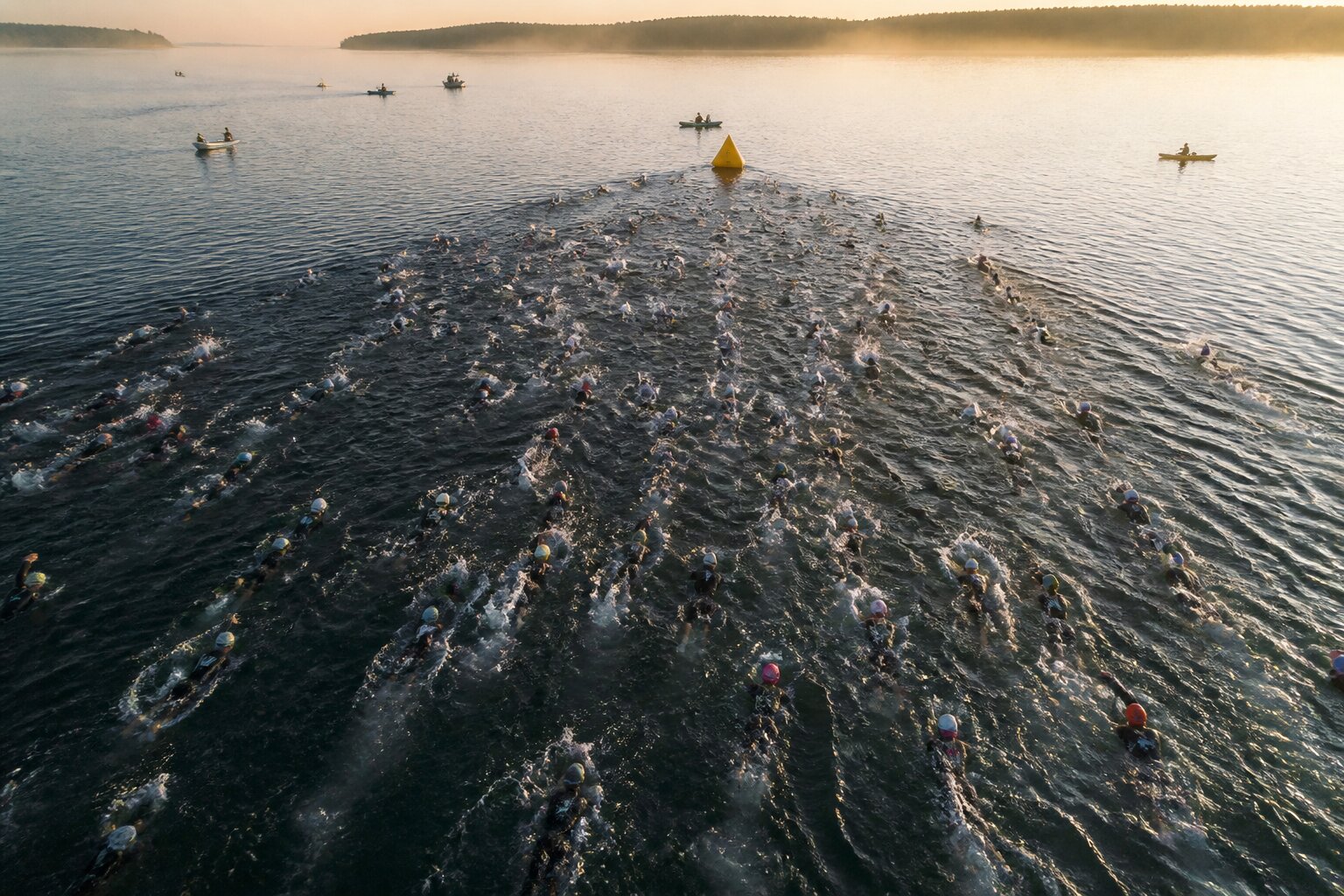
The swim took place on Lake Borówno, four laps for the full distance and two for the half. The finish and T2 transition were at the Zawisza sports complex on Gdańska 163 in Bydgoszcz, so the final kilometres of the run passed through the city. Three distances were on offer: sprint, half and full.
The event is a veteran on the Polish calendar, held since 1997. For a full-distance race without a Hawaii-sized entry fee, this is the address.
7. Räppo wins again in Tallinn
On the same day, 23 August, Henry Räppo won IRONMAN 70.3 Tallinn for the second time. The Estonian crossed the line in 3:38:31, with Hannes Butters (3:39:38) and Enzo Bourdon (3:41:12) following.
Italy’s Marta Bernardi won the women’s race in 4:12:04. The rest of the podium was tighter, with three seconds separating Sandra Huon (4:13:05) from Liis Kapten (4:13:08).
8. Lima goes to the Americans, Molėtai blown out by weather
Team USA swept the Pan American Cup in Lima. Carter Stuhlmacher won the men’s race after posting the fastest swim of the field (9:41 over 750m) and exiting the water 4 seconds clear. Foster Wilfong took silver. He trailed his teammate by 58 seconds out of the water but closed the gap in the bike group and ran the fastest split of the day (14:20 over 5 km).
In the women’s race, Faith Duncan added a second win of the season after July’s Magog. The American rode the fastest bike split of the day (30:48), was first into T2, and added the fastest run (15:53), leaving experienced Elizabeth Bravo behind.
Europe fared worse. The Junior Cup finals in Molėtai, Lithuania were cancelled because of weather, a season that had already lost races to heat this time lost one to the opposite extreme.
Frodeno’s age-group win at UTMB and Wołos in the rainbow jersey are the week’s two best stories. The one with the most practical consequences is the third: since this season, a camera on an IRONMAN course wipes the result.
9. WTCS Weihai: Beaugrand chases the title
Tomorrow, 29 August, the WTCS series returns to Weihai for the third time running. The women’s start list has 55 names, including the last three world champions. The field is effectively complete.
The most interesting situation belongs to Cassandre Beaugrand. The Olympic champion is sixth in the series standings with three results from four possible starts, so she needs points. Lisa Tertsch and Beth Potter, meanwhile, are defending their lead over the Frenchwoman.
In the men’s race, remember the name Solomon Okrafo-Smart. The Briton will make his WTCS debut straight off his first World Cup win in Edmonton.
10. Philipp heads to Kona after three races in a row
Laura Philipp demolished the field at Kalmar two weeks ago. This Sunday she lines up at 70.3 Zell am See, then heads to the world championship in Nice, then straight to Hawaii. Three starts in under a month and a half before the season’s toughest race is a deliberate change after last year’s Kona, where the German defended her number one and finished third.
“I think I overdid the preparation, because I really wanted to be ready for the heat and set myself the goal of winning,” she said on The Women’s Race podcast. “There’s a thin line between wanting something and wanting it too much.”
Last year she spent weeks in isolation on Maui, then walked into Kona race week with a full schedule of champion’s duties. This year she will fly to the island two weeks before the start, and that is it. “Nobody can guarantee it will work. Nobody can guarantee it either if you focus on nothing but Hawaii from now on and grind through every session.”
11. What’s next: Zell am See-Kaprun
On Sunday 30 August, the 70.3 calendar moves to Austria for IRONMAN 70.3 Zell am See-Kaprun. The Alpine course usually rewards strong cyclists, so times will be noticeably slower than in flat Leipzig.