Tag: Race Reports

  • Run-Walk Pacing for an IRONMAN Marathon

    Run-Walk Pacing for an IRONMAN Marathon

    By the time you start the marathon in a full-distance IRONMAN, you’ve already been racing for hours. The leaders have around 5 to 6 hours behind them, slower athletes even 9 to 10. You’re tired, your energy is low, and 42 km are still ahead of you. Trying to just run the whole thing on feel usually ends in walking through the second half anyway, the forced, unplanned kind. The run-walk strategy flips that logic: you walk before you have to, and end up running faster overall.

    Why planned walking works

    It sounds paradoxical, but the mechanics behind it are straightforward. Triathletes who work short walking breaks into the run from the start tend to finish the marathon with a better overall time. The reason is simple: they don’t fall apart around the 30 km mark and don’t end up in a long, uncontrolled walk to the finish. A short walking break isn’t rest, it’s active recovery that protects the muscles’ ability to keep running over the following kilometres.

    Researchers describe a similar effect in ultrarunners. A study published in PLoS One looked at runners in the extreme Tor des Géants race, around 330 km (205 miles) with about 24,000 m of elevation gain, and compared them with participants in much shorter ultra races. The finding: athletes in the longest race had lower markers of muscle damage and inflammation, despite covering a far greater distance. The authors put this down to a protective, anticipatory pacing strategy, a slow and controlled pace from the very start. A body that knows a long road is coming holds itself back.

    Run-walk is the same strategy, built rigidly into the plan. Instead of waiting for the body to force a walk, you impose one deliberately, while you’re still fully in control.

    How to build your own pattern

    The pattern depends on your level and time goal. A proven approach is a walking break at every aid station, which on an IRONMAN course are usually spaced about every 1.5 to 2 km. These are natural anchor points: you slow down, take a gel and water, swallow calmly, and move on.

    Two rules keep this under control:

    • Breaks are short and consistent. Ten to a few dozen seconds of walking, not a stroll. The point is to reset heart rate and get calories down, not to fully rest.
    • Practise before race day. Trying run-walk for the first time on race day is a risk. Work it into long runs and brick sessions so the body learns and accepts the rhythm.

    Pace: three indicators, not one

    Run pace in an IRONMAN is decided earlier, on the bike and in your fuelling. Ride too hard and there’s nothing left for the marathon. A smart bike leg and getting carbohydrate intake right give you a shot at a good run.

    On the marathon itself, you can’t rely on a single number. Wind, climbs and heart rate drift from overheating throw off any one indicator on its own. Combine three: RPE, heart rate and pace. Hold the first half at the bottom end of your range. If you feel fresh at halfway, you can pick it up slightly. Most of the time you won’t even need to.

    The key rule: the risk of starting too fast is far bigger than the risk of starting too slow. A pace that’s too slow can be made up in the second half. Blow up at the start and there’s nothing left to make up.

    Base it on reality

    The last point is to base your target pace on real results from the last 8 weeks, not on ambition or last season’s form. A run-walk plan built on inflated assumptions falls apart just as fast as any other feel-based pacing strategy.

  • IRONMAN 70.3 Kraków 2026: Stępniak defends by 20 seconds

    IRONMAN 70.3 Kraków 2026: Stępniak defends by 20 seconds

    The second edition of IRONMAN 70.3 Kraków ended exactly as the crowd would have scripted it. Kacper Stępniak defended the title he won last year, taking a head-to-head fight with a Dane right before the line on Kraków’s Main Square. In the women’s race Nikki Bartlett came out of the water more than a minute down and rode to the win anyway. The race was held on Sunday 2 August 2026, in temperatures reaching 30°C.

    Men: 20 seconds after 113 kilometres

    Germany’s Hannes Butters led out of the water (21:12), just ahead of Marc Dubrick and Cenzino Lebot. Stępniak (21:19) and Daniel Baekkegaard started the bike a few seconds later, in the same group.

    On the 90-kilometre course through Wieliczka and Bochnia, Stępniak took the initiative straight away and cut the lead group to five. When Baekkegaard lifted the pace over the final 30 km of the bike, Johannes Vogel and Butters lost contact. Three men started the run: Stępniak, Baekkegaard and Dubrick.

    Dubrick lost touch in the first kilometres of the half marathon, though not because he cracked. The American put down the fastest run of the day, 1:11:35, and still could not close the gap. Baekkegaard stayed with the Pole stride for stride until the last few metres. Stępniak attacked just before the line and won in 3:36:37, 20 seconds ahead of the Dane (3:36:57). Dubrick completed the podium in 3:38:22.

    A year ago Stępniak won the inaugural edition in 3:39:40. This year’s time is three minutes quicker, against considerably sharper competition.

    Women: Bartlett takes back 1:41 on the bike

    Italy’s Lilli Gelmini led out of the water (24:45). Nikki Bartlett reached T1 in eighth place, 1:41 behind the leader.

    On the bike the Briton started taking that back immediately. She was fourth before the 45-kilometre mark, took the lead a few kilometres later and never gave it up. At T2 she held 1.5 minutes on Brooke Gillies and Megan McDonald, with Francesca Crestani chasing.

    Places behind Bartlett kept changing on the run. The front did not. The Briton won in 4:08:26. Crestani ran through for second (4:09:59), and France’s Aurelia Boulanger took the last podium spot with the third-fastest time (4:10:45).

    The Poles: Stępniak was not alone

    Behind the winner, Jacek Krawczyk took fourth in the PRO classification in 3:41:24, only three minutes down on Dubrick. The fastest Polish woman was Agnieszka Gadomska, seventh in 4:16:51.

    More than 2,000 athletes from several dozen countries started, so on entry numbers Kraków in its second year already sits alongside Poland’s older races over this distance.

    The course: from Zakrzówek to the Main Square

    The swim was held in Lake Zakrzówek, a flooded quarry inside the city limits of Kraków. The bike course ran from there through Wieliczka to Bochnia and back, mostly along the DK94, which makes it a fast leg that rewards strong time triallists. The run finished on the Main Square, still a rare thing for age-groupers racing in Poland. Few events in the country finish in the middle of a major city.

    Thinking about Kraków in 2027?

    Two editions are not enough to draw hard rules, but one thing is already visible: an August date means heat. In 2026 the thermometers showed close to 30°C, and on a half marathon after 90 km on the bike that counts for more than the course profile. If you are planning to race here, train in the heat and rehearse your hydration strategy on brick sessions instead of improvising on the day.

  • Ultra Baltic Swim 2026: Kubkowski swims Sweden to Poland

    Ultra Baltic Swim 2026: Kubkowski swims Sweden to Poland

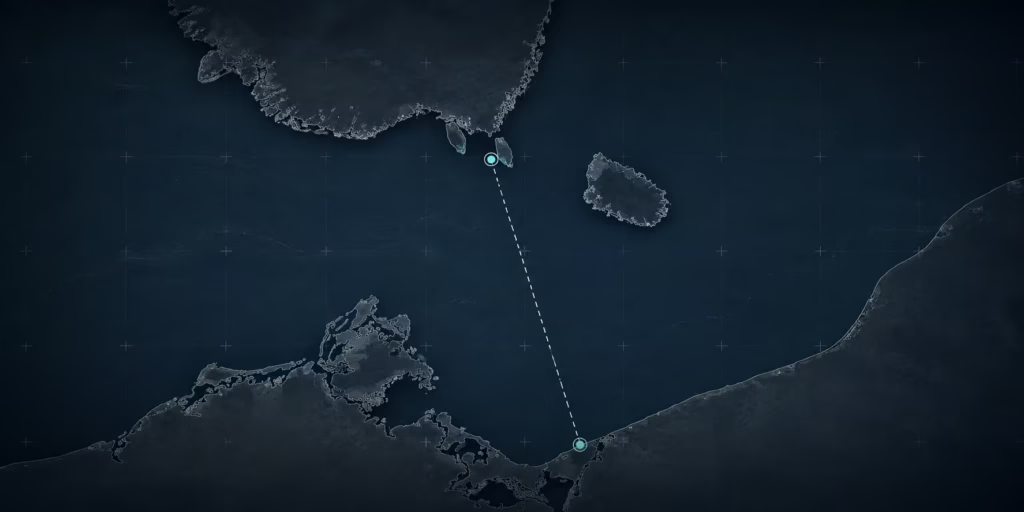
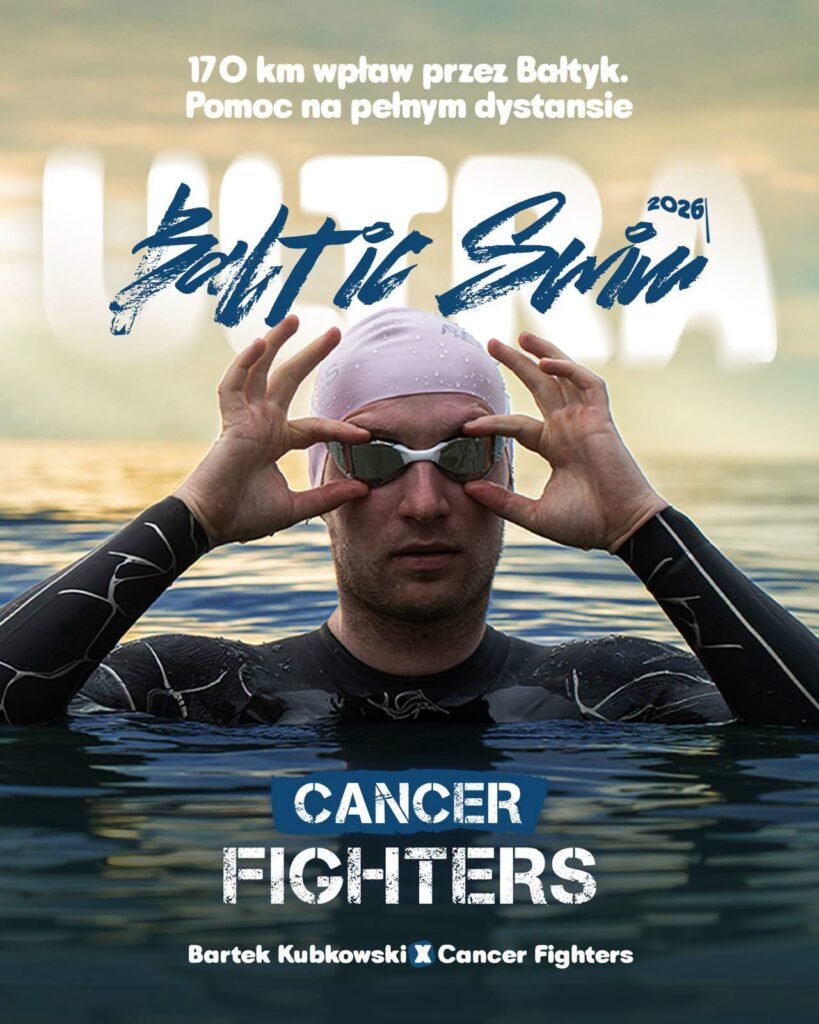
    When Bartłomiej “Foka” Kubkowski walked out onto the beach at Dziwnowo, on Poland’s Baltic coast, under his own power at around 20:30 on Sunday evening, 2 August 2026, everyone on the shore was in tears. After nearly 55 hours of unbroken effort in the black water of the Baltic Sea, he became the first person in history to swim from Sweden to Poland. Roughly 160 kilometres, though some accounts put it closer to 170 km because the currents lengthened the distance actually covered, done at the fifth attempt, announced as “Last Dance”.

    It was not a one-man show. Karolina Szczepaniak started from Sweden in the same weather window, a two-time Olympian (Beijing 2008, London 2012). She spent 58 hours in the water. Extreme exhaustion and heavy chafing led her crew to make the hard call to stop the attempt before she reached the Polish shore, but her swim goes into the history of Polish ultra-swimming regardless. She showed a resilience that carried thousands of people who were following her.

    Baltic Sea crossing, illustration

    Rather than add another round of general congratulations, it is worth breaking the weekend down. Here is what sat behind the project physiologically, in equipment terms and logistically.

    Physiological hell: face, hands and head after two and a half days at sea

    Spending more than two days in high-salinity water at an open-sea temperature of 16-18°C wrecks the human body.

    • Skin maceration: after that long in continuous immersion, skin loses its protective barrier. It soaks up water, goes soft as paper and gives way to the smallest injury. Swimmers’ hands and feet after attempts like this are wrinkled and bleached white, and even the touch of a towel hurts.
    • Damage to the mouth and eyes: constant contact with sea salt swells the face. Eyes sting and fog up behind goggles despite the seal. The worst of it is breathing in salt spray and swallowing water by accident. After many hours the tongue and throat can swell enough to make eating anything a torture.
    • Sleep deprivation and hallucinations: close to three days without sleep, combined with the monotony of black water, throws off the sense of balance. In 2025 Bartek was pulled out of the water 11 km from the Polish shore after more than 50 hours of effort. He had lost his bearings and was close to losing consciousness, so his crew ended the attempt. This year the key was surviving two full nights on open water without losing contact with reality.

    Equipment: what do you swim the Baltic in?

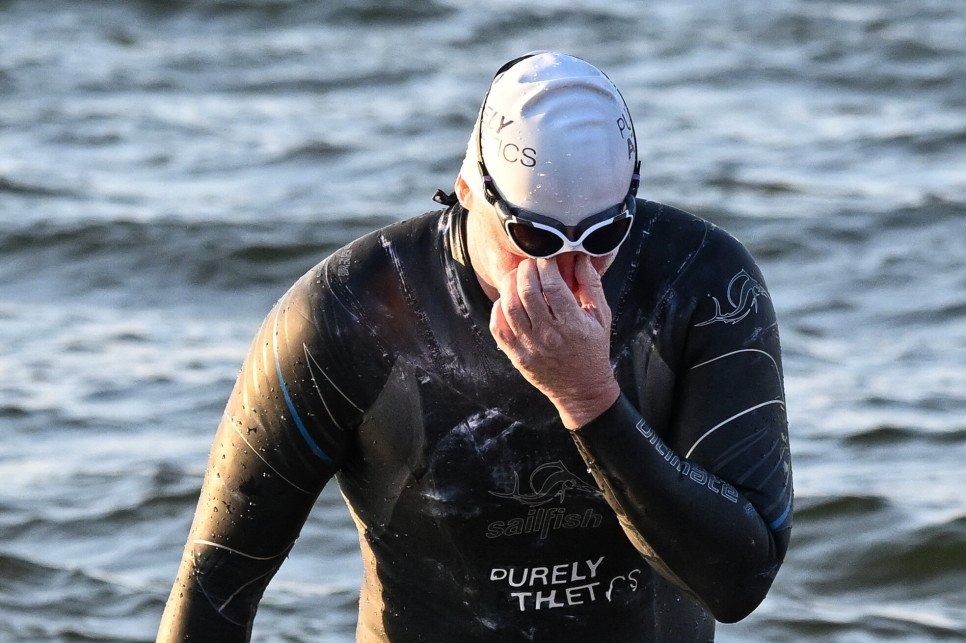
    Under Ultra Baltic Swim rules a neoprene wetsuit is allowed, and it is the basis of survival. What the swimmer may not do, at any point, is touch the support boat. Bartek swam in a sailfish wetsuit, visible in the photographs from the finish at Dziwnowo. The pressure points, neck, armpits and groin, are usually covered in a thick layer of protective grease so the wetsuit seams and salt crystals do not wear the skin down to raw flesh. That is standard practice among long-distance swimmers, not something specific to the Baltic. He used dark-lensed goggles for the crossing, and a lifeboat crew watched over him around the clock.

    Caloric hell: how do you feed a man who cannot stop?

    The constant arm work is only part of the energy cost. Most of it goes on thermoregulation, on fighting hypothermia and generating heat to hold core temperature. According to media reports Kubkowski burned around 55,000 kilocalories during the crossing. Everything was passed to him from the boat without him touching it, as drinks and food handed over on a pole.

    More than sport: over 800,000 złoty (about €185,000) raised

    The effort had a purpose beyond the swim from the start. Kubkowski swam for the beneficiaries of the Cancer Fighters Foundation, which supports children and adults being treated for cancer. Alongside the sporting record, the one that mattered most fell too: the dedicated fundraiser on the foundation’s site passed 800,000 złoty (about 214,000 USD) and is still climbing (as of 3 August it stood at roughly 780,000 złoty, about 208,000 USD). Conversions use the National Bank of Poland rate of 3.7468 złoty to the dollar, table 149/A/NBP/2026 of 4 August 2026.

    Bartłomiej Kubkowski after the Baltic crossing
  • World Cup Rio: Legg and Michalickova Win It by a Second

    World Cup Rio: Legg and Michalickova Win It by a Second

    Copacabana had not seen elite triathlon since the 2016 Olympics. A decade later, the World Triathlon Cup returned to the beach, and both sprint races, men’s and women’s, were decided by one second. The event took place on Sunday, 2 August 2026.

    Legg wins by a second

    American Braxton Legg won the men’s race in 50:56 over the sprint distance: 750 m swim, 20 km bike, 5 km run. Most of the world’s top-ranked field skipped Rio, opening the door for athletes outside the front line. Legg took the opportunity and held his lead to the finish.

    New Zealand’s Dylan McCullough finished second (50:57), and the Netherlands’ Mitch Kolkman third (51:04). All three finished within eight seconds of each other.

    Michalickova gives Slovakia its first-ever win

    In the women’s race, Slovakia’s Zuzana Michalickova took the win in 58:13, also by a single second. American Kelly Wetteland finished second (58:14), and Italy’s Beatrice Mallozzi third (58:16).

    It is Slovakia’s first-ever World Triathlon Cup win.

    What a race without the stars gives you

    The World Triathlon Cup sits a level below the WTCS. Less show, but a harder fight for ranking points that decide entry into the bigger races. The absence of the top names opened up the field, and both races ended the same way, a sprint over the final metres.

    For anyone who likes spotting athletes before they become well known, the Cup is a better place to look than the WTCS. On Copacabana, two people few had talked about before Sunday won.

  • Flash News: Słupek European gold, WTCS back in London

    Flash News: Słupek European gold, WTCS back in London

    This was a week when triathlon got everything at once: a historic Polish gold, WTCS returning to London, a structural reform of the professional calendar, and Alistair Brownlee starting one of the hardest triathlons in the world. Plus Boise, Toronto, Kórnik, Starachowice, the end of Flora Duffy’s career, and the story of Mohamed Lahna, who crossed America in triathlon format.

    1. Roksana Słupek is European champion. Elbląg went up

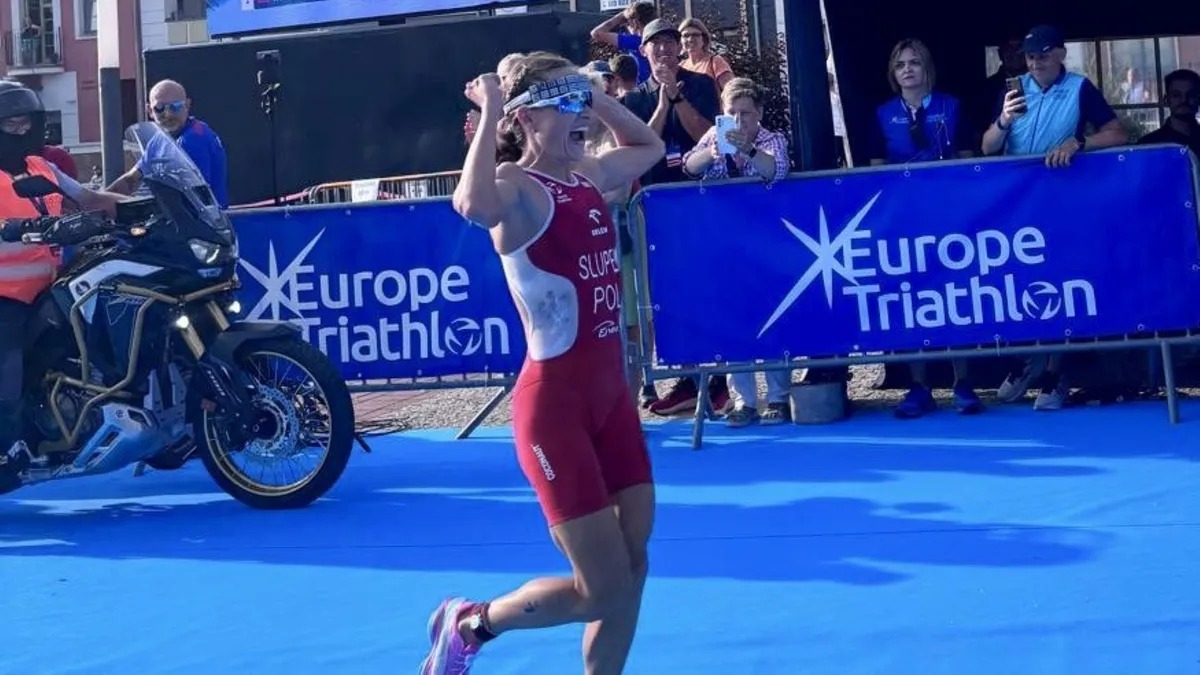
    The biggest Polish story of the week is not in doubt: Roksana Słupek became European champion in sprint-distance triathlon. On Friday 31 July in Elbląg she won the women’s elite race in 1:00:31, 15 seconds ahead of Ambre Grasset and 16 ahead of Léa Houart.

    This was not a case of leading out of the water and riding away with it. After the swim Słupek was 24th and more than 20 seconds down on the front. She came back on the bike, and on the run she did what you expect from someone racing for gold: she left everyone.

    It is Poland’s first ever European Championship medal in this event, and it is gold. A result like that in front of a home crowd needs no extra drama written into it.

    2. Elbląg gave Poland more than one result

    The European Championships in Elbląg did not end with Słupek’s gold. Milan Larivière took the men’s title, and the best of the Poles was Michał Oliwa in eighth. Poland’s mixed relay finished sixth.

    For Polish triathlon it was an important weekend organisationally as well as competitively. Elbląg was given a championship event, the national team put people near the front, and the crowd got something Polish triathlon still wants more of: a big race on home roads.

    3. WTCS returned to London. Hauser and Beaugrand dealt the cards

    After an 11-year gap WTCS came back to London and immediately got a script worth the stage. Matthew Hauser won the men’s race in 50:28, beating Vasco Vilaça by three seconds. Csongor Lehmann completed the podium.

    In the women’s race Cassandre Beaugrand did what she has done best this season: won. It was the Frenchwoman’s third victory in three WTCS starts in 2026, finishing in 56:06. Lisa Tertsch and Tilda Månsson followed her in, and the best of the British, Beth Potter, was fourth.

    The home disappointment was Alex Yee. The Olympic champion raced in front of his own crowd, but after trouble on the bike and a crash he finished 14th. London was a reminder that form guarantees nothing, even for the best.

    4. Triathlon World Tour: the end of the format war?

    London also produced an announcement that could reshape professional triathlon. The PTO and World Triathlon presented the Triathlon World Tour brand, a shared structure meant to bring order to the professional calendar from 2027.

    WTCS is to run as the T50 World Championship Tour, and T100 as the T100 World Championship Tour. A Challenger level is to sit underneath, serving as the qualifying path and feeder for the main series.

    Technical, yes. The point is simple though: less chaos, a clearer hierarchy, and a better chance that athletes, sponsors and spectators end up looking at one coherent system.

    5. T100 puts on smart glasses, IRONMAN bans cameras

    Triathlon currently has two opposing visions of technology on course. IRONMAN’s 2026 rules ban athletes from filming or taking photographs during a race. T100 went in exactly the other direction.

    The PTO announced Meta as the official wearables partner of the T100 series. In practice that means Oakley Meta Vanguard and Oakley Meta HSTN Performance AI glasses used for footage from the perspective of athletes, officials and age-group participants.

    One organisation is talking about safety and concentration. The other is talking about showing people the race from the inside. That argument is more interesting than the hardware, because the same questions will reach age-groupers soon enough.

    6. Sam Long and Kirsten Kasper win IRONMAN 70.3 Boise

    Sam Long was back in Idaho. The American won IRONMAN 70.3 Boise in 3:32:25, building his lead mainly on the bike. Ari Klau was second and Blake Harris third, a few seconds ahead of Vincent Luis.

    The women’s race went to Kirsten Kasper in 4:00:50. It was a strong running comeback: Kasper pulled back time after the bike and took control over the closing kilometres.

    Boise was a reminder of something plain: you can win a 70.3 on the bike, but without a strong run you cannot close it out calmly.

    7. Supertri Toronto: Mislawchuk wins at home

    Toronto gave its crowd a local winner. Tyler Mislawchuk took Supertri Toronto in 51:27, with the fastest run of the day: 13:12 for 5 km.

    Solomon Okrafo-Smart was second and Nathan Grayel third. Among the women Zuzana Michaličková won, the only one to break the hour, in 59:34.

    The race closed qualification for the Supertri Pro Series final in Jersey, where the prize pool is to be 800,000 dollars. Short distance, fast legs, big money. Supertri knows exactly what it wants to be.

    8. Kórnik: full distance for Decewicz and Hanuszewicz

    Kórnik, in western Poland, put in a hard weekend domestically. At the GREATMAN Triathlon Kórnik athletes raced everything from one-eighth distance up to full.

    Over the longest course Przemysław Decewicz won in 9:43:48. The fastest woman was Pamela Hanuszewicz in 11:01:16. Joanna Preiss was third woman overall.

    This is worth saying out loud: Polish triathlon is not only big brands and televised events. It is also races like this one, where full distance still smells of local work, family on the course, and a very long day.

    9. Starachowice: Szymanowski and Madej take the Polish cross titles

    Triathlon does not live on tarmac alone. Starachowice hosted the Polish cross triathlon championships, and the golds went to Przemysław Szymanowski and Zuzanna Madej.

    Szymanowski won in 1:12:55, taking back a national title after 12 years. Madej was the fastest woman in 1:25:29. The course: a swim in the Lubianka reservoir, a technical mountain-bike leg and an off-road run.

    It is a different sport from fast half distances on flat, PB-friendly courses. Less aero, more bike handling. Less sterile, more terrain.

    10. Brownlee at Norseman. No longer “racing”, but second

    Alistair Brownlee said before the start that since retiring from professional racing he no longer competes, he “participates”. Norseman tested how true that was.

    On 1 August the two-time Olympic champion started the Norseman Xtreme Triathlon and finished second. Defending champion Kristian Grue won in 9:53:48, with Brownlee reaching Gaustatoppen in 10:18:21. Hans Christian Tungesvik was third.

    Norseman is a 3.8 km swim in a fjord, 180 km on the bike through the Norwegian mountains, and a marathon with a legendary climb at the end. If that is “participating”, most of us can safely stick to less dramatic hobbies.

    11. Flora Duffy retires

    This one is two weeks old, and still hard to walk past. Flora Duffy announced her retirement on 15 July 2026.

    The Bermudian leaves an exceptional record: Olympic gold from Tokyo, four WTCS world titles, six XTERRA titles, two Commonwealth Games golds and five Olympic appearances. It is one of those careers that needs no footnotes.

    For years Duffy was the definition of a complete triathlete: strong in the water, merciless on the bike, mentally durable on the run. Retirements like hers always leave an empty space in the sport.

    12. Mohamed Lahna crossed America by triathlon

    To finish, a story from the hard-to-believe category. Mohamed Lahna, a Paralympian and Games medallist, completed a 47-day triathlon across the United States.

    In total he covered about 3,300 miles, more than 5,300 km. The project included a swim around Manhattan, roughly 3,000 miles of cycling through 16 states, and 300 miles of running to Venice Beach. It was also raising money for Save the Children and the Challenged Athletes Foundation.

    In a week full of results, tables and seconds, that story sets the proportions well. Triathlon is sometimes a sport about a place on the podium. It is also sometimes a way of telling the world that the limits sit further out than we assume.

    The week in summary

    Roksana Słupek gave Poland a historic gold, London was a reminder of how spectacular a WTCS sprint can be, and the Triathlon World Tour showed that the biggest organisations finally want to tidy the calendar rather than add another layer of chaos.

    Add Brownlee in Norway, Duffy closing a great career, domestic racing in Kórnik and Starachowice, and stories that go well beyond classic results. A good week: plenty of substance, some emotion, and several subjects that will be argued about for a while.
  • Słupek takes European sprint title in Elbląg

    Słupek takes European sprint title in Elbląg

    The European sprint-distance championships came back to Poland, and Roksana Słupek won them in front of a home crowd. The men’s race went the other way: the whole podium fitted inside seven seconds.

    Elbląg, in northern Poland, hosted the event across two days: individual sprints on 31 July, mixed relays on 1 August. Around 300 athletes from more than 30 countries started, in the Elite, U23 and Junior categories. The race zone was the Old Town.

    Słupek: “one of the hardest races of my life”

    The women’s Elite/U23 race started 65 athletes and 62 finished. Słupek settled it on the run and crossed the line in 1:00:31.

    Two French athletes came in behind her. Ambre Grasset, 1:00:46, 15 seconds back, which also took the European U23 title. Léa Houart, 1:00:47, a second behind her team-mate.

    The whole piece could have ended on those times, if not for what Słupek said afterwards.

    “I don’t think it was my day at all. I suffered on the swim, on the bike and on the run. On top of that I had very high expectations of myself. I don’t get many chances to race in front of a Polish crowd, so winning mattered to me.”

    She added that she had told her coach she felt “the way I did before the Olympics”. Her father was waiting at the finish, watching only the second race of his daughter’s career in person.

    Winning on a day she describes as not hers. That usually means the form is higher than the clock suggests.

    Men: the whole podium inside seven seconds

    This one stayed tight to the end. 78 started, 65 finished.

    France’s Milan Larivière won in 54:20. Britain’s Michael Gar lost five seconds (54:25). Hungary’s Zalán Hóbor gave up two more (54:27).

    Seven seconds between gold and bronze after a 750 m swim, 20 km on the bike and a 5 km run. That is what a sprint looks like when nobody rides away and everything comes down to the 5k.

    The best of the Poles was Michał Oliwa, eighth in 54:41, 14 seconds off bronze. Given how compressed the front was, that is genuinely close.

    Behind him:

    • Maciej Bruździak, 21st, 55:18
    • Kamil Kulik, 23rd, 55:20
    • Kuba Gajda, 31st, 55:45

    All four finished within 85 seconds of the winner. Over a sprint that is not a gulf.

    Relays: Hungary confirm their form

    The mixed relays ran on the second day, juniors at 9:00 and Elite/U23 at 12:30. Standard format: four athletes, two women and two men, each over a shortened distance.

    In the Elite/U23 category Hungary won, ahead of Spain and Germany. Three weeks earlier the Hungarians had been second at the mixed relay world championships in Hamburg, so Elbląg simply confirmed where they were.

    Poland’s relay finished sixth.

    The European Championships in Elbląg

    Elbląg handled an event of this level well, and the race zone in the Old Town did its job: spectators stood a few metres from the best of the continent.

  • Week in triathlon: records and Garmin buys TrainingPeaks

    Week in triathlon: records and Garmin buys TrainingPeaks

    Triathlon did not let anyone rest last week. Records over full distance, European medals for Poland, heat that shortened the course in Banyoles, WTCS returning to London after 11 years, and a piece of industry news with weight: Garmin has bought TrainingPeaks and TrainHeroic. Plus domestic racing in Rawa Mazowiecka and Starachowice.

    1. Van Riel and Findlay took Lake Placid apart

    IRONMAN Lake Placid was meant to be hard, classic and unrewarding. It was. Marten Van Riel and Paula Findlay apparently did not get the memo.

    The Belgian won in 7:41:57, taking more than eight minutes off the course record and adding the fastest marathon in the event’s history. It is his first full-distance IRONMAN win, and a firm signal ahead of the season’s main targets.

    Findlay had the debut you dream about: a first race over full distance, victory in 8:47:43, and a new bike course record of 4:50:26. It was not an outright women’s course record, but for a debut on a hard Lake Placid it belongs in the watch-it-twice category.

    2. Banyoles cooked the field. Run cut to 14 km

    The Multisport European Championships in Banyoles, in Catalonia, ended in conditions that had more to do with fighting the weather than racing middle distance.

    Organisers cut the run from 21 km to 14 km on grounds of heat and athlete safety. The final course was 1.9 km swimming, 83 km of non-drafting cycling and 14 km running.

    The elite races went to Mikel Arrasate Larrea and Marta Bernardi. The shortening was announced before the start, so there is nothing to speculate about here: athlete health beat the distance table.

    3. Garmin buys TrainingPeaks and TrainHeroic

    This is the week’s biggest technology story in endurance sport.

    On 22 July 2026 Garmin officially announced the acquisition of TrainingPeaks and TrainHeroic from Peaksware Holdings. Financial terms were not disclosed, but around 120 employees in Louisville, Colorado, move across to Garmin.

    What does it mean for a triathlete? Today, nothing to click in settings. Strategically it is a heavy move. Garmin takes in the platform coaches and endurance athletes actually use, plus a tool with deep roots in strength training.

    The question is no longer whether Garmin will build out coaching. It is how deeply it will fold training, data analysis and plans into its own ecosystem.

    4. WTCS returned to London after 11 years

    London got a top-tier race again. The World Triathlon Championship Series came back to the British capital after 11 years, as part of the London T100 weekend.

    It was raced over sprint distance: 750 m swim, 20 km bike, 5 km run.

    In the men’s race Matthew Hauser beat Vasco Vilaça to win in 50:28, with Csongor Lehmann completing the podium. In the women’s, Cassandre Beaugrand showed her running class and won in 56:06, ahead of Lisa Tertsch and Tilda Månsson.

    Alex Yee was only 14th, though with racing like that there was plenty to watch anyway.

    5. Hayden Wilde out of London

    The field lost one of its hottest names before London even started.

    Hayden Wilde withdrew from WTCS London after an MRI showed inflammation around his lungs. The New Zealander said it might explain his uneven form in training.

    A loss for the spectacle, a good decision by the athlete. With a season and targets like his, there is no sense pretending lungs are a detail.

    6. Laidlow’s Canyon Speedmax goes on sale

    Sam Laidlow won Challenge Roth in 7:21:04 on the new Canyon Speedmax CFR, beating the best mark over iron distance. A few days later Canyon officially put the new Speedmax on sale.

    The new frame is built around the AeroID system, meant to bring some of the pro-level aerodynamic fitting to bikes customers can actually buy.

    With the usual footnote: the wallet may give out sooner than the legs do on the second climb.

    7. RaceRanger shows data can change racing

    Challenge Roth published its RaceRanger data, and the numbers are concrete.

    Average time spent illegally inside the drafting zone fell from 2:40 in 2025 to 1:15 in 2026. That is a drop of 53%, even though the zone for pro athletes was widened from 12 to 20 metres.

    This may be one of the more important directions for long distance: fewer arguments after the race, more hard data. Officials are still needed, but telemetry is starting to do what an eye from a motorbike cannot always catch.

    The week in summary

    This week had everything: records, heat, an acquisition and London’s return to WTCS. The best part is that the season shows no sign of easing off.

  • Triathlon Week: Roth World Record, Hamburg Sabotage

    Triathlon Week: Roth World Record, Hamburg Sabotage

    Long-distance triathlon got a new world record in Roth. Hamburg showed a darker side of the sport alongside a dominant short-course weekend. On the domestic front, Bydgoszcz, in Poland, drew close to five thousand athletes. On the gear side, COROS pushed a free update that takes aim at Garmin. Here is what mattered this week.

    1. Sam Laidlow breaks the iron-distance world record in Challenge Roth

    Sam Laidlow defended his Roth title and set a new world record of 7:21:04, improving on Kristian Blummenfelt’s previous mark of 7:21:12 from Cozumel.

    Blummenfelt finished second, in 7:30:15. Third place went to debutant Rico Bogen, who also posted the fastest bike split of the day: 3:54:45, against Laidlow’s 3:54:58. That is an exceptional level for a first start over full distance.

    The women’s race went to 24-year-old Alanis Siffert, in 8:09:09, the youngest winner in Challenge Roth history. The Swiss athlete led on the bike and the run, closing with a marathon of 2:45:00. Lucy Charles-Barclay finished second, Kat Matthews third.

    2. Matthew Hauser dominates WTCS Hamburg

    Matt Hauser won the men’s race for the third year running, in 50:07, beating Vasco Vilaça and Henry Graf with room to spare.

    In the women’s race Leonie Périault defended her title, improving her time from last year by 30 seconds to 55:51. Lisa Tertsch was second. In the mixed relay, France took gold and an automatic qualification spot for the Los Angeles Games, fielding Périault, Richard, Lombardi and Coninx.

    3. World Triathlon Para Series makes its Hamburg debut

    Hamburg hosted the fourth round of the World Triathlon Para Series for the first time. It is an important stop on the calendar, letting athletes test their form against strong competition. The courses through central Hamburg suited fast racing, and the event underlined how quickly the discipline is developing internationally.

    4. Julie Derron books her Kona slot at IRONMAN Thun

    Julie Derron won IRONMAN Thun, in Switzerland, in 8:42:40, taking a direct qualification spot for the IRONMAN World Championship in Kona.

    Derron started well behind swim leader Imogen Simmonds but was unstoppable on the bike and the run, winning by nearly 14 minutes (Simmonds finished in 8:56:27). Julie joins her sister Nina in Kona; Nina had already qualified at Lanzarote.

    5. Nearly five thousand athletes at Enea Bydgoszcz Triathlon

    Bydgoszcz, in Poland, hosted the 12th edition of its triathlon, drawing close to 5,000 athletes across distances from Super Sprint to half-distance.

    On the half-distance course, Piotr Klupczyński was the only athlete to break four hours, in 3:59:56, built on a 1:21:42 run. Barbara Streng won the women’s race. Over the shortest distance, Wiktor Brojerski won in 48:19, ahead of Jan Krakowski and Wojciech Szyp.

    6. Investigation into course sabotage at IRONMAN Hamburg

    Hamburg police are still investigating an incident on the bike course. Metal tacks and glass fragments scattered along the route caused widespread tyre and tube damage, forcing 300 to 400 athletes to stop and more than a hundred to withdraw completely.

    Organisers confirmed the course had been swept before the start, pointing to deliberate action taken during the race itself, near Kirchwerder. Local authorities suspect a link to resident protests against the road closures. Affected athletes were offered free entries to other 2026 races or to the 2027 Hamburg edition, and the incident is already pushing organisers worldwide to tighten security procedures.

    7. COROS chases Garmin with a free update

    COROS released a major software update for the Pace 3 and newer watches, adding features aimed squarely at its main rival’s strengths:

    • Pace Strategy: a race-plan generator built around the course profile, FTP, and a three-day weather forecast broken down by segment.
    • Hill Alerts: real-time notifications for climbs and descents, similar to Garmin’s ClimbPro.
    • Heart Rate Recovery: tracks the drop in heart rate during rest and exactly two minutes after finishing an effort.

    All of these are free. COROS is visibly closing the gap on the market leader, building loyalty without adding hidden subscription costs.

    8. Cooling materials arrive on the start line

    Mid-July also brought a clear rise in interest in thermoregulation. Triathlon clothing makers, Castelli among them along with smaller, more experimental brands, are pushing race suits built with graphene and UV-reflecting fibres. Combined with aero helmets designed with airflow channels for triathlon cruising speeds, the fight for seconds over iron distance is moving from wind tunnels into thermal labs. This season, the body’s ability to shed heat has become as important as saving watts.

  • T100 returns to San Francisco: what to expect

    T100 returns to San Francisco: what to expect

    T100 returns to San Francisco, and this time not as a one-off attraction but as a fixed date on the PTO series calendar. After a year away, the bridges over the bay get another look at 100 km of suffering from the best in the world.

    The T100 distance

    The PTO T100 format is 2 km of swimming, 80 km on the bike and 18 km of running, 100 km in total. Shorter than a full IRONMAN, longer than a 70.3, sharper than a classic olympic. A winning time typically falls between 3:30 and 3:50 depending on the course.

    San Francisco is not a flat course. Bridges, wind off the ocean and the climbs on the Embarcadero make it a poor place to chase a world best.

    What is known about the bay course

    The swim takes place in San Francisco Bay. The water is cold, typically 13 to 15°C (55 to 59°F), with weak but constant currents. Wetsuits are mandatory.

    The bike normally heads across the Golden Gate Bridge towards Sausalito and back, and two crossings add up to roughly 3 km in a strong crosswind. Add the climbs in the Marin Headlands if the organisers keep them from previous editions.

    The run is the traditional Embarcadero loop, flat and even underfoot, but the sun and wind will break anyone who came off the bike badly hydrated.

    The field and the points

    T100 ranking points are what matters here. The series winner takes 200,000 USD, so each race carries real money alongside the prestige.

    In both the men’s and women’s races the fight for points has been running since the first start of the season. San Francisco sits in the middle of the year, so the ranking has already taken shape.

    The interesting split is between athletes arriving in full form and athletes using San Francisco as a tune-up for the IRONMAN World Championship. T100 is the season’s second front, and every athlete plays it with a different strategy.

    Coverage

    T100 coverage runs on PTO+ and on selected regional broadcasters.

    Why the course is worth watching

    Cold water, wind and a rolling profile put San Francisco much closer to a typical northern European race than to the heat of Hawaii. The useful thing to watch is how the front of the field handles fuelling with a cold swim followed by a hard bike.

    The bridges are a lesson in how not to blow apart on the bike, and that lesson transfers directly to anyone pacing a 70.3 on a similar profile.