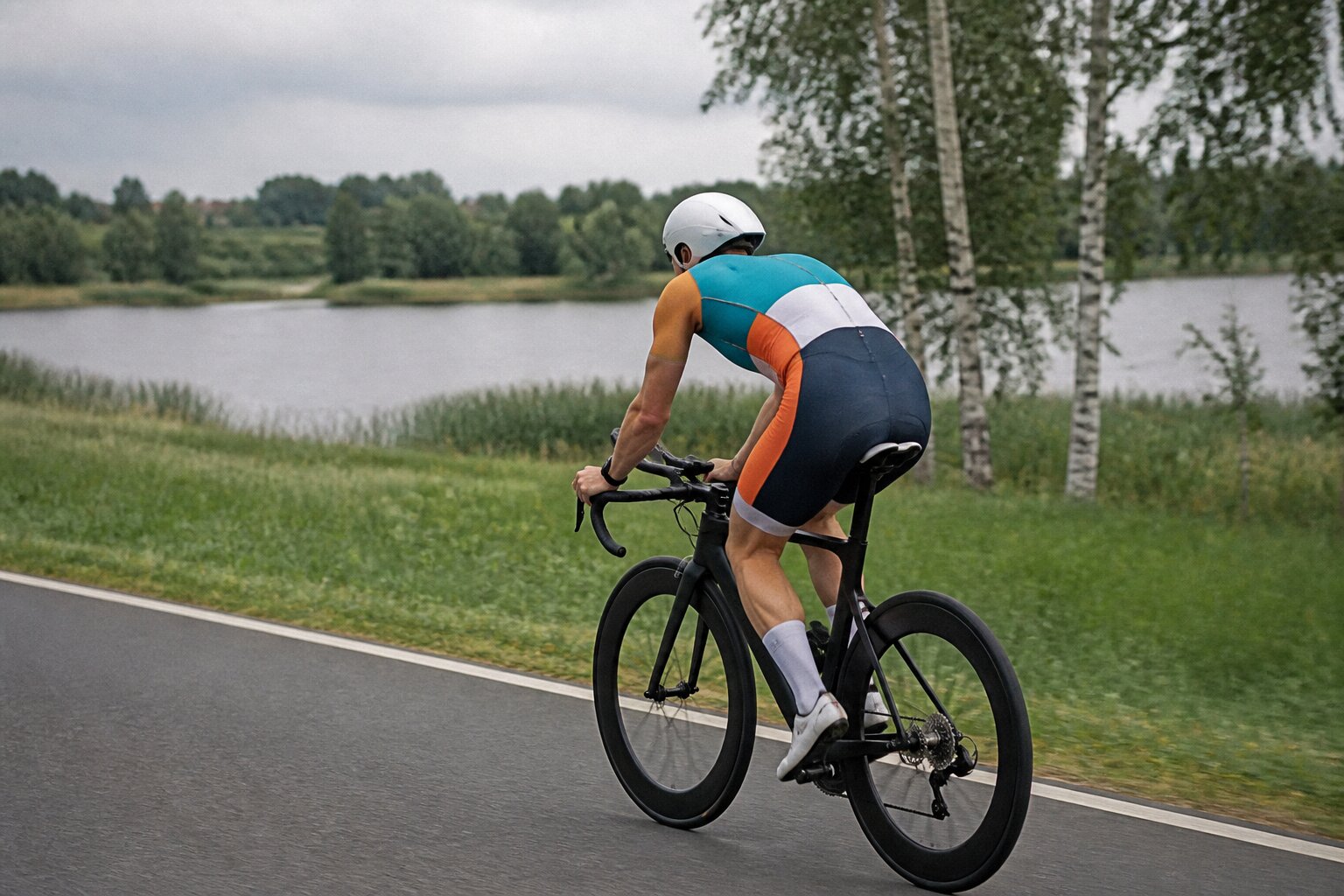
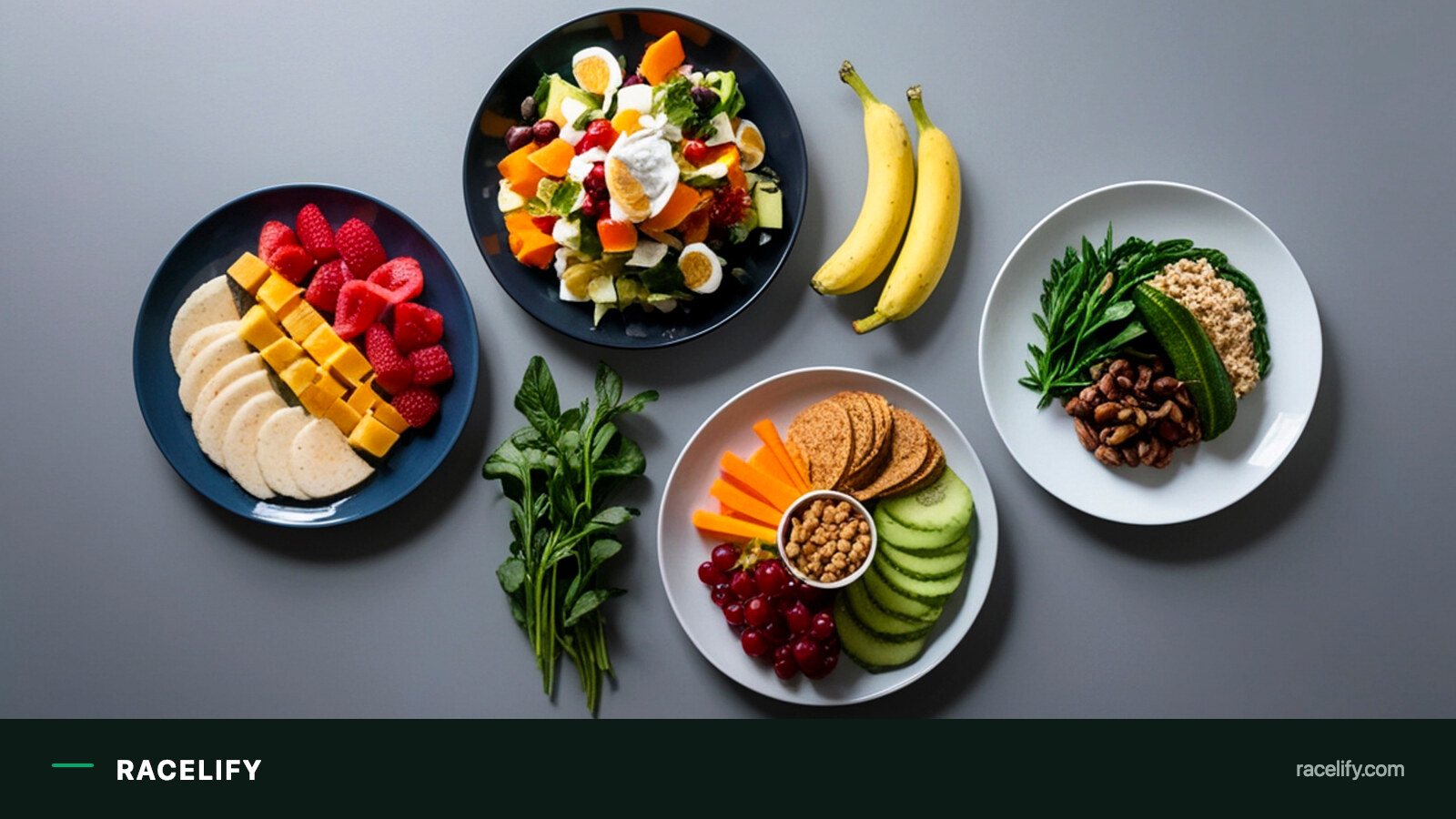
A triathlon run does not fail in the legs, it fails in the stomach. Most amateurs who fade in the final kilometres are not undertrained. They are running low on fuel, because they ate too little through the whole bike leg. The bike is the dining table. The only question is how much actually fits in an hour.
The numbers to start from
The longer the race, the more carbohydrate per hour it takes. Short efforts need roughly 30 to 60 g/h. Very long races need more. Specifically for triathlon:
70.3 (half distance): about 60 to 90 g/h
Full IRONMAN: about 90 to 120 g/h
Most of that dose gets taken on the bike. It is the calmest discipline, the one where the stomach tolerates food best. Everything bounces around on the run and absorption drops, so the bike is the moment to fill the tank completely.
Why glucose alone is not enough
This is where the physiology explains the rest. The gut absorbs glucose through a specific transport channel that has a ceiling, around 60 g/h. Anything above that sits in the stomach, ferments, and ends in cramps or a stop in the bushes. That is why 60 g/h was treated as the physical limit for years.
The breakthrough was a second channel: fructose absorbs through a separate route. Combining glucose with fructose bypasses the bottleneck and lets the body oxidise significantly more carbohydrate per hour. A 2:1 ratio of glucose to fructose was the historical standard; newer products lean toward 1:0.8. That is why modern gels and drinks list both sugars on the label. It is not marketing, it is gut throughput.
Individual tolerance: do not copy the pros
Before aiming for 120 g/h because that is what a champion does, remember the gut is not the same from person to person. The differences are large: some athletes do not absorb much more than 55 g/h, others handle 120 g/h or more over many hours of racing.
Which is why dosing should never be guessed on race day. It is set in training, gram by gram. The goal is the highest dose the stomach tolerates without revolt, not the highest number from a table online.
How to train the gut
The good news: gut throughput is a trainable trait, just like FTP. The bad news: it has to be trained deliberately, not left to chance on race day.
The method is simple. Pick long bike rides and treat them as a dress rehearsal for nutrition. Start from a dose already familiar, say 60 g/h, and add 10 to 15 g/h every few weeks. Train on the same gels and drinks planned for race day, since the stomach prefers what it already knows. After every ride, note what and how much was eaten and how the stomach reacted. After a few weeks, there is a proven personal strategy instead of a guess.
More fuel during the ride means less glycogen burned, which means more left for the final run, right when the competition is already slowing down.
The most common amateur mistake
It is not the wrong product or the wrong sugar ratio. It is simply eating too little, too late. The first gel should not wait for hunger or a drop in power, by then it is already too late and the energy deficit is building. Fuel from the first minutes of the bike leg, in a steady, regular rhythm, before the tank runs dry.
June, 11 a.m., 32°C (90°F), the sun fighting the shaded start of T2. You come off the bike with a plan: hold 5:10 per km. After 800 metres your body says no. By 2 km you’re slowing down. A familiar story.
The problem isn’t weakness, it’s a bad strategy. Running in the heat follows its own rules, and ignoring them costs minutes, and with bad pacing, costs your health.
Why Heat Wrecks Your Pace
Above 28°C (82°F) your body sends more blood to the skin to cool itself. Less blood reaches the muscles. Your heart rate climbs at the same pace you’d hold on a cooler day. This isn’t a motivation problem, it’s physiology.
Research on heat and endurance performance suggests that every 5°C (9°F) above the optimal starting temperature (roughly 12 to 15°C, 54 to 59°F) can slow an average amateur’s pace by 10 to 20 seconds per kilometre. Over 10 km that’s as much as 1.5 to 3 minutes.
Strategy: Forget Pace, Run on RPE
The key mistake on a hot run is fixating on pace from a cool day. In the heat, set a target RPE (rate of perceived exertion) instead of a speed.
For an IRONMAN 70.3 in the heat: target RPE 6 to 7/10 for the first 7 km, and let your body pick up the pace only in the final three
For a sprint or Olympic-distance race in the heat: RPE 7 to 8/10 for the first 3 km, then see what’s left in your legs
A Garmin or COROS watch will show your heart rate, which is a better measure of effort on a hot day than pace. A heart rate above lactate threshold in the first two kilometres is close to a guarantee of a blow-up in the closing stages.
Cooling: Before, During and After
Before the Run (Pre-Cooling)
The most effective method: an ice slushie or a cold drink 10 to 15 minutes before T2. Research shows that dropping core temperature by as little as 0.5 to 0.7°C (about 1 to 1.3°F) before the run start translates into noticeably better performance over the opening kilometres.
Other options: a wet towel on your neck and wrists while you wait for T2, a cold, wet headband.
During the Run
At every aid station take water and pour it over your head, neck and wrists, not just drink it. A wet shirt or a cap with a soaked brim noticeably lowers how hot your body feels for a few minutes.
If organisers hand out sponges, take all of them. Soaked shorts or socks are not a problem, overheating is.
Hydration and Electrolytes
General rule: 150 to 250 ml every 15 to 20 minutes in high heat. Water alone isn’t enough, heavy sweating strips sodium and potassium too. Electrolyte tablets or an isotonic drink at aid stations aren’t optional, they’re necessary in races above 25°C (77°F).
Warning sign: you stop sweating even though your body is hot. That’s a sign of dehydration or heat stroke, get off the course immediately.
Pacing: The Negative Split in the Heat
In normal conditions a negative split, the second half faster than the first, is a strategy for advanced athletes. In the heat it should be the default even for amateurs.
A starting plan for 10 km above 28°C (82°F):
km 1 to 3: 15 to 20 seconds per km slower than your target pace
km 4 to 7: watch your heart rate, hold RPE steady
km 8 to 10: if you have anything left, pick up the pace
Simple arithmetic: start too fast and you lose 2 to 4 minutes in the second half. Start sensibly and you gain 1 to 2 minutes at the end.
Heat Adaptation, If You Have Time
The body adapts to heat training within 10 to 14 days of regular exposure. You don’t need to train through the middle of the day right away, moving a few sessions to the 10 a.m. to 2 p.m. window for two weeks before a hot race is enough. The effect: better thermoregulation, a smaller heart-rate rise in heat, lower perceived effort.
A 20-minute sauna session after training works too, the same heat-adaptation effect without running in full sun.
Months of training are behind you, the taper is done, the gear is ready. Then at 5:30am you are standing in front of the fridge, unsure whether it is porridge or toast, a banana or nothing, or whether there is even time left to eat. Bad food decisions on race morning have wrecked better preparation than the worst training block ever could. Here is how to avoid that.
When to get up and when to eat
The core rule: breakfast 2 to 3 hours before the start. For an early race (6:00 to 7:00am) that means an alarm at 3:30 to 4:00am. Uncomfortable, but necessary. Eating 60 minutes before the gun is asking for stomach trouble in the water.
If the start is after 9:00am, there is the luxury of a normal morning routine.
Meal size: 1 to 4 g of carbohydrate per kilogram of body weight, depending on distance. Sprint or Olympic distance sits closer to 1 to 2 g/kg. A 70.3 or full Ironman needs 3 to 4 g/kg, because glycogen stores have to last far longer.
At a body weight of 70 kg racing Olympic distance, that works out to around 70 to 140 g of carbohydrate. A large bowl of porridge with banana and a spoon of honey lands in that range without any trouble.
What to actually eat
Tested options that will not let you down:
Porridge with banana and honey. A classic that works. Digestion is predictable, carbohydrate is high, fat is low.
White toast with jam or honey. Easy to digest and quick to absorb. Two to three slices is fine.
Bagel with jam. Popular among professionals. White flour, minimal fibre, plenty of starch.
White rice with banana. Sounds odd, but plenty of Ironman athletes use it, especially those prone to stomach trouble.
Gel or an isotonic drink as a top-up. If breakfast was three hours earlier, a gel or a banana 30 minutes before the start works well (one gel is roughly 20 to 25 g of carbohydrate).
What to avoid, and why
Fibre: wholegrain cereal, flaxseed, chia seeds, raw vegetables. Everything that is healthy day to day can force an unplanned toilet stop on the course before a race.
Fat: scrambled eggs with bacon, or avocado on toast, digest too slowly. Fat slows gastric emptying, and it can leave a heavy feeling through the whole bike leg.
New products: race day is the worst time to experiment. A new brand of energy bar bought at the expo on the way to registration should wait until after the finish.
High-fat dairy: Greek yoghurt or kefir can bring unpleasant surprises. Anyone who tolerates milk fine can still have it, but sparingly.
The evening before
There is room to get this right or to get it wrong here too. The dinner the night before should be carbohydrate-rich, pasta, rice, potatoes, with a moderate amount of protein and without excess fibre. Real carb loading starts 36 to 48 hours before the start, so the pre-race dinner finishes the process rather than starting it.
Avoid new restaurants and heavily spiced ethnic food. Not because the food is bad, but because the stomach deserves a quiet night.
30 minutes before the start
With time in the race zone and 30 minutes to go, an energy gel with 150 to 200 ml of water, or a banana muffin from a nearby café, both work. The goal is a small carbohydrate top-up that will not sit heavy on the stomach.
Avoid a large dose of caffeine at this point if it is not something the body is used to. But for anyone who drinks coffee regularly and uses caffeine as part of training, around 200 mg roughly 60 minutes before the start can genuinely help. Research backs this up.
One rule above all the others
Everything eaten on race day is worth testing beforehand, at least once, during a longer training session. No guide can replace knowing your own stomach. The body has memory and its own preferences. Train nutrition the same way swimming, riding and running get trained.
You’re training as usual, sleeping reasonably well, and your legs are still heavy, your heart rate takes longer to climb in training, and your form has stalled. Before blaming the plan, check something that doesn’t hurt and gives no clear symptoms until it’s already bad: your iron level, specifically ferritin.
Ferritin: the store that runs out first
Iron fuels oxygen transport. Without it, haemoglobin can’t carry oxygen from the lungs to the muscles, and mitochondria can’t turn it into energy. The problem is that the body empties its store first, and ferritin is the measure of that store.
That’s where the trap sits. The standard lab range treats ferritin of 12 ng/ml as normal. That threshold was set for the general population and misses the deficiency that actually limits performance. For women in endurance sport, 35 to 40 ng/ml is usually treated as the minimum for good form, and a range of 50 to 70 ng/ml is sometimes recommended for good recovery, energy and injury protection. So you can have a result that’s technically normal and still be running on fumes.
The most dangerous version is so-called iron deficiency without anaemia. Haemoglobin still looks fine, so a GP says everything’s normal, while ferritin is already on the floor and quietly suppressing performance. A systematic review covering 669 female athletes found that iron deficiency lowered endurance capacity by 3 to 4% compared with athletes at normal levels. Over the finish line of a 70.3, that handful of percentage points is worth ten-plus minutes.
Why triathletes lose iron faster
This isn’t about poor diet. The sport itself increases losses, through several mechanisms:
Footstrike haemolysis. Every running stride causes micro-damage to red blood cells in the foot. The more you run on hard surfaces, the bigger the losses.
Sweat. You lose iron through sweat, and triathletes sweat a lot and often.
Small gastrointestinal bleeds during long, intense efforts.
Menstruation. For women, it’s one of the main reasons deficiency is far more common.
Hepcidin. A hormone that rises after intense exercise and blocks iron absorption in the gut exactly when you need it most.
Iron deficiency affects roughly 15 to 35% of female athletes and 3 to 11% of male athletes. Among competitive runners and triathletes, an estimated 55 to 60% of women and 31 to 37% of men go through at least one deficiency episode during their career. In one study of recreational female runners, nearly three-quarters had ferritin below 15 ng/ml despite showing no signs of anaemia.
Don’t guess, test
The most important rule: don’t supplement iron blind. Excess iron is harmful, and the body has no efficient way to get rid of the surplus. Instead of guessing, get a blood test that includes ferritin, ideally alongside a full blood count and transferrin saturation. That helps separate a genuine deficiency from a temporary dip after a heavy training block, because ferritin also behaves as an inflammation marker and can read high right after a hard effort.
Leave interpretation and any supplementation decision to a doctor or sports dietitian. This article is background knowledge, not medical advice. Dose and form of any supplement should be decided individually.
How to supplement iron sensibly
If a deficiency is confirmed, research in recent years has changed the approach to dosing:
Less is more. Lower doses, in the range of 40 to 80 mg of iron, maximise the percentage actually absorbed. Splitting the dose into two a day doesn’t help, it just raises hepcidin.
Every other day instead of daily. After a dose of iron, hepcidin stays elevated for about 24 hours, blocking further absorption. Dosing every other day improves iron uptake and causes fewer stomach side effects. Ferritin rises at a similar rate over 8 weeks on both daily and alternate-day schedules, but the alternate-day one is gentler on the gut.
Vitamin C helps. Taking iron on an empty stomach with vitamin C increases absorption by around 65%.
Keep it away from coffee, tea and calcium. Coffee can cut iron absorption by as much as 39%, tea by up to 64%, and calcium by up to 50%. Leave a gap of at least 2 hours.
The practical takeaway: a single moderate dose every other day, on an empty stomach, with vitamin C, away from morning coffee, works far better than swallowing a large dose daily and washing it down with a latte.
Summary
Iron is one of the few markers where a single blood test can explain weeks of unexplained fatigue. If your form has stalled for no clear reason and you run a lot or menstruate, check ferritin before prescribing yourself another hard block. The best training plan is worthless if your blood has nothing to carry oxygen with.
The peloton of the Tour de France 2026 rides into another mountain stage, and a soigneur from UAE Team Emirates-XRG hands Tadej Pogačar a bottle with something new in it. It doesn’t only contain glucose and fructose. It also contains lactate, a compound athletes were taught for decades to avoid, and which is now being sold as fuel.
This isn’t a forum rumour. Enervit and its rival From Lab to Field have officially confirmed testing lactate gels and drinks during this year’s Tour. It’s the question every amateur triathlete asks: does this actually make sense for them, or is it another fad that will vanish from the shelves as fast as it appeared?
What lactate actually is as fuel
Forget what you were taught in PE class. Lactate, lactic acid in its dissociated form, is not waste that “acidifies” muscles and needs to be “flushed out” with a jog. This is established physiology, confirmed for decades: the lactate shuttle theory, developed by Prof. George A. Brooks of UC Berkeley, shows that muscles, the heart and the brain use lactate as an energy source in real time, during exercise. This isn’t speculation, it’s textbook exercise physiology.
The novelty isn’t the knowledge about lactate itself. It’s the attempt to deliver it externally, in a form the body can actually use without triggering a stomach disaster. A standard carbohydrate gel has a natural ceiling: glucose enters the bloodstream through a single intestinal transporter, and above 60g/h it stops giving any extra benefit. Adding fructose, which uses a different transporter, raises that ceiling to 90-120g/h, and that’s the basis of today’s carbohydrate gels. Lactate manufacturers claim it enters through a third, independent pathway, so in theory it could push that energy limit even higher. In theory, and that word does all the work here.
Who’s testing it, and what’s actually in it
Two specific products are circulating at the Tour, not one.
On sale after the Vuelta a España 2026 (September)
ExoLactate is the result of seven years of work by Aitor Viribay, a doctor of exercise physiology and former head physiologist at Ineos Grenadiers, now working in performance at Salomon. Enervit, meanwhile, doesn’t use its product routinely on every stage. UAE Team Emirates-XRG’s nutritionist, Gorka Prieto-Bellver, told Cyclingnews plainly: “we use it when it’s needed, not always… on stages where energy expenditure is high.” That sounds reasonable enough, since the team itself admits it’s still testing rather than running a proven protocol.
What the research confirms, and what is marketing
This is where physiology needs to be separated from sales.
Prof. Brooks, whose years of research Enervit built this product on, called C2:1PRO “a breakthrough that starts a new era in sports nutrition.” That’s a quote repeated in the manufacturer’s promotional material, not a conclusion from an independent clinical trial. Worth keeping those two things apart.
The actual research says little, and what exists is mixed. A randomised, double-blind crossover study from 2024 (Ewell et al., published in Nutrients) was not conducted on professionals: it involved 15 recreationally active people with an average age of 24, and the authors note that none belonged to the elite. Calcium and magnesium lactate supplementation didn’t change VO2peak, lactate threshold or ventilatory threshold. It recorded a 4 percent increase in average power over a 20-minute time trial, with no change in heart rate or perceived exertion. That’s a signal, but from a small pilot sample of amateurs, not proof for a professional.
A second 2024 study (Bordoli et al.) went the other way and involved 16 trained cyclists, at a higher dose of about 120mg/kg of body weight, roughly 8g for a 70kg (154lb) rider. Across five repeated blocks with 1km and 4km trials, it showed no time benefit at all, even though it raised blood bicarbonate levels and lowered perceived exertion. A 2025 study from the University of Tokyo (Seike, Takahashi, Hatta) confirmed that the body metabolically uses orally administered lactate, but it also found no breakthrough in performance.
The shared conclusion from these three studies: exogenous lactate works mostly as a mild acid-base buffer, similar to the already familiar sodium bicarbonate. It reduces perceived exertion and changes blood chemistry, but doesn’t reliably produce a measurable time advantage. Olav Bu, head of performance at Uno-X Mobility, is even more reserved in comments to Cyclist magazine: lactate delivers less energy than glucose for a similar absorption cost, and his team’s own research hasn’t yet found a “hard ceiling” for exogenous carbohydrate oxidation. Until that ceiling is established, lactate remains a less efficient fuel than what’s already known.
Gut tolerance: promising, but not independently confirmed
Manufacturers and some riders report that the new formulations, in ExoLactate’s case at a dose of 15-25g of lactate per hour, cause less gastrointestinal irritation than earlier, prototype versions of lactate supplements. That matters, because previous attempts at oral lactate had exactly this problem: it was hard to absorb a meaningful dose without stomach pain during exercise.
It’s worth being precise here, though: these are reports from the manufacturer and athletes at the race, not the result of a controlled study on gut tolerance under race conditions. No such study exists for this specific formulation. Lactate is, however, a substance the body produces naturally, so these products aren’t on the prohibited substances list. That’s one of the few things here that can be stated without qualification.
What this means for you as an amateur
Neither of these products is available for normal purchase yet. ExoLactate will reach the market after the Tour de France 2026 ends, Enervit C2:1PRO after the Vuelta a España, in September. Neither manufacturer has released a retail price yet, so there isn’t one here either. Don’t guess at it based on comparisons to gels like Maurten.
Before you trade a proven carbohydrate gel for something with lactate, it’s worth remembering: the strategy of 90-120g of carbohydrate per hour in a glucose-fructose mix has decades of research and years of race testing behind it. Lactate has three small, contradictory studies behind it and an enthusiastic quote from a press kit. That doesn’t mean the topic is meaningless, since Aitor Viribay spent seven years on this and UAE Team Emirates-XRG wouldn’t be testing it without reason on cycling’s biggest stage. It means that, for now, this is an elite experiment, not a protocol ready to copy for your next half-distance race.
If this topic intrigues you, watch what appears after September, and don’t try anything new for the first time on race day. That rule applies to lactate even more than to an ordinary gel, since there’s far less data on its tolerance under race conditions.
You would think a triathlete, someone who spends long hours outdoors on a bike or in running shoes, would be the last person to worry about vitamin D.
The research says otherwise. Deficiency shows up in endurance athletes surprisingly often, including well-tanned ones. The reason is geographic and biological, and it applies directly to anyone training and living in countries with less sun.
Sun caught during a session is not enough on its own. Here is why, and how the theory translates into watts and faster recovery.
1. Why sunlight is not always enough for a triathlete
Skin only produces vitamin D when the sun sits high enough in the sky. From October to March the angle of UVB radiation is too low for any synthesis to happen in the skin, even on a training run in full sun with no shirt on.
That is not the whole story. Even in summer, when sunlight is theoretically plentiful, triathlon habits themselves get in the way:
UV filters (SPF 30/50): sensible sun protection against burns and melanoma during a five-hour ride is the right call. But an SPF 15 sunscreen blocks vitamin D synthesis by more than 95%, and SPF 30 blocks it almost completely.
Training hours: to fit sport around work and avoid summer heat, most training happens early morning or late afternoon, when the sun’s angle rules out skin synthesis.
Technical clothing: fitted cycling and running kit covers most of the body.
The result is a season spent covering thousands of kilometres, a cyclist’s tan lined up perfectly with shorts and jersey, and an autumn that starts with an empty vitamin D reserve.
2. What vitamin D does for muscles and bones
For an athlete this is not just an “immunity” vitamin. It behaves as a hormone with a strong anabolic and metabolic role.
Faster type II muscle fibres
Vitamin D receptors sit directly in muscle tissue. A deficiency leads to fatty degeneration of type II fibres, the fast-twitch fibres responsible for a finishing kick, power on climbs, and sudden force output on the bike.
Protection against stress fractures
Without vitamin D, calcium absorption in the gut drops sharply, by as much as 50 to 80%. You can drink litres of isotonic drinks and eat a dairy-rich diet, but with low vitamin D your bones will still lose density. Combined with a high running volume, that is a straight path to stress fractures that can end a season for months.
Faster recovery and lower inflammation
An optimal vitamin D level suppresses pro-inflammatory cytokines and speeds up repair of muscle micro-damage after hard sessions. Research also shows a clear correlation between high blood levels of 25(OH)D and a higher VO2max in endurance athletes.
The enzymes that activate vitamin D in the liver and kidneys need magnesium to work. If you train hard, sweat heavily and run low on magnesium, even high doses of vitamin D may raise your blood level poorly. Keep the two in balance.
3. Target levels for athletes: Polish 2023 guidelines
Vitamin D status is measured through the blood metabolite 25(OH)D. Under the latest official guidelines for Central Europe (Płudowski et al., 2023), your supply status breaks down as follows:
25(OH)D (ng/ml)
25(OH)D (nmol/l)
Status
What it means for a triathlete
0 to 20
0 to 50
Deficient
Red flag. Loss of form, higher injury and infection risk. Needs prompt treatment.
>20 to 30
>50 to 75
Suboptimal
Too low for an athlete. Needs a supplementation correction.
>30 to 50
>75 to 125
Optimal, the target
The level that delivers full health and performance benefits.
>50 to 100
>125 to 250
High
Safe, but with no extra benefit beyond the optimal range.
>100
>250
Toxic
Poisoning risk. Supplementation should stop immediately.
While a level of 30 ng/ml is enough for an inactive person, endurance athletes aim to hold a stable level between 40 and 50 ng/ml.
4. How much to supplement: prevention versus treatment
Dosing should match your current blood result and the time of year.
Prevention, for healthy adults
If between May and September you train in full sun, arms and legs uncovered, no SPF, for at least 30 to 45 minutes between 10:00 and 15:00, you can skip supplementation over summer. Otherwise, and as standard from October to April:
At a normal body weight: 1,000 to 2,000 IU a day (cholecalciferol).
With overweight or obesity, BMI over 30: double the dose, 2,000 to 4,000 IU a day, year-round.
Treating a confirmed deficiency, 20 ng/ml or below
If testing shows a deep deficiency, a preventive 2,000 IU will not be enough. A treatment protocol is then run under a doctor’s or dietitian’s supervision:
Therapeutic doses: typically 4,000 to 10,000 IU a day for one to three months, depending on the severity of the deficiency and body weight.
Bundled dosing: current guidelines allow safely bundling doses, for example once a week at 20,000 to 30,000 IU instead of small daily amounts, a useful option for anyone who forgets a daily pill.
Follow-up: after 8 to 12 weeks of treatment, retest, and once the target level is reached, above 30 to 40 ng/ml, switch to a maintenance dose.
A note of caution: current guidelines advise against single, high-dose “mega” boosts, for example 100,000 IU at once, in Poland without a clear clinical indication, because of the load on the kidneys. Steady daily or weekly supplementation is considerably safer.
5. How, when and for how much to test vitamin D
For a triathlete, the rule is simple: test first, then dose. Vitamin D is fat-soluble and accumulates in the body, so it should not be taken blind in very large amounts.
Cost: a private 25(OH)D test at a lab typically runs about $20 to $60 – depending on country. Look for “packages for runners” or “active people”, which often bundle a blood count, iron and ferritin with the vitamin D test at a better combined price.
When to test: March or April, at the end of winter, is when levels are at their lowest, a true test of whether winter supplementation worked. October, at the end of the season, shows how well natural summer sun protected you into autumn.
Preparation: you do not need to fast, unless other parameters are being tested too. Stop vitamin D supplementation 3 to 5 days before the blood draw, so the result reflects your real stored reserve rather than a recently taken capsule.
Take vitamin D with a meal that contains some fat, for example with scrambled eggs, a meal with olive oil, avocado or peanut butter. Taken on an empty stomach it absorbs poorly.
Vitamin D is one of the cheapest, and most underrated, performance factors in endurance sport. Get tested, plan supplementation around the result, and do not let one small blood parameter cost you power on the day that matters most.