Category: Swim

  • Sighting in Open Water: How to Swim a Straight Line

    Sighting in Open Water: How to Swim a Straight Line

    In a pool, there is a line on the bottom and a wall every 25 metres. In open water, there’s nothing. That’s why two swimmers with an identical pace can exit the water at very different times: one held a straight line, the other zigzagged and added hundreds of extra metres. The skill that decides the difference is sighting, a controlled glance at the buoy. Here is how to do it well without losing pace.

    Crocodile eyes, not a raised head

    The most common mistake is lifting the whole head out of the water. A high head pushes the hips and legs down, which slows you and wastes energy. Instead, use the crocodile eyes technique: lift your head only enough to clear your eyes above the surface, take a quick look, and drop your face straight back down. Surface as little as you need to, not a centimetre more.

    Combine sighting with breathing

    Sighting the buoy and breathing are one movement, not two. Look forward at the buoy first, then rotate your head to the side to take a breath: sight, then breathe. This way you avoid adding a separate, costly head lift to every stroke cycle. Kick a little harder at the moment you sight, to hold speed and stop your hips from dropping.

    The three-look rule

    A reliable system: sight two to three times in a row, every other arm stroke. The first look locates the buoy, the second corrects the angle, the third confirms direction. Then swim blind, straight, for 20 to 30 seconds and repeat. You don’t need to look on every stroke, that only slows you down. Adjust frequency to conditions: sight more often in chop and with sun in your eyes, less often on calm water.

    Training: start in the pool

    Sighting isn’t something to practise for the first time on race day. Build it into pool sessions: every few strokes, lift your eyes and look at the wall as if it were a buoy. Practise bilateral breathing too, a symmetrical breathing pattern keeps the stroke balanced and limits the natural drift to one side that pulls many swimmers off course. In open water before a race, swim a few stretches sighting on a fixed point on shore, to check how much the current or wind is pushing you off line.

  • Torso Rotation in Front Crawl: Swim Less Flat

    Torso Rotation in Front Crawl: Swim Less Flat

    Most amateur triathletes swim front crawl flat: chest glued to the surface, the stroke driven by the arms alone. The result is a short, jerky pull, overloaded shoulders, and a pace that refuses to move no matter how many hours go into the pool. One thing is missing: torso rotation. It turns swimming from tiring arm-waving into a long, efficient glide.

    What rotation actually does

    When you rotate the torso around the body’s long axis, you bring the lats and the core into the work, alongside the shoulders and arms. The underwater pull gets longer, because the arm reaches further on entry and the hip adds force to every stroke. It is like rowing with the whole body instead of the forearm alone.

    Rotation gives three concrete benefits: a longer stroke (fewer cycles per length), a lower risk of shoulder overload, because the force comes from the big muscle groups, and easier breathing, since the mouth clears the water on its own during the turn instead of you having to crane the neck.

    How much to rotate, and when it is too much

    This is not about rolling side to side like a log. Aim to rotate both hips and shoulders together, enough that the body is clearly on its side but still moving in a stable line. Coaches quote different numbers here, most commonly around 30 to 45 degrees to each side (some technique schools go lower), and the exact range is individual. What matters is that both sides rotate evenly: rotate hard only toward your breathing side and you become asymmetric, drifting into a zigzag.

    Too much rotation is also a mistake. Roll almost onto your back and you lose balance, the legs drop, and the whole body brakes. The target is enough to engage the torso, and no more than that, so the water line stays intact.

    Three common mistakes

    • Rotating from the shoulders, not the hips. You twist the arms while the hips stay flat. Force never travels through the torso, and the spine takes the twist instead. Start the rotation from the hips; the shoulders follow.
    • Snaking. Uneven rotation combined with crossing the hand over the body’s centreline sends you swimming in a sine wave. It adds distance and burns energy on correcting course.
    • Rotation that stalls on the breath. Many swimmers freeze on their side waiting to inhale. The breath should be part of the continuous rotation, not a pause in it.

    Four drills that fix it

    1. 6-3-6 (six-kick switch). Swim on your side with one arm extended forward, the other at the hip, face down. Six kicks on one side, three strokes, six kicks on the other. Teaches balance on the side and a controlled transition through the rotation.
    2. Side kick, with or without a board. On your side, lower arm extended, kicking while holding a stable position. You feel how to balance the body in rotation without panicking.
    3. Fingertip drag with a hip cue. The classic fingertip drag on the recovery, but you consciously start each stroke from a hip rotation. It links a high elbow with rotation.
    4. Single-arm swimming. Swim with one arm, the other extended forward or resting at the hip. Without the other arm to help, torso rotation has to drive the stroke, and the flaw shows up immediately.

    Use these as a warm-up or work them into a technique set two to three times a week. Technique does not improve from one session; it needs repetition until the new pattern becomes a habit.

    Taking it to open water

    In open water, rotation works even harder in your favour. A stable balance helps you hold a line through chop, and a smooth rotation makes it easier to combine breathing with sighting. A swimmer who rotates evenly on both sides can breathe to either side, which is invaluable when the sun or the swell is hitting you from one direction.

    Try one thing at your next session: count your stroke cycles per length, correct the rotation from the hips, then count again. If the number drops at the same pace, that is proof it works.

  • Bilateral Breathing: Why You Need It and How to Learn It

    Bilateral Breathing: Why You Need It and How to Learn It

    Most triathletes breathe to the same side every time they swim freestyle. It is comfortable, familiar, safe, and that is exactly why it quietly slows you down. Bilateral breathing, breathing to both sides, is not a technique flex. It is a tool that evens out your stroke and saves you in open water when the chop happens to be hitting your “good” side.

    Why one side is a trap

    When you breathe only to the right, your body rotates harder to that side. Over time this locks in an asymmetry: one arm works differently from the other, the pull on the “weaker” side is shallower, and your body position in the water drifts slightly sideways. In the pool it gets away with it. In open water that drift adds metres you cannot see, and energy you waste.

    Breathing to both sides forces even pulls and more symmetrical rotation. The result is a smoother, better balanced stroke and more evenly developed muscles. In other words, you learn to swim straight.

    The real advantage is in open water

    This is where bilateral breathing stops being pool theory. Race conditions are rarely ideal:

    • Chop and splash coming from one side: you can breathe to the sheltered, dry side instead of swallowing water.
    • Low sun blinding you from one direction: turn your head the other way.
    • Crowded starts: if someone is right at your shoulder, breathe to the opposite side to avoid a head clash or a mouthful of water.
    • Sighting: you see the buoys and rivals on both sides, so it is easier to hold your line.

    A swimmer who can only breathe one way loses every one of those options in open water, exactly when they matter most.

    How to learn it: from basics to rhythm

    Do not jump straight into the hard pattern. Build it in layers.

    • Start with breathing every 2 strokes to your comfortable side, until it feels completely relaxed and you are never short of air.
    • Move to breathing every 3 strokes, the classic bilateral pattern, because it automatically switches sides on every breath. Your “weak” side will feel clumsy at first. That is normal.
    • Add longer patterns, every 5 and every 7 strokes, in short reps, to get comfortable holding your breath and to force a calm, controlled exhale underwater.

    The key is exhaling underwater. Most breathing problems come from holding your breath and then trying to exhale and inhale in a split second above the surface. Exhale steadily the whole time your face is in the water, so that all that is left above the surface is a quick inhale. That is what keeps breathing smooth and out of the way of your technique.

    Drills that speed it up

    Willpower alone is not enough. Technique comes from drills that isolate individual elements:

    • Single-arm swimming: one arm works while the other stays extended in front or at your hip. It forces rotation and teaches breathing on both sides.
    • Side kick: lying on your side with one arm extended and the other at your body, gently turning your head to breathe. Builds the stability and position typical of open water.
    • The “zipper” drill: your hand slides along your body like a zip, forcing smooth rotation and head turn. Ideal for practising bilateral breathing.
    • Centre snorkel: removes the need to turn your head, so you can focus on body position and arm work before adding the breath.

    Weave them into your warm-up and technique work: a few 25m reps, unhurried, with the focus on quality of movement rather than pace.

    One nuance for race day

    Bilateral breathing is a great training tool and a rescue skill for open water, but it is not a rule for race day. During the hard effort of a start, when your body is calling for oxygen, breathing every 3 strokes can leave you short. Many racers breathe every 2 strokes to a chosen side during the race itself, and switch to bilateral only when conditions force it: chop, sun, a swimmer at their shoulder.

    Train both sides so that on race day you have a choice. The goal is not a rigid rhythm but freedom: you can breathe either way, so conditions cannot catch you out.

  • SWOLF and Swimming Economy: Where You Lose Time

    SWOLF and Swimming Economy: Where You Lose Time

    The watch shows you swam 1500 m in the same time as a year ago, despite training more. The problem is rarely fitness. More often it is how much effort gets wasted every hundred metres. That is why SWOLF is worth knowing.

    What SWOLF is

    SWOLF is short for Swim Golf, and the scoring works exactly like golf: lower is better. Two numbers go into it:

    • time to cover one pool length, in seconds
    • stroke count over the same length

    Add them together. The result is your SWOLF.

    Example: you swim 25 m in 35 seconds with 20 strokes (single-arm cycles). SWOLF is 55. Next time you cover the same 25 m in 33 seconds with 18 strokes: SWOLF is 51. That is a four-point improvement, even if the difference was not obvious to the eye.

    Why it matters for a triathlete

    Runners measure running economy in watts or pace per watt. Cyclists have FTP and TSS. Swimmers mostly measured pace for years, but pace tells you how fast, not how efficient. SWOLF links speed with technique.

    In triathlon, fatigue builds through the swim to the finish. Inefficient technique costs energy that will not come back on the bike. Someone with weaker aerobic fitness but better technique often exits the water almost as fast, and with a noticeably smaller energy deficit.

    How to measure SWOLF

    The simplest way is a sports watch. Garmin, COROS, Suunto and Polar all calculate SWOLF automatically during pool swimming. Start pool swim mode, swim, and the watch counts strokes and time. Once the session ends, there is a SWOLF value per length and an average for the whole workout.

    Without a watch, it can be done by hand: have someone time the swim with a stopwatch and count strokes. One measured session a week is enough to track progress.

    What the numbers mean

    Rough benchmarks for a 25 m pool, freestyle:

    • below 35: elite level, rarely seen among amateurs
    • 35 to 45: very good efficiency, a technically trained amateur
    • 45 to 55: average for regularly training adults
    • above 55: significant technical room, the biggest potential for improvement

    In a 50 m pool the numbers run higher: a result in the 70s over 50 m is very good economy.

    Compare SWOLF against your own numbers, under the same conditions: same pool, similar fatigue. Comparing it against a training partner makes little sense if you have different heights and arm spans.

    The trap: a low SWOLF for the wrong reasons

    SWOLF drops when you swim slower with long strokes, and rises when you thrash through short, fast ones. Neither extreme is ideal. The goal is the right balance of pace and stroke count, not minimising either number at any cost.

    So do not track SWOLF alone. Track it alongside pace. If SWOLF drops by 4 points but pace slows by 5 seconds per 100 m, something has gone wrong.

    How to improve SWOLF: three routes

    1. Increase distance per stroke (DPS)

    DPS, distance per stroke, is how many metres you cover per arm cycle. Longer is better, since it means less work for the same distance. Useful drills: closed-fist drill, single-arm drill, catch-up drill. Each one teaches you to engage the catch before pulling, which produces propulsion for less effort.

    2. Cut frontal drag

    A great pull can still lose energy if the body is not sitting flat in the water. Legs dropping, the hand crossing the midline on entry, lifting the head to breathe: each of these creates drag that raises the number of strokes needed per metre. Footage shot from the side and from underwater often reveals faults that are hard to feel.

    3. Find your optimal stroke rate

    Too slow a stroke rate loses momentum between strokes. Too fast and the strokes get short and inefficient. For triathlon distances of 1.5 km and up, most amateurs settle around 55 to 65 cycles a minute, though it is individual. Rather than copying someone else’s rate, adjust gradually and watch how SWOLF responds at a fixed pace.

    How much you can gain

    Most adult amateur swimmers can improve SWOLF by 5 to 10 points after a few months of consistent technique work. For scale, 10 points in a 25 m pool over an Olympic-distance 1500 m swim means a few hundred fewer strokes, and correspondingly less energy spent, energy that stays available for the bike.

    Start with one measured session a week. Write down the result. Come back in a month and compare.

  • How to Find Your Optimal Swimming Pace

    How to Find Your Optimal Swimming Pace

    Swimming is a physical activity, and it’s also an exercise in managing pace: a mix of technique, endurance and strategy in the water. Many swimmers ask themselves one question: what pace is actually good for me? There’s no single answer, because it depends on training level, distance, stroke and conditions in the water. Understanding and setting your own pace is central to effective training, better results and enjoying every metre in the water. The sections below look at swim pace from a few different angles.

    Pool Swim Pace

    Why Pool Pace Matters

    Pool pace is the basic measure of a swimmer’s progress. Tracking the time needed to cover a set distance lets you gauge your current level and plan your next training targets. Stroke efficiency and technique have a direct effect on speed, so refining technique matters as much as building fitness. A few tools help track pace:

    • Stopwatches and timers: the classic method, good for anyone who wants to focus purely on timing without distracting extras.
    • Sports watches with swim tracking: modern devices that measure distance, pace and stroke count, and analyse efficiency from motion sensor data.

    Regular measurement makes it possible to track progress and adjust the training plan based on results.

    Typical Pace by Swimmer Level

    Pool pace varies significantly by training level:

    • Beginners: around 2:00 per 100 m on average. At this stage, the priority is building efficient technique and a base level of endurance.
    • Intermediate swimmers: pace sits around 1:30 min/100 m, alongside more training aimed at technique and conditioning.
    • Elite swimmers: times below 1:00 min/100 m reflect a very high level of technique and endurance.

    Research published in the Journal of Sports Sciences, among other journals, backs this up: regularly tracking pace supports effective development of swimming skill.

    Open Water Swim Pace: Conditions and Challenges

    What Determines Pace in Open Water

    Swimming in open water, lakes, rivers or the sea, is significantly harder than swimming in a pool. Currents, waves, water temperature and visibility can slow pace by as much as 5 to 20 seconds per 100 m compared with the pool. Tougher conditions raise fatigue and demand more, both physically and mentally.

    At IRONMAN races, for example, the swim takes place in open water, where even experienced triathletes have to expect a slower pace than they would hit in the pool.

    Elite Pace: The World’s Best

    The best 10 km open water swimmers hold a pace of around 1:12 per 100 m, the product of years of training, technique and race strategy. Their pace over sprint open water distances is faster still.

    How Stroke Affects Pace

    The Fastest Strokes: Freestyle and Backstroke

    • Freestyle is the fastest and most efficient stroke. It delivers the highest speeds and is the default for amateurs and professionals alike.
    • Backstroke is slower, but more comfortable and puts less strain on certain muscle groups, which helps during longer sessions and rehab work.

    Butterfly and Breaststroke: Demands and Traits

    • Butterfly demands strength and endurance, is technically difficult and hard to hold over long distances. Good technique matters here in particular, to avoid injury.
    • Breaststroke is the slowest stroke, but popular with amateurs for its comfort and relatively low demand on the respiratory system.

    For performance, and for triathlon specifically, freestyle is the stroke most commonly recommended.

    Swim Pace in Triathlon

    Pace Among Professionals

    Top triathletes swim around 1:15 min/100 m for men and 1:20 min/100 m for women. Those times come from strong technique, well-planned training and the ability to adapt to changing conditions.

    Gear and Conditions

    A wetsuit in open water races improves buoyancy and reduces drag, which can shave a few seconds off pace per 100 m. Calm, warm conditions favour faster times, while rough weather demands more flexibility and adaptability from the athlete.

    What Counts as a Good 1K Pace?

    Elite Numbers

    Elite swimmers cover 1 km in under 10 minutes, reflecting a very high level of fitness, technique and endurance.

    Amateur Benchmarks

    For recreational swimmers, or those preparing for a first race, hitting around 20 minutes is already a solid target to train toward. A time under 15 minutes points to strong fitness.

    Tracking and Planning Progress

    Regular time trials over 1 km, under controlled conditions, help assess training effectiveness and set realistic goals. Using data such as 100 m pace makes it possible to predict and plan results over longer distances.

    Planning Swim Training Around Pace

    Structure and Periodisation

    Consistency is the foundation. A training plan should include technical sessions (stroke work), endurance sessions (longer sets in the aerobic zone), intervals (high intensity, for example 4×100 m with 30 seconds’ rest) and recovery.

    A Sample Microcycle for an Intermediate Swimmer

    • Monday: 1500 m warm-up, 6×100 m at threshold pace (around 1:30 min/100 m), 200 m cool-down
    • Wednesday: 800 m technique work, 4×50 m sprint, 600 m easy swimming
    • Friday: intervals, 10×100 m at RPE (Rate of Perceived Exertion, a subjective sense of intensity) 7 to 8 out of 10, with 20 seconds’ rest
    • Sunday: 2000 m continuous, steady swimming at zone 2 pace (moderate endurance, around 65 to 75% of maximum heart rate)

    Reading the Data

    • Heart rate zones: help pin down effort level. Zone 2 is a comfortable pace where the body burns mostly fat.
    • FTP (Functional Threshold Pace): the threshold pace a swimmer can hold for roughly 30 to 60 minutes, central to anaerobic threshold work.
    • TSS (Training Stress Score): a measure of overall training load that accounts for both intensity and session length.

    Tracking these numbers regularly helps prevent overtraining and helps keep motivation up.

    Recovery, Nutrition and Mental Preparation

    Proper recovery, good sleep and balanced nutrition are essential to improving both pace and endurance. Sleep restores the nervous system and lets muscles rebuild. Carbohydrates are the primary fuel, and protein supports muscle repair. On the mental side, visualisation and mindfulness help manage race-day nerves and keep focus in the water.

    Swim Pace Is Something You Shape

    Swim pace isn’t fixed. It shifts with deliberate training, better technique and mental preparation. Whether you’re new to swimming or working to improve a triathlon split, the fundamentals are patience, consistency and setting realistic new goals. Start by measuring your current pace, then build a training plan on that baseline: each metre gets easier to cover from there.
  • Deep Water Start: A Guide to the First 200 Metres

    Deep Water Start: A Guide to the First 200 Metres

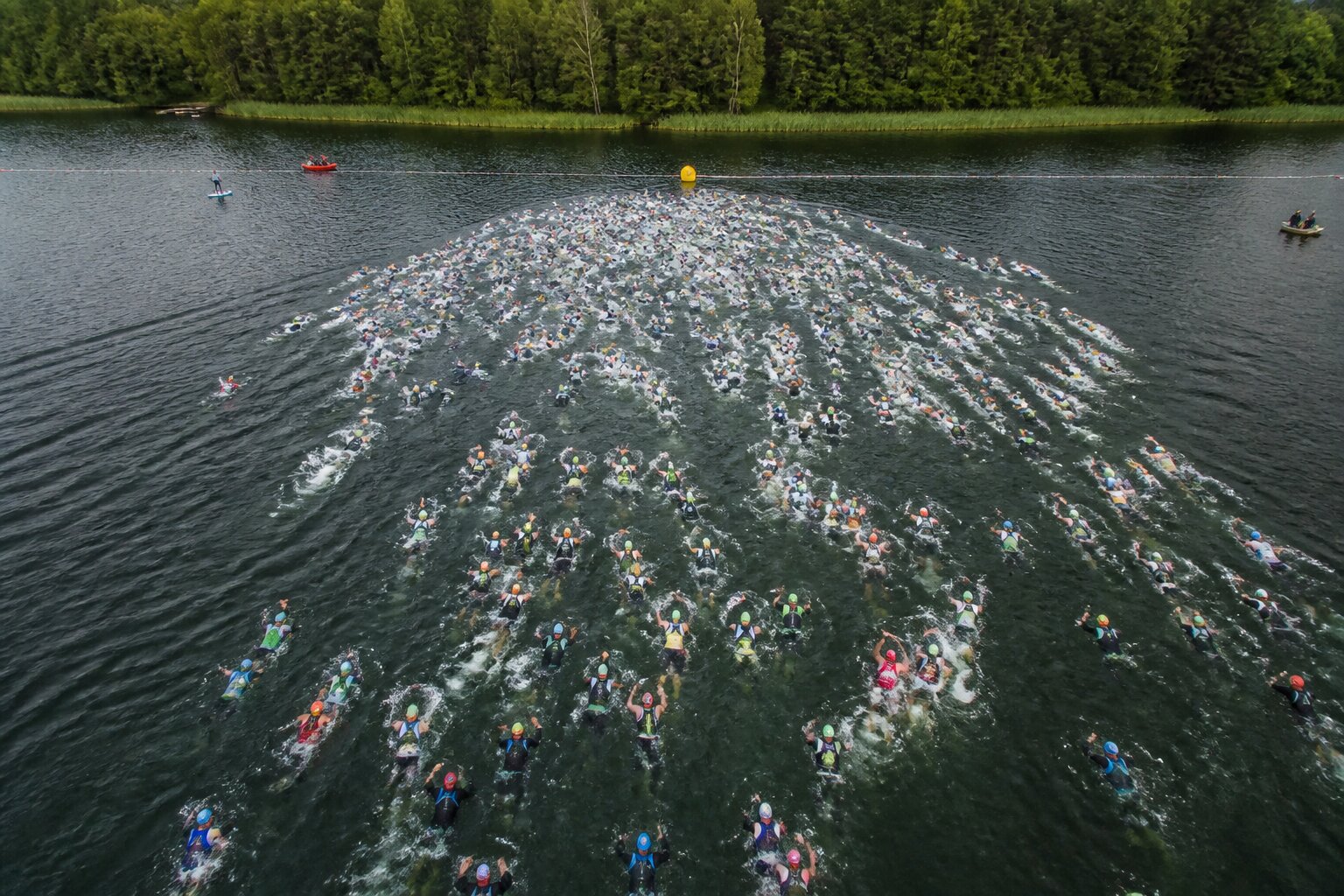
    The most stressful minute of an entire triathlon doesn’t happen at the 180th kilometre of the bike leg, or in the closing stretch of the marathon. It happens at the start, when you’re standing, or really floating, in the water with a hundred other people about to swim straight through you. A deep water start, one with no ground under your feet, is a skill nobody teaches in a pool. And it decides whether you swim the first 200 metres in rhythm or in panic.

    First, the decision: where to line up

    Before you swim a stroke, you need to make a tactical call, and an honest one about your own level. You have three options:

    • Front, aggressively: for genuinely fast swimmers. If you can’t hold a strong pace in the pool, don’t push in here. You’ll get swum over and lose your composure at the start.
    • Mid-pack, for the draft: a good compromise if you can hold onto a faster swimmer’s feet.
    • Side or back, calmly: the smartest choice if open water stresses you out. You avoid the washing machine of the main group, at a cost of only a few seconds.

    The key rule: line up according to the truth about yourself, not your ambition. Too far forward and you’ll get trampled. Too far back and you’ll be stuck behind slower swimmers, passing them for half the distance.

    How to wait upright without wasting energy

    Waiting for the gun in deep water is its own skill. Don’t thrash your legs like you’re treading water in a rescue drill: you’ll tire yourself out before the start even happens.

    Stay on the surface with calm figure-eight sculling movements of your hands underwater, with your body tilted slightly forward. This is the most important detail: the closer to horizontal you are right before the start, the easier it is to get moving. The switch to swimming from a horizontal position is much faster than launching from vertical.

    One more trick: keep your hands spread wide as you scull in front of you. It creates space around you and discourages other swimmers from crowding in beside you. A bit of elbows, in the good sense of the word.

    The first metres: survival mode, not race mode

    When the gun goes, don’t go straight to 100%, but don’t hesitate either. The first metres are controlled aggression: a short, faster surge to find clear water and avoid getting pushed into the middle of the pack.

    In this phase, change two things about how you swim:

    1. Sight more often: lift your eyes every few strokes to spot gaps in the crowd and correct your position.
    2. Breathe on both sides: bilateral breathing lets you track who’s swimming next to you and where it’s getting less crowded.

    This isn’t the moment for picture-perfect technique. It’s the time to get through the chaos in one piece without losing your head when someone taps your heel or swims over your arm. Expect the contact, and it won’t catch you off guard or trigger panic.

    Around 150 to 200 metres: switch into race mode

    The good news: the chaos doesn’t last long. After about 150 metres the group starts to spread out as everyone settles into their natural pace. This is the moment you’re waiting for, the switch from survival mode into race rhythm.

    This is where the most valuable open water skill comes in: drafting. Sit right off another swimmer’s feet, or slightly off their hip, on the diagonal. In that water shadow, drag can drop by anywhere from around ten to several tens of percent, and your energy cost at the same speed goes down for real. Find someone a little faster than you and hold their feet.

    One catch that’s easy to forget: drafting only works if the swimmer in front is swimming straight. If they drift off course, you drift with them. So keep sighting even while drafting, checking that your locomotive is actually on the right line.

    How to train for it before the season

    You practise a deep water start in open water, not in a pool, but there are a few things you can prepare in advance:

    • Sculling and vertical positioning: practise in deep water until holding position without thrashing your legs feels effortless.
    • Starts from a standstill: get into a lake, position yourself horizontally, and push from zero to a strong pace a few times. It’s a completely different effort from pushing off a pool wall.
    • Swimming in a group: if you train with others, practise starts together. Contact, taps, swimming on someone’s feet, the less unfamiliar it is, the calmer your head will be on race day.

    A deep water start isn’t about strength. It’s about composure and a handful of technical habits. Master them, and the first 200 metres stop being the worst part of your triathlon, and you’ll come out of the water with a heart rate that won’t wreck the rest of your race.

  • Open Water Drafting: Save Your Legs for the Run

    Open Water Drafting: Save Your Legs for the Run

    Drafting is banned on the bike in triathlon, but in the water it’s completely legal. It’s the only part of the race where you can tuck in behind a rival, swim their pace, and save the energy you’ll be short of on the run. Amateurs routinely waste this, swimming alone alongside a group instead of latching onto its back.

    Why drafting works in the water

    When you swim, you push a wall of water ahead of you. The swimmer in front breaks that wall, and you move into the lower-resistance zone left behind them. Less resistance means a lower energy cost at the same speed, or a higher speed at the same effort.

    A well-known study by Chatard and Wilson found that swimming in the draft cuts oxygen uptake by about 10%, with heart rate, lactate and perceived effort dropping alongside it. Resistance drops more, by around 20%, than energy cost does. Swimming in someone else’s tunnel is less efficient than swimming in open water yourself would be if resistance were the only factor, but still far cheaper than swimming solo. In practice the difference shows up most on long distance, where every percentage point saved means fresher legs coming out of the water.

    Feet or hip: two schools of drafting

    There are two main positions you can take.

    • On the feet. You swim right behind the leader’s toes. This gives the biggest resistance reduction, because you’re sitting directly in their tunnel. The downsides are no visibility ahead, the risk of a kick to the face, and the need to match pace exactly. Ease off for a moment and you drop out of the zone.
    • On the hip. You sit slightly to the side, roughly level with the leader’s hips. The resistance reduction is a bit smaller than on the feet, but you gain two important things: you can see where you’re going, and you need to sight less often. Fewer head lifts mean less disruption to body position and less wasted energy.

    For most amateurs, the hip position is the more practical choice. It gives better visibility, less risk of a kick, and more control over the situation. The feet position is worth trying only when you know the leader’s pace well and trust them not to drop you.

    How to catch and hold a draft in practice

    A few rules keep you out of trouble and save seconds:

    • Pick the right feet. Stick with someone swimming slightly faster than your solo pace, but not so fast you blow up after 200 metres.
    • Position yourself before the start. In the start zone, line up next to someone at your pace rather than wherever there happens to be space.
    • Sight less often, but smarter. On the hip you’re relying on the leader to navigate for you. Check direction every few breaths, not every other stroke.
    • Don’t crowd the leader’s back. Constantly tapping their feet is the fastest way to make them speed up or lose you on purpose. Leave a few tens of centimetres of space.
    • Practise it in the pool and in open water. Drafting is a skill, not an instinct. Try swimming on a training partner’s feet in practice before attempting it in a race-day crowd.

    Start with one thing

    If you’ve been swimming solo so far, don’t jump straight into the feet position in the middle of a crowd. At your next race, do one thing: find someone at your pace and settle on their hip. That’s it. You’ll feel the difference by the first buoy, and your legs will thank you on the run.

  • Ultra Baltic Swim 2026: Kubkowski swims Sweden to Poland

    Ultra Baltic Swim 2026: Kubkowski swims Sweden to Poland

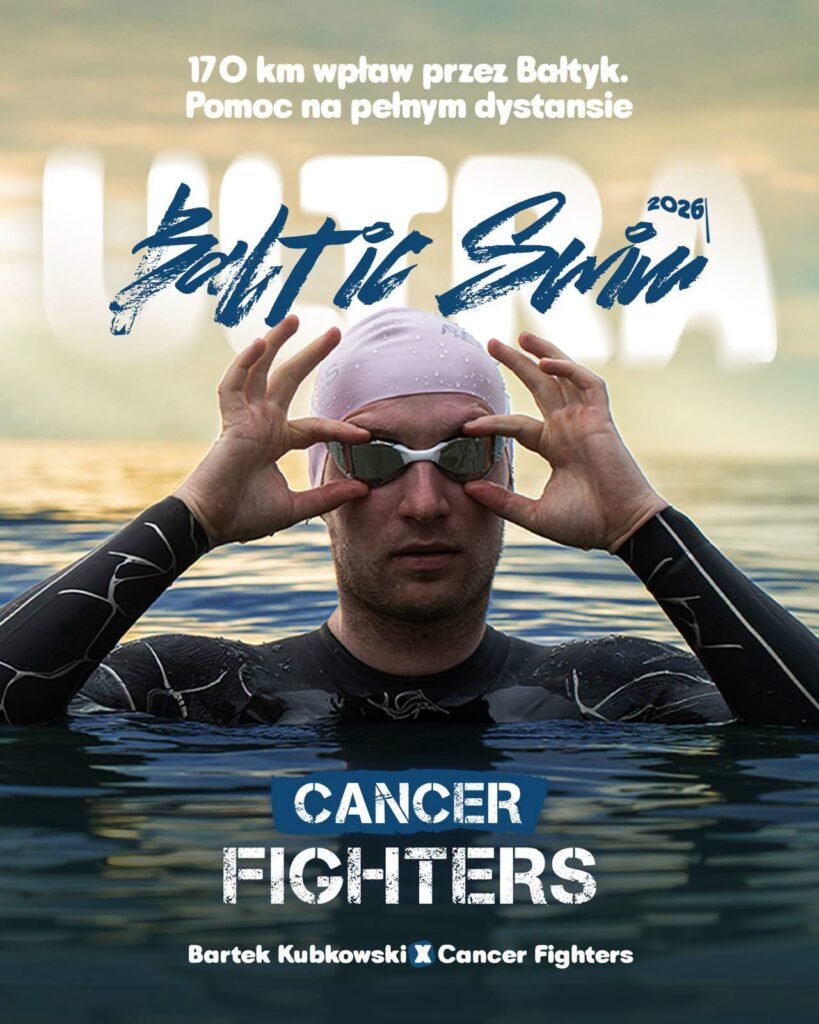
    When Bartłomiej “Foka” Kubkowski walked out onto the beach at Dziwnowo, on Poland’s Baltic coast, under his own power at around 20:30 on Sunday evening, 2 August 2026, everyone on the shore was in tears. After nearly 55 hours of unbroken effort in the black water of the Baltic Sea, he became the first person in history to swim from Sweden to Poland. Roughly 160 kilometres, though some accounts put it closer to 170 km because the currents lengthened the distance actually covered, done at the fifth attempt, announced as “Last Dance”.

    It was not a one-man show. Karolina Szczepaniak started from Sweden in the same weather window, a two-time Olympian (Beijing 2008, London 2012). She spent 58 hours in the water. Extreme exhaustion and heavy chafing led her crew to make the hard call to stop the attempt before she reached the Polish shore, but her swim goes into the history of Polish ultra-swimming regardless. She showed a resilience that carried thousands of people who were following her.

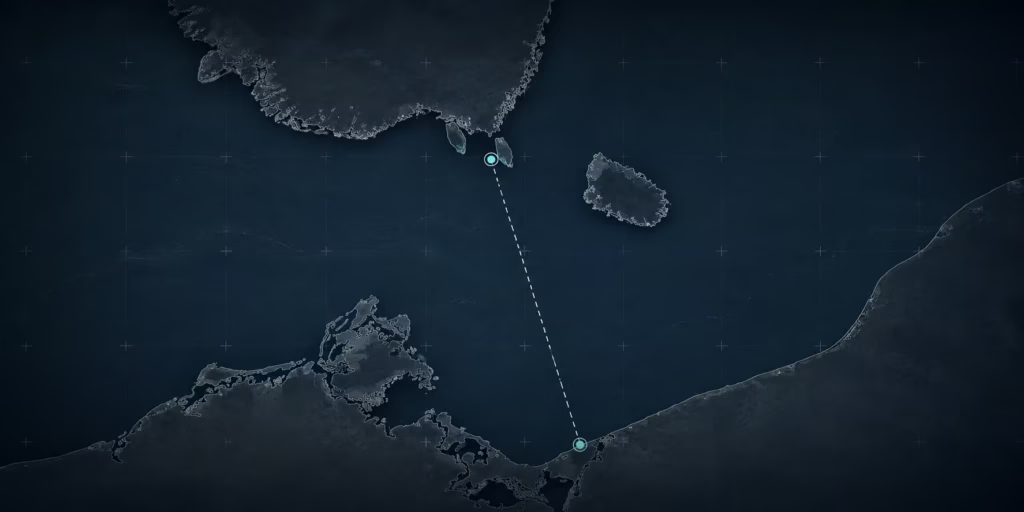
    Baltic Sea crossing, illustration

    Rather than add another round of general congratulations, it is worth breaking the weekend down. Here is what sat behind the project physiologically, in equipment terms and logistically.

    Physiological hell: face, hands and head after two and a half days at sea

    Spending more than two days in high-salinity water at an open-sea temperature of 16-18°C wrecks the human body.

    • Skin maceration: after that long in continuous immersion, skin loses its protective barrier. It soaks up water, goes soft as paper and gives way to the smallest injury. Swimmers’ hands and feet after attempts like this are wrinkled and bleached white, and even the touch of a towel hurts.
    • Damage to the mouth and eyes: constant contact with sea salt swells the face. Eyes sting and fog up behind goggles despite the seal. The worst of it is breathing in salt spray and swallowing water by accident. After many hours the tongue and throat can swell enough to make eating anything a torture.
    • Sleep deprivation and hallucinations: close to three days without sleep, combined with the monotony of black water, throws off the sense of balance. In 2025 Bartek was pulled out of the water 11 km from the Polish shore after more than 50 hours of effort. He had lost his bearings and was close to losing consciousness, so his crew ended the attempt. This year the key was surviving two full nights on open water without losing contact with reality.

    Equipment: what do you swim the Baltic in?

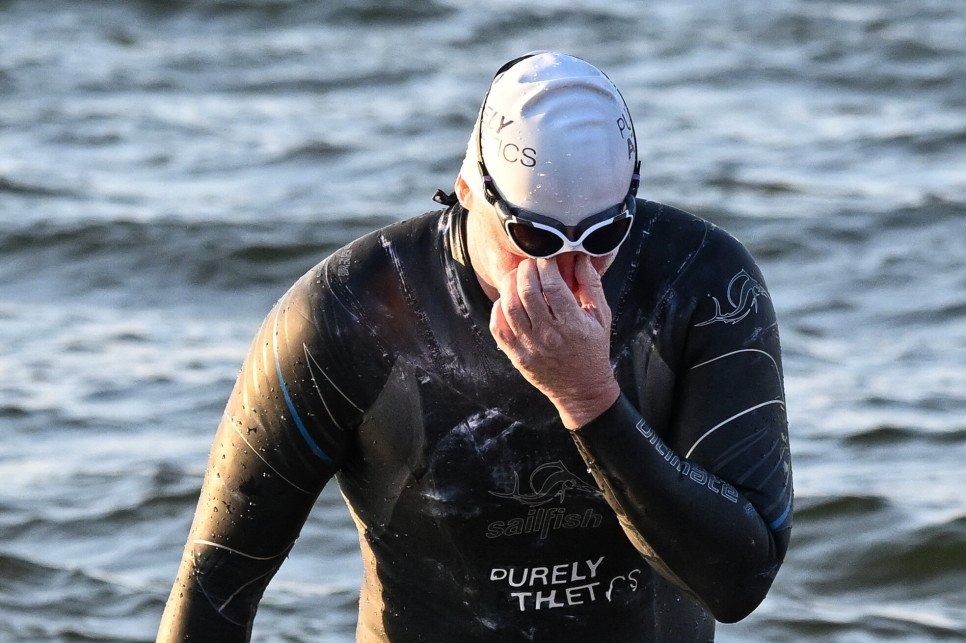
    Under Ultra Baltic Swim rules a neoprene wetsuit is allowed, and it is the basis of survival. What the swimmer may not do, at any point, is touch the support boat. Bartek swam in a sailfish wetsuit, visible in the photographs from the finish at Dziwnowo. The pressure points, neck, armpits and groin, are usually covered in a thick layer of protective grease so the wetsuit seams and salt crystals do not wear the skin down to raw flesh. That is standard practice among long-distance swimmers, not something specific to the Baltic. He used dark-lensed goggles for the crossing, and a lifeboat crew watched over him around the clock.

    Caloric hell: how do you feed a man who cannot stop?

    The constant arm work is only part of the energy cost. Most of it goes on thermoregulation, on fighting hypothermia and generating heat to hold core temperature. According to media reports Kubkowski burned around 55,000 kilocalories during the crossing. Everything was passed to him from the boat without him touching it, as drinks and food handed over on a pole.

    More than sport: over 800,000 złoty (about €185,000) raised

    The effort had a purpose beyond the swim from the start. Kubkowski swam for the beneficiaries of the Cancer Fighters Foundation, which supports children and adults being treated for cancer. Alongside the sporting record, the one that mattered most fell too: the dedicated fundraiser on the foundation’s site passed 800,000 złoty (about 214,000 USD) and is still climbing (as of 3 August it stood at roughly 780,000 złoty, about 208,000 USD). Conversions use the National Bank of Poland rate of 3.7468 złoty to the dollar, table 149/A/NBP/2026 of 4 August 2026.

    Bartłomiej Kubkowski after the Baltic crossing